Multiplying polynomials
As shown in the example below, multiplying polynomials demand the following steps.
- Use the distributive law of multiplication to multiply each term in the first polynomial by each term in the second polynomial. In this step, we multiply the coefficients and the variables separately. If the variables are the same, you can just add the exponents. If the variables are different, just put them next to each other.
- Combine and add like terms to simplify the polynomial
- Write the polynomial in standard form
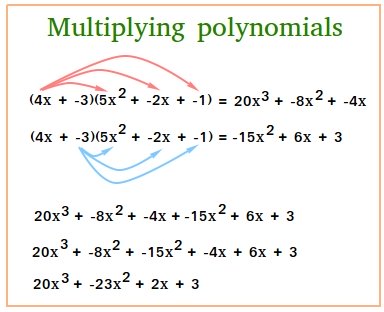
How to multiply a monomial by a binomial
It is kind of easy to multiply a monomial by a binomial. Just multiply the monomial by each term in the binomial.
Example #1:
2x(5x + 1) = 2x(5x) + 2x(1)
2x(5x + 1) = 10x2 + 2x
How to multiply a binomial by a binomial
Important concept
You must know what a term is when multiplying polynomials. It is because the goal is to multiply each term of the polynomial on the left by each term of the polynomial on the right and then adding the whole thing!
Example #2:
(2x3 + 8)(3x + 4)
It is quite common to use the foil method to multiply a binomial by a binomial. Suppose each binomial is written in standard form then the first term of 2x3 + 8 is 2x3 and the second term is 8. Here is how to follow foil to find the product of (2x3 + 8)(3x + 4).
Firsts:
Multiply the first term of the first binomial (binomial on the left) by the first term of the second binomial (binomial on the right)
2x3 × 3x = 6x4
Outers:
Multiply the first term of the first binomial by the second term of the second binomial
2x3 × 4 = 8x3
Inners:
Multiply the second term of the first binomial by the first term of the second binomial
8 × 3x = 24x
Lasts:
Multiply the second term of the first binomial by the second term of the second binomial
8 × 4 = 32
(2x3 + 8)(3x + 4) = 6x4 + 8x3 + 24x + 32
Check the lesson about about multiplying binomials to learn more
More examples about multiplying polynomials
How to multiply a trinomial by a trinomial
Example #3:
Multiply 4x3 + 2x + 5 by 3x4 + x + 6
(4x3 + 2x + 5) × (3x4 + x + 6)
The result of each multiplication or whatever will be added together is shown in bold.
The polynomial on the left is 4x3 + 2x + 5
Each term is separated by an addition sign.
- The first term is 4x3
- The second term is 2x
- The third term is 5
The polynomial on the right is 3x4 + x + 6
Each term is separated by an addition sign.
- The first term is 3x4
- The second term is x
- The third term is 6
Now multiply the first term of the polynomial on the left that is 4x3 by each term of the polynomial on the right and these are 3x4, x , and 6.
4x3 × 3x4 = 4 × 3 × x3 × x4 = 12x3 + 4 = 12x7
4x3 × x = 4 × x3 × x = 4 × x3 × x1 = 4x3 + 1 = 4x4
4x3 × 6 = 4 × 6x3 = 24x3
Next, multiply the second term of the polynomial on the left that is 2x by each term of the polynomial on the right and these are 3x4, x , and 6.
2x × 3x4 = 2 × 3 × x × x4 = 2 × 3 × x1 × x4 = 6x1 + 4 = 6x5
2x × x = 2 × x × x = 2 × x1 × x1 = 2x 1 + 1 = 2x2
2x × 6 = 2 × 6x = 12x
Finally, multiply the third term of the polynomial on the left that is 5 by each term of the polynomial on the right and these are 3x4, x , and 6.
5 × 3x4 = 15x4
5 × x = 5x
5 × 6 = 30
Adding the result in bold together, we get:
12x7 + 4x4 + 24x3 + 6x5 + 2x2 + 12x + 15x4 + 5x + 30
Combine like terms
12x7 + (4x4 + 15x4) + 24x3 + 6x5 + 2x2 + (12x + 5x) + 30
12x7 + 19x4 + 24x3 + 6x5 + 2x2 + 17x + 30
Write in standard form
12x7 + 6x5 + 19x4 + 24x3 + 2x2 + 17x + 30
Example #4:
Multiply 4x3 − 2x + 5 by 3x4 + x − 6
Example #4 is almost the same as example #3. We just incorporated a couple of subtraction signs.
My teaching experience has taught me that when multiplying polynomials, it is best to say to students to replace minus with + -
Then, do the exact same thing you did in example #3
(4x3 − 2x + 5) × (3x4 + x − 6) = (4x3 + -2x + 5) × (3x4 + x + -6)
4x3 × 3x4 = 12x7
4x3 × x = 4x4
4x3 × -6 = 4 × -6x3 = -24x3
Notice this time that the second term of the polynomial on the left has a negative next to it! Same thing for the third term of the polynomial on the right.
-2x × 3x4 = -2 × 3 × x × x4 = -2 × 3 × x1 × x4 = -6x1 + 4 = -6x5
-2x × x = -2 × x × x = -2 × x1 × x1 = -2x1 + 1 = -2x2
-2x × -6 = -2 × -6x = 12x
5 × 3x4 = 15x4
5 × x = 5x
5 × -6 = -30
We get 12x7 + 4x4 + -24x3 + -6x5 + -2x2 + 12x + 15x4 + 5x + -30
Combine like terms
12x7 + (4x4 + 15x4) + -24x3 + -6x5 + -2x2 + (12x + 5x) + -30
12x7 + 19x4 + -24x3 + -6x5 + -2x2 + 17x + -30
Write the polynomial in standard form
12x7 + -6x5 + 19x4 + -24x3 + -2x2 + 17x + -30
Multiplying polynomials should be a breeze if you really understand the four examples above.
Multiplying polynomials with different variables
Example #5:
Multiply 3x + 4y by y + 2
(3x + 4y)(y + z) = 3x × y + 3x × z + 4y × y + 4y × z
(3x + 4y)(y + z) = 3xy + 3xz + 4y2 + 4yz
Notice that when the variables are different, just put them next to each other!