What Is Density in Physics?
In this lesson, you will learn
- What density means, in math and in everyday life
- How to find density with the formula density = mass ÷ volume
- The density of some common materials
- What weight density and specific gravity are
What Is Density?
Mathematically speaking, density is the ratio of the mass to the volume. Physically speaking, density is the measure of how much matter is squeezed in a given space.
The more matter is squeezed in the same space, the more dense it is.
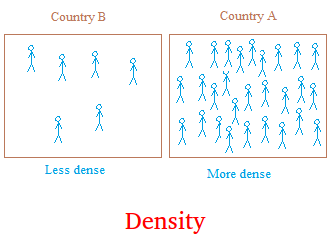
Looking at the figure above, you may have heard people saying that the population of country A is very dense. Well, this means that compared to country B that has about the same surface area as country A, country A has a lot more people living in it than country B.
Two jars are the same size. Jar A holds 10 marbles and jar B holds 30 of the same marbles. Which jar is more dense?
Show answer
Jar B. More matter is squeezed in the same space.
The Density Formula: A Sponge Example
Another good example of density is a sponge. Take a sponge and squeeze the whole thing until the sponge becomes very small.
Since the volume of the sponge is much less after you have squeezed it, the sponge has become more dense. You are able to put the same amount of matter in a smaller space or volume.
Let us see why this makes sense using the formula for density.
Pretend that the volume of the sponge is 80 cm3.
Pretend that the mass is 10 grams. Notice that these are very good estimates for the mass and volume of a sponge.
density = 10 g80 cm3
density = 0.125 g/cm3
Suppose that after squeezing the sponge the volume is now 4 times smaller, such as 20 cm3.
density = 10 g20 cm3
density = 0.50 g/cm3
Since 0.50 g/cm3 is bigger than 0.125 g/cm3, the sponge is more dense when you squeeze it.
You can also increase the density by increasing the mass. Say the mass of another sponge is now 40 grams and you are able to squeeze this sponge with your hand so hard that the volume is 20 cm3.
density = 40 g20 cm3
density = 2.00 g/cm3
As you can see now, 2.00 grams in each cubic centimeter, or a lot more mass, is squeezed in the same space or volume.
The density is determined by both the masses of atoms and the space between atoms.
In other words, the higher the mass, the higher the density. The less space between atoms, the higher the density.
The densest substance on earth is osmium. The density is 22.6 g/cm3.
Dividing the volume by the mass. Density is mass ÷ volume. For the first sponge, 10 ÷ 80 = 0.125 g/cm3. Doing 80 ÷ 10 = 8 gives a wrong answer.
A 30 g sponge has a volume of 60 cm3. What is its density?
Show answer
0.5 g/cm3. density = 30 g60 cm3 = 0.5 g/cm3.
What Is the Density of Some Other Materials?
A list is given below for some materials. Keep in mind that density varies somewhat with pressure and temperature.
With the exception of water, density is given at 0°C and atmospheric pressure.
| Material | Density (g/cm3) |
|---|---|
| Platinum | 21.4 |
| Gold | 19.3 |
| Lead | 11.3 |
| Silver | 10.5 |
| Copper | 8.9 |
| Iron | 7.8 |
| Steel | 7.8 |
| Diamonds | 3.5 |
| Aluminum | 2.7 |
| Graphite | 2.25 |
| Ice | 0.92 |
| Pine wood | 0.50 |
| Material | Density (g/cm3) |
|---|---|
| Mercury | 13.6 |
| Seawater | 1.03 |
| Water at 4°C | 1.00 |
| Ethyl alcohol | 0.81 |
- Write the formula: density = mass ÷ volume.
- Divide: 54 ÷ 20 = 2.7.
- The density is 2.7 g/cm3. In the table, aluminum has a density of 2.7 g/cm3.
The block could be made of aluminum.
Which is more dense, iron or copper?
Show answer
Copper. Copper has a density of 8.9 g/cm3 and iron has a density of 7.8 g/cm3.
Weight Density and Specific Gravity
Definition of weight density
Weight density is the ratio of the amount of weight a body has to the volume.
Definition of specific gravity
Specific gravity is the ratio of the density of a material to the density of water.
For example:
specific gravity of gold = 19.3 g/cm31.00 g/cm3
g/cm3 is on top and at the bottom, so it will cancel.
Specific gravity of gold = 19.3. The specific gravity of every material above is therefore the number that you see without the unit.
What is the specific gravity of mercury?
Show answer
13.6. 13.6 g/cm31.00 g/cm3 = 13.6. The units cancel, so specific gravity has no unit.
Summary
- Density is the ratio of the mass to the volume: density = mass ÷ volume.
- The more matter is squeezed in the same space, the more dense it is.
- Squeezing an object into a smaller volume, or adding mass in the same volume, increases its density.
- Density is often given in g/cm3. Osmium is the densest substance on earth, at 22.6 g/cm3.
- Specific gravity is the density of a material divided by the density of water. It has no unit.
Test Yourself: Interactive 10-Question Quiz
Now check what you learned. Every answer is explained, and each time you play you get new questions.
Quiz complete!