How to Calculate Momentum
This lesson will show you how to calculate momentum using the mass and velocity.
In this lesson, you will learn
- Why momentum depends on both mass and velocity
- How to calculate momentum with the formula momentum = mass × velocity
- Why an object at rest has no momentum
- The unit of momentum, kg·m/s
Why Momentum Depends on Mass and Velocity
Does it make sense though why we need the mass and the velocity?
Look at the two vehicles below and tell me which vehicle will require more effort to stop?
A 2,500-pound car moving 50 miles per hour or a 20,000-pound truck moving 50 miles per hour.
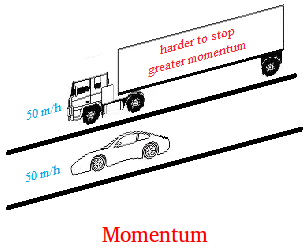
It will be harder to stop the truck, so we say that the truck has more momentum.
Thus, momentum depends on the mass.
What about the velocity?
Which vehicle will require more effort to stop?
A 2,500-pound car moving 5 miles per hour or a 2,500-pound car moving 90 miles per hour.
It will be harder to stop the 2,500-pound car moving 90 miles per hour, so we say that the car with the greater velocity has more momentum. Momentum thus depends also on the velocity.
A 16-pound bowling ball and a 1-pound ball both roll at 5 miles per hour. Which one has more momentum?
Show answer
The bowling ball. They have the same speed, so the one with more mass, the bowling ball, has more momentum and is harder to stop.
How to Calculate Momentum: Here Is the Formula!
The momentum of an object is the product of the mass and the velocity.
When direction is not important, we can use instead the following formula.
Notice that we still use v as an abbreviation for the velocity or the speed whether direction is important or not.
- Write the formula: momentum = mv.
- Replace m with 1,500 kg and v with 20 m/s.
- Multiply: 1,500 × 20 = 30,000.
The momentum of the car is 30,000 kg·m/s.
A 2 kg ball moves at 3 m/s. What is its momentum?
Show answer
6 kg·m/s. momentum = mv = 2 × 3 = 6.
Can a Bicycle Have More Momentum Than a Truck?
Resist the urge though to think that mass has more bearing on the momentum.
It is quite possible that a bicycle can have more momentum than a truck.
A bike weighing 40 pounds moving with a speed of 30 miles per hour will have more momentum than a 20,000-pound truck creeping along at 0.05 miles per hour.
Bike: 40 × 30 = 1,200
Truck: 20,000 × 0.05 = 1,000
An object at rest has no momentum because it has no speed even though the mass is still there.
It is easy to see. Since v = 0, momentum = m × 0 = 0
The concept of momentum applies only to moving objects. It is basically inertia in motion.
However, once an object is in motion, both mass and speed are taken into account.
From what we have seen so far, you may have realized that a moving object can have a large momentum if either the mass or the speed is large or both.
A 30,000-pound truck is parked in a driveway. What is its momentum?
Show answer
0. The truck is at rest, so v = 0 and momentum = m × 0 = 0.
Unit of Momentum
The mass is expressed in kg and the velocity can be expressed in m/s.
The momentum is thus expressed in kg·m/s.
Using grams instead of kilograms. Change grams to kilograms first: 500 g = 0.5 kg.
A 500 g ball moves at 4 m/s. What is its momentum in kg·m/s?
Show answer
2 kg·m/s. 500 g = 0.5 kg, and 0.5 × 4 = 2.
Summary
- Momentum depends on both the mass and the velocity of an object.
- momentum = mass × velocity = mv
- An object at rest has no momentum, because v = 0.
- A light object can have more momentum than a heavy one if it moves fast enough.
- The unit of momentum is kg·m/s, with the mass in kg and the velocity in m/s.
Test Yourself: Interactive 10-Question Quiz
Now check what you learned. Every answer is explained, and each time you play you get new questions.
Quiz complete!
Keep learning