Variables in Algebra
In this lesson, you will learn
- What a variable is and why we use letters for unknown numbers
- How to find the value of a variable and replace the variable with it
- The difference between a variable with one value and variables that can change
- How to graph a variable on a number line
What Is a Variable in Algebra?
Variables in algebra are letters, such as x, y, v or g (or any letter you want), that can be used to represent unknown numbers.
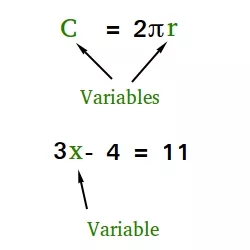
Basically, whenever we do not know the value of a number, we use a variable until we figure out what the number is. The variables that we often use are x and y, with x perhaps being the most popular.
Once the value of the variable is known, you can replace the variable or the letter with the known value.
Reading 3x as "3 plus x". A number written right next to a variable means multiplication, so 3x means 3 times x. If x = 5, then 3x = 3 × 5 = 15, not 35 or 8.
In the equation 7y + 2 = 30, which letter or number is the variable?
Show answer
y is the variable. It is the letter that stands for the unknown number. The numbers 7, 2 and 30 are known.
A Variable With One Value: 3x − 4 = 11
In the figure above, x is a variable in the equation 3x − 4 = 11 because we have no idea what the value of x is at the moment.
Let us figure it out.
3x − 4 = 11
3x − 4 + 4 = 11 + 4
3x = 15
x = 153
x = 5
Now that we know the value of x, we can replace it in the equation with 5.
- Write 5 in place of x: 3 × 5 − 4 = 11.
- Multiply first: 3 × 5 = 15, so the left side is 15 − 4.
- Subtract: 15 − 4 = 11.
- Both sides are 11, so the equation is true.
Answer: yes, x = 5 makes 3x − 4 = 11 true.
Notice that x represents a variable that has a value that cannot change.
x will always equal 5 for the equation 3x − 4 = 11.
What is the value of x in x − 6 = 9?
Show answer
x = 15. Add 6 to both sides: x − 6 + 6 = 9 + 6, so x = 15. Check: 15 − 6 = 9.
Variables That Can Change: C = 2πr
You may have recognized the equation C = 2πr. It is the equation that we use to find the circumference of a circle.
This equation has two variables, and these are r and C.
Unlike x in the equation 3x − 4 = 11 that has a value that cannot change, r and C can take on values that can change.
This makes sense since the radius of the circle (r) can be any length.
The value of the circumference (C) will change based on the value of r.
π is a letter, but it is not a variable. It stands for one number (about 3.14) that never changes.
In C = 2πr, what happens to C when the radius r gets bigger?
Show answer
C gets bigger. C is 2π times r, so a bigger radius gives a bigger circumference.
How to Graph Variables in Algebra
Once you know the value of a variable, you can graph it, since all numbers can be graphed on a number line. Just locate the value on the number line and put a dot.
For example, graphing x = 4 gives the following graph:

Other examples
Graph x = −6 on the number line.
Just locate −6 on the number line and put a dot at −6.

Graph x = 0.
Just locate 0 on the number line and put a dot.

Drawing an open circle. To graph x = 4, fill in the dot, because x is exactly 4. Open circles are used for inequalities such as x > 4, where the number itself is not included.
Your turn
Now, write a statement of equality for each of the following graphs. Use x as the variable.
Graph #1

Show answer
Answer: x = −2
Graph #2

Show answer
Answer: x = 8
Summary
- A variable is a letter, such as x or y, that stands for an unknown number.
- Once you find the value of a variable, you can replace the letter with that value.
- In an equation like 3x − 4 = 11, x has one value that cannot change: x = 5.
- In a formula like C = 2πr, the variables r and C can take on many values.
- To graph a variable, locate its value on a number line and put a dot there.
Test Yourself: 10-Question Quiz
Now check what you learned. Every answer is explained, and each time you play you get new questions.
Quiz Complete!