Evaluate algebraic expressions
Evaluate Algebraic Expressions
In this lesson, you will learn
- What an algebraic expression is, and how it differs from an equation
- How to evaluate an expression by substituting numbers and following the order of operations
- How to evaluate expressions with negative numbers, exponents and square roots
- How to use expressions to solve real-life problems
What are algebraic expressions? How do we evaluate algebraic expressions? Are there any real-life applications? These questions will be answered in this lesson.
What Are Algebraic Expressions?
When mathematical expressions use only real numbers, we call these expressions numerical expressions.
Algebraic expressions, also called variable expressions, are expressions that contain numbers, operation symbols, and one or more variables.
Keep in mind that algebraic expressions never have equal signs!
Below see some examples of algebraic expressions. Notice that the last two expressions are radicals. We will also show how we can evaluate them in the next section. The last section will show you some real-life applications.
Is 4x + 7 = 15 an algebraic expression?
Show answer
No. It has an equal sign, so it is an equation. The left side, 4x + 7, is an algebraic expression.
How to Evaluate Algebraic Expressions
You can evaluate algebraic expressions when you substitute numbers for the variables in the algebraic expressions and then follow the order of operations.
For example, in the figure below, notice the given value of each variable, also called "assigned value".
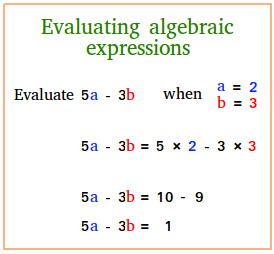
As you can see, a has the given number or value 2 and b has the given value 3. Just replace these given values in the algebraic expression and then follow the order of operations.
- Substitute 2 for y and 13 for z: √(2 × 13 − 10).
- Work inside the square root first. Multiply 2 and 13: √(26 − 10).
- Subtract 10 from 26: √16.
- Take the square root: √16 = 4, because 4 × 4 = 16.
Answer: √(yz − 10) = 4
Evaluate 5a − 3b for a = 4 and b = 2.
Show answer
14. 5 × 4 − 3 × 2 = 20 − 6 = 14.
Examples Without Exponents
More examples showing how to evaluate algebraic expressions without exponents.
Example #1: Evaluate 2a + b + 1 for a = 3 and b = 5
Substitute 3 for a and 5 for b
2a + b + 1 = 2 × 3 + 5 + 1
First, multiply 2 and 3
2a + b + 1 = 6 + 5 + 1
Add from left to right starting with 6 and 5
2a + b + 1 = 11 + 1
Finally, add 11 and 1
2a + b + 1 = 12
The variables in an algebraic expression can be assigned different values. Notice that if you wish, you could change the value of either a, b, or the value of both a and b. In this case, the value of the expression changes as well!
Example #2: Evaluate a + 4b − ab for a = 2 and b = −1
Substitute 2 for a and −1 for b
a + 4b − ab = 2 + 4(−1) − (2)(−1)
First, multiply 4 and −1 and also 2 and −1
a + 4b − ab = 2 + (−4) − (−2)
Add the opposite when subtracting
a + 4b − ab = 2 + (−4) + 2
Add from left to right starting with 2 and −4
a + 4b − ab = −2 + 2
Finally, add −2 and 2
a + 4b − ab = 0
Example #3: Evaluate a + 4a ÷ b − 3b for a = 5 and b = −4
Substitute 5 for a and −4 for b
a + 4a ÷ b − 3b = 5 + 4(5) ÷ (−4) − 3(−4)
First, multiply 4 and 5 and also 3 and −4
a + 4a ÷ b − 3b = 5 + 20 ÷ (−4) − (−12)
Divide 20 by −4
a + 4a ÷ b − 3b = 5 + (−5) − (−12)
Add the opposite when subtracting
a + 4a ÷ b − 3b = 5 + (−5) + 12
Add from left to right starting with 5 and −5
a + 4a ÷ b − 3b = 0 + 12
Add 0 and 12
a + 4a ÷ b − 3b = 12
Example #4: Evaluate xy + 2yz + 5 for x = 2, y = −3, and z = 4
Substitute 2 for x, −3 for y, and 4 for z
xy + 2yz + 5 = (2)(−3) + 2(−3)(4) + 5
First, multiply 2 and −3 and also −3 and 4
xy + 2yz + 5 = −6 + 2(−12) + 5
Multiply 2 and −12
xy + 2yz + 5 = −6 + (−24) + 5
Add or subtract from left to right starting with −6 and −24
xy + 2yz + 5 = −30 + 5
xy + 2yz + 5 = −25
Substituting a negative number without parentheses. For b = −1, write 4b as 4(−1) = −4. Writing 4 − 1 changes the problem into a subtraction and gives 3, which is wrong.
Evaluate 2a + b + 1 for a = 4 and b = −3.
Show answer
6. 2 × 4 + (−3) + 1 = 8 + (−3) + 1 = 5 + 1 = 6.
Examples With Exponents
A couple of examples showing how to evaluate algebraic expressions with exponents.
Example #5: Evaluate x3 + y2 for x = 2 and y = 2
x3 + y2 = (2)3 + (2)2
Evaluate the exponents
x3 + y2 = 8 + 4
Add 8 and 4
x3 + y2 = 12
Example #6: Evaluate 3x2 − 4x + 2 for x = 4
3x2 − 4x + 2 = 3(4)2 − 4(4) + 2
First, evaluate the exponent
3x2 − 4x + 2 = 3(16) − 4(4) + 2
Perform the multiplications by multiplying 3 and 16 and also 4 and 4
3x2 − 4x + 2 = 48 − 16 + 2
Add or subtract from left to right starting with 48 and 16
3x2 − 4x + 2 = 32 + 2
Add 32 and 2
3x2 − 4x + 2 = 34
Squaring a negative number without parentheses. For x = −3, x2 = (−3)2 = (−3)(−3) = 9. Writing −32 means −(3 × 3) = −9, which is wrong here.
Evaluate x2 + 2x for x = 3.
Show answer
15. (3)2 + 2(3) = 9 + 6 = 15.
Evaluating Algebraic Expressions With Real-Life Examples
Example #7: The expression 16t2 models the distance in feet that an object falls during t seconds after being dropped from a certain height. Find the distance an object falls after 10 seconds.
The given expression above has only one variable. You just need to evaluate 16t2 for t = 10
16t2 = 16 × t × t
16t2 = 16 × 10 × 10
Multiply from left to right starting with 16 and 10
16t2 = 160 × 10
Multiply 160 and 10
16t2 = 1600
The distance the object fell is 1600 feet.
Example #8: Richard owns x cars and y trucks. James owns four fewer cars than Richard, but twice as many trucks. Write an algebraic expression showing the number of vehicles James owns. If Richard owns 6 cars and 2 trucks, how many vehicles does James own?
James owns four fewer cars than Richard, or x − 4
James owns twice as many trucks as Richard, or 2y
The number of vehicles James owns is x − 4 + 2y
To find out how many vehicles James owns, we need to evaluate the algebraic expression x − 4 + 2y for x = 6 and y = 2.
x − 4 + 2y = 6 − 4 + 2 × 2
First, multiply 2 and 2
x − 4 + 2y = 6 − 4 + 4
Add or subtract from left to right starting with 6 and 4
x − 4 + 2y = 2 + 4
At this point, you can say that James owns 2 cars and 4 trucks. But you are looking for the number of vehicles he owns. So, add 2 and 4
x − 4 + 2y = 6
The number of vehicles James owns is 6.
Use 16t2 to find how far an object falls in 3 seconds.
Show answer
144 feet. 16 × 3 × 3 = 48 × 3 = 144.
Summary
- An algebraic expression contains numbers, operation symbols and one or more variables. It never has an equal sign.
- To evaluate an expression, substitute the given value for each variable, then follow the order of operations.
- Put negative numbers in parentheses when you substitute them, such as 4(−1) or (−3)2.
- Evaluate exponents before you multiply, and work inside a square root first.
- When the values of the variables change, the value of the expression changes too.
Test Yourself: 10-Question Quiz
Now check what you learned. Every answer is explained, and each time you play you get new questions.
Quiz Complete!