Understanding Decimals
In this lesson, you will learn
- what a decimal is and the different forms it can take
- the place value of the digits after the decimal point
- what decimal fractions and mixed decimals are
- how to change a fraction into a decimal and a decimal into a fraction
What Is a Decimal?
Decimals are an essential part of mathematics, bridging the gap between whole numbers and fractions. A solid grasp of decimal place value is crucial for mastering more complex mathematical concepts. This lesson will introduce you to decimals, their place value, and how they relate to fractions.
The term "decimal" comes from the Latin word decimus, which means tenth. Therefore, one decimal place represents a division by ten.
Formally, a decimal is a number that includes a whole number and/or a fraction, expressed using powers of ten as the denominator. For example, 110 equals 0.1.
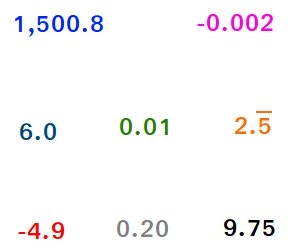
It could be any of the following:
- Just a whole number with decimal places (e.g., 5.0)
- Just a fraction less than 1 (e.g., 0.25)
- A combination of both (e.g., 5.25)
For example:
- 0.5 is a decimal (no whole number part)
- 3.0 is a decimal (no fractional part)
- 3.14 is a decimal (has both parts)
In general, decimals can represent any proper or improper fraction where the denominator is a power of ten, such as 10, 100, 1000, and so on. This structure allows for precise representation of values between whole numbers.
Write 310 as a decimal.
Show answer
0.3. Three tenths is written with a 3 in the first place after the decimal point.
Decimal Place Value
Understanding the place value of each digit in a decimal is fundamental. Each position to the right of the decimal point represents a power of ten.
- The first position to the right of the decimal point is the tenths place (10−1) as shown in 0.5.
- The second position to the right of the decimal point is the hundredths place (10−2) as in 0.02.
- The third position to the right of the decimal point is the thousandths place (10−3) as shown with the 9 in 0.0195
Notice that the first five examples are proper fractions, where the numerator is less than the denominator, resulting in a decimal less than one. The last two are improper fractions, where the numerator is greater than or equal to the denominator, resulting in a decimal greater than or equal to one.
- The 3 is in the first position after the decimal point: the tenths place.
- The 8 is in the second position: the hundredths place.
- The 5 is in the third position: the thousandths place.
2.385 = 2 + 310 + 8100 + 51000 = 2 + 3851000
Thinking that a decimal with more digits is bigger. 0.25 is less than 0.5, because 0.5 = 0.50 and 50 hundredths is more than 25 hundredths.
In 0.0195, which digit is in the hundredths place?
Show answer
1. The digits after the decimal point are 0 (tenths), 1 (hundredths), 9 (thousandths) and 5 (ten-thousandths).
A Few Important Terms to Keep in Mind about Decimals
A proper fraction whose denominator can be written as a power of 10 is called a decimal fraction.
510 = 0.5 and 161000 = 0.016 are examples of decimal fractions.
An improper fraction whose denominator can be written as a power of 10 gives a mixed decimal: a decimal with a whole number part and a decimal part.
4510 = 4.5 and 234100 = 2.34 are examples of mixed decimals.
We can say that a decimal is a combination of a whole number and a fraction of a whole number.
Notice also that a whole number is also a decimal. For example, 69 can also be written as 69.0 since 69 = 69.0.
Is 7100 = 0.07 a decimal fraction or a mixed decimal?
Show answer
A decimal fraction. It is a proper fraction (7 is less than 100) with a denominator that is a power of 10, so the decimal has no whole number part.
The Relationship Between Decimals and Fractions
Decimals and fractions are two different ways of representing parts of a whole. Decimals are particularly useful in measurements and financial calculations due to their precision and ease of use in addition and subtraction. Understanding how to convert between fractions and decimals is a valuable skill:
Converting Fractions to Decimals: Divide the numerator by the denominator. For example, 510 = 5 ÷ 10 = 0.5
Converting Decimals to Fractions: Write the decimal over its place value and simplify if possible. For example, 0.016 = 161000 = 2125
- The last digit, 5, is in the hundredths place, so write 75 over 100: 0.75 = 75100.
- 75 and 100 are both divisible by 25: 75 ÷ 25 = 3 and 100 ÷ 25 = 4.
0.75 = 34
Write 0.6 as a fraction in simplest form.
Show answer
35. 0.6 = 610, and dividing the top and bottom by 2 gives 35.
Summary
- A decimal is a number with a whole number part and/or a fraction part whose denominator is a power of ten.
- After the decimal point come the tenths (10−1), hundredths (10−2), thousandths (10−3) and so on.
- A proper fraction with a power-of-ten denominator is a decimal fraction (0.016); an improper one gives a mixed decimal (4.5).
- Every whole number is also a decimal: 69 = 69.0.
- To change a fraction to a decimal, divide the numerator by the denominator. To change a decimal to a fraction, write it over its place value and simplify.
Test Yourself: Interactive 10-Question Quiz
Now check what you learned. Every answer is explained, and each time you play you get new questions.
Quiz Complete!