Solving Absolute Value Equations
In this lesson, you will learn
- how the definition of absolute value gives two equations to solve
- how to replace the expression inside the bars with y to see the two cases
- why an absolute value equation usually has two solutions, and when it has one or none
- how to check your solutions
The Goal: Use the Absolute Value Definition to Solve Absolute Value Equations
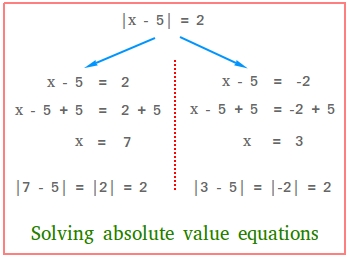
When solving absolute value equations, many people routinely solve these as the example below demonstrates without really understanding deep concepts involving absolute value. It is the goal of this lesson to remedy this common pitfall.
Absolute value definition:
If x is positive or zero, |x| = x
If x is negative, |x| = −x
When solving absolute value equations, you will usually get two solutions.
Solving an equation such as |x| = −3. An absolute value is never negative, so |x| = −3 has no solution. And |x| = 0 has only one solution, x = 0.
What is |−6|, using the definition?
Show answer
6. −6 is negative, so |−6| = −(−6) = 6.
Example #1: Solve for x When |x| = 4
After applying the definition to example #1, you will have two equations to solve.
In fact, when solving absolute value equations, you will usually get two solutions. That is important to keep in mind.
If x is positive or zero
|x| = x, so the first equation to solve is x = 4. We are done because x is automatically isolated.
If x is negative
|x| = −x, so the second equation to solve is −x = 4.
You can write −x = 4 as −1x = 4 and divide both sides by −1 to isolate x.
(−1−1)x = 4−1
1x = −4
x = −4
Therefore, the solutions are 4 and −4.
Solve |x| = 9.
Show answer
x = 9 or x = −9. Both |9| and |−9| equal 9.
Example #2: Solve for x When |x − 5| = 2
Before we apply the definition, let's make a useful substitution.
Let y = x − 5, so |x − 5| = 2 becomes |y| = 2. You must understand this step. No excuses!
Now, let's apply the definition to |y| = 2. Again, you will have two equations to solve. Once again, when solving absolute value equations, you will usually get two solutions.
If y is positive or zero
|y| = y, so the first equation to solve is y = 2. No, you are not done! You have to substitute x − 5 for y.
After substitution, y = 2 becomes x − 5 = 2.
x − 5 = 2
x + (−5) = 2
x + (−5) + 5 = 2 + 5
x = 7
If y is negative
|y| = −y, so the second equation to solve is −y = 2. You have to substitute x − 5 for y.
You get −(x − 5) = 2. Notice the inclusion of parentheses this time.
−(x − 5) = 2
Multiply both sides by −1:
−1 × −(x + (−5)) = −1 × 2
x + (−5) = −2
x + (−5) + 5 = −2 + 5
x + 0 = −2 + 5
x = 3
The solutions are 3 and 7.
Check each solution in the original equation: |7 − 5| = |2| = 2 and |3 − 5| = |−2| = 2.
Solve |x + 1| = 6.
Show answer
x = 5 or x = −7. x + 1 = 6 gives x = 5, and −(x + 1) = 6 gives x = −7.
Example #3: Solve for x When |3x + 3| = 15
Before we apply the definition, let's again make a useful substitution.
Let y = 3x + 3, so |3x + 3| = 15 becomes |y| = 15.
Now, let's apply the definition to |y| = 15. Again, you will have two equations to solve.
If y is positive or zero
|y| = y, so the first equation to solve is y = 15. You have to substitute 3x + 3 for y.
After substitution, y = 15 becomes 3x + 3 = 15.
3x + 3 = 15
3x + 3 − 3 = 15 − 3
3x = 12
(33)x = 123
x = 4
If y is negative
|y| = −y, so the second equation to solve is −y = 15. You have to substitute 3x + 3 for y.
You get −(3x + 3) = 15. Notice the inclusion of parentheses this time.
−3x + (−3) = 15
−3x + (−3) + 3 = 15 + 3
−3x = 18
(−3−3)x = 18−3
x = −6
The solutions are −6 and 4.
- Let y = 2x − 4, so |y| = 10.
- First equation, y = 10: 2x − 4 = 10, so 2x = 14 and x = 7.
- Second equation, −y = 10: −(2x − 4) = 10, so −2x + 4 = 10, −2x = 6 and x = −3.
- Check: |2(7) − 4| = |10| = 10 and |2(−3) − 4| = |−10| = 10.
x = 7 or x = −3
Solve |2x + 1| = 9.
Show answer
x = 4 or x = −5. 2x + 1 = 9 gives x = 4, and −(2x + 1) = 9 gives x = −5.
Solving absolute value equations should be straightforward if you follow my guidelines above.
Summary
- Absolute value definition: if x is positive or zero, |x| = x; if x is negative, |x| = −x.
- Replace the expression inside the bars with y, then solve y = c and −y = c.
- Substitute the expression back for y, and keep the parentheses in −(…).
- Most absolute value equations have two solutions; |…| = 0 has one, and |…| = a negative number has none.
- Check each solution in the original equation.
Test Yourself: Interactive 10-Question Quiz
Now check what you learned. Every answer is explained, and each time you play you get new questions.
Quiz Complete! 🎉