How to Solve Tough Absolute Value Equations
In this lesson, you will learn
- how to collect like absolute value terms such as 6|2x + 3| − 2|2x + 3|
- how to find where an expression inside the bars changes sign
- how to split the number line into cases and solve each case
- why you must reject a solution that is not in its case, and how to check the others
Learn how to solve tough absolute value equations with two carefully chosen examples.
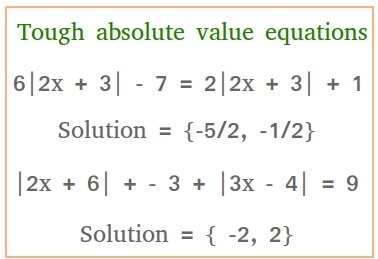
Example #1: 6|2x + 3| − 7 = 2|2x + 3| + 1
Try to have the numbers on the right side. Add 7 to both sides of the equation.
6|2x + 3| − 7 + 7 = 2|2x + 3| + 1 + 7
6|2x + 3| = 2|2x + 3| + 8
Now, try to have the expressions 6|2x + 3| and 2|2x + 3| on the left side. Subtract 2|2x + 3| from both sides of the equation.
6|2x + 3| − 2|2x + 3| = 2|2x + 3| − 2|2x + 3| + 8
6|2x + 3| − 2|2x + 3| = 8
Finally, you need to make an important observation.
Notice that 6|2x + 3| and −2|2x + 3| are like terms. Therefore, you can use the distributive property to simplify.
6|2x + 3| − 2|2x + 3| = (6 − 2)|2x + 3| = 4|2x + 3|
We end up with 4|2x + 3| = 8. Divide both sides of the equation by 4.
(44)|2x + 3| = 84
1|2x + 3| = 2
|2x + 3| = 2
2x + 3 = 0 when x = −32, so you can pick a number on the right of −32 or on the left of −32.
On the right of −32
If you pick any number on the right of −32, 2x + 3 will be positive. For example, if you pick −12, 2(−0.5) + 3 = −1 + 3 = 2.
Therefore, |2x + 3| = 2x + 3. You need to solve 2x + 3 = 2.
2x + 3 = 2
2x + 3 − 3 = 2 − 3
2x = −1
x = −12
On the left of −32
If you pick any number on the left of −32, 2x + 3 will be negative. For example, if you pick −2, 2(−2) + 3 = −4 + 3 = −1.
Therefore, |2x + 3| = −(2x + 3). You need to solve −(2x + 3) = 2.
−(2x + 3) = 2
2x + 3 = −2
2x + 3 − 3 = −2 − 3
2x = −5
x = −52
Solution = { −52, −12 }
Simplify 7|x − 1| − 3|x − 1|.
Show answer
4|x − 1|. They are like terms: (7 − 3)|x − 1| = 4|x − 1|.
Solve Tough Absolute Value Equations: A Complex Case!
Example #2: |2x + 6| + (−3) + |3x − 4| = 9
|2x + 6| + (−3) + 3 + |3x − 4| = 9 + 3
|2x + 6| + |3x − 4| = 12
This problem is complex because you have multiple cases to consider. 2x + 6 = 0 when x = −3, and 3x − 4 = 0 when x = 43.
The number that we pick could be on the left of −3, between −3 and 43, or on the right of 43.
Case 1: on the left of −3
On the left of −3, both 2x + 6 and 3x − 4 will be negative. For example, if x = −4:
2x + 6 = 2 × −4 + 6 = −8 + 6 = −2
3x − 4 = 3 × −4 − 4 = −12 − 4 = −16
Therefore, |2x + 6| = −(2x + 6) and |3x − 4| = −(3x − 4).
We need to solve −(2x + 6) + −(3x − 4) = 12. Multiply everything by −1:
−1 × −(2x + 6) + −1 × −(3x − 4) = −1 × 12
2x + 6 + 3x − 4 = −12
2x + 3x + 6 − 4 = −12
5x + 2 = −12
5x + 2 − 2 = −12 − 2
5x = −14
x = −145 = −2.8
This answer will make no sense since we chose our number on the left of −3. However, −2.8 is on the right of −3. So −2.8 will not solve the equation.
Case 2: between −3 and 43
Between −3 and 43, 2x + 6 is positive and 3x − 4 is negative. For example, if x = −1:
2x + 6 = 2 × −1 + 6 = −2 + 6 = 4
3x − 4 = 3 × −1 − 4 = −3 − 4 = −7
Therefore, |2x + 6| = (2x + 6) and |3x − 4| = −(3x − 4).
We need to solve (2x + 6) + −(3x − 4) = 12.
2x + 6 + (−3x) + 4 = 12
2x + (−3x) + 6 + 4 = 12
−x + 10 = 12
−x + 10 − 10 = 12 − 10
−x = 2
x = −2
−2 is between −3 and 43. Check the answer: |2(−2) + 6| + |3(−2) − 4| = |2| + |−10| = 2 + 10 = 12.
Case 3: on the right of 43
On the right of 43, both 2x + 6 and 3x − 4 will be positive. For example, if x = 3:
2x + 6 = 2 × 3 + 6 = 6 + 6 = 12
3x − 4 = 3 × 3 − 4 = 9 − 4 = 5
Therefore, |2x + 6| = 2x + 6 and |3x − 4| = 3x − 4.
We need to solve (2x + 6) + (3x − 4) = 12.
2x + 6 + 3x − 4 = 12
2x + 3x + 6 − 4 = 12
5x + 2 = 12
5x + 2 − 2 = 12 − 2
5x = 10
x = 105 = 2
2 is on the right of 43. Check the answer: |2(2) + 6| + |3(2) − 4| = |10| + |2| = 10 + 2 = 12.
Solution = { −2, 2 }
Keeping every answer you find. Each case only allows numbers in its own part of the number line. If a case gives an answer outside its part, like −2.8 in case 1, reject it.
- x − 1 changes sign at 1 and x − 5 changes sign at 5, so the cases are: left of 1, between 1 and 5, right of 5.
- Left of 1: −(x − 1) − (x − 5) = 8, so −2x + 6 = 8 and x = −1. −1 is on the left of 1, so keep it.
- Between 1 and 5: (x − 1) − (x − 5) = 8 gives 4 = 8, which is false. No solution in this case.
- Right of 5: (x − 1) + (x − 5) = 8, so 2x − 6 = 8 and x = 7. 7 is on the right of 5, so keep it.
- Check: |−1 − 1| + |−1 − 5| = 2 + 6 = 8 and |7 − 1| + |7 − 5| = 6 + 2 = 8.
Solution = { −1, 7 }
For |x + 4| + |2x − 6| = 20, at which two numbers do you split the number line?
Show answer
−4 and 3. x + 4 = 0 when x = −4, and 2x − 6 = 0 when x = 3.
Summary
- Terms such as 6|2x + 3| and −2|2x + 3| are like terms: collect them with the distributive property.
- Find where each expression inside the bars equals 0; these numbers split the number line into cases.
- In each case, replace |…| with (…) if the expression is positive there, or −(…) if it is negative.
- Keep a solution only if it lies in its own case, then check it in the original equation.
Test Yourself: Interactive 10-Question Quiz
Now check what you learned. Every answer is explained, and each time you play you get new questions.
Quiz Complete! 🎉