Polynomial Long Division
In this lesson, you will learn
- the four repeating steps: divide, multiply, subtract, bring down
- how to line up like terms and subtract by changing signs
- when to stop, and how to write the quotient and the remainder
- how to handle missing terms and how to use long division to find factors
What Is Polynomial Long Division?
Long division of polynomials is basically the same as numerical division. You follow the same long division algorithm consisting of the steps "Divide, multiply, subtract, bring down, and repeat as necessary" in order to find a quotient and a remainder.
- Divide the leading term of the current dividend by the leading term of the divisor. The answer is the next term of the quotient.
- Multiply that quotient term by the whole divisor.
- Subtract the product from the dividend, lining up like terms.
- Bring down the next term, then repeat with the new dividend.
Learn long division of polynomials here with examples and steps that are easy to follow and straight to the point. Take a look at the example below showing how to divide a second-degree polynomial by a first-degree polynomial.
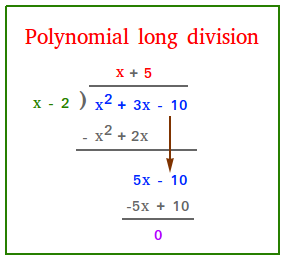
The polynomial long division in the figure above is a summary showing how to divide a trinomial by a binomial using long division. Read example #1 carefully so you can clearly see all the steps for long division of polynomials. In the end, you will fully understand it!
Example 1: Divide x2 + 3x − 10 by x − 2
Step 1: Write both polynomials in standard form.
First, make sure the divisor and dividend are in standard form. For example, if the dividend is 3x + x2 − 10, write it in standard form as x2 + 3x − 10.
Step 2: Divide the leading terms.
When you start, always divide the leading term of the dividend by the leading term of the divisor. This will give you the first term of the quotient.
The leading term of the dividend (x2 + 3x − 10) is x2 and the leading term of the divisor (x − 2) is x
x2 ÷ x = x
Write x as the first term of the quotient, above the x term of the dividend.
| x | ||||
| x − 2) | x2 | + 3x | − 10 |
Step 3: Multiply, subtract, bring down.
Multiply the first term of the quotient (x) by the divisor (x − 2) to get the product. Subtract the product from the dividend to get the difference. Then, bring down the next term, if any. The difference along with the term you brought down is your new dividend.
x(x − 2) = x2 − 2x
Subtract x2 − 2x from the dividend making sure that you line up the similar terms.
| x | ||||
| x − 2) | x2 | + 3x | − 10 | |
| −( | x2 | − 2x) |
To subtract, change the sign of every term of the product and add: x2 − x2 = 0, and 3x + 2x = 5x.
| x | ||||
| x − 2) | x2 | + 3x | − 10 | |
| −x2 | + 2x | |||
| 5x |
Bring down −10.
| x | ||||
| x − 2) | x2 | + 3x | − 10 | |
| −x2 | + 2x | |||
| 5x | − 10 |
Notice that the new dividend is 5x − 10.
5x is the difference between x2 + 3x and x2 − 2x.
−10 is the term you brought down.
Step 4: Repeat with the new dividend.
At this point, the process will repeat itself.
Do step 2 with the new dividend (5x − 10). Divide the leading term of the new dividend by the leading term of the divisor. This will give you the second term of the quotient.
The leading term of the new dividend (5x − 10) is 5x and the leading term of the divisor (x − 2) is x
5x ÷ x = 5
Write 5 as the second term of the quotient. Since 5 is positive, you can put a + sign between the first term and the second term.
| x | + 5 | |||
| x − 2) | x2 | + 3x | − 10 | |
| −x2 | + 2x | |||
| 5x | − 10 |
Do step 3. Multiply the second term of the quotient (5) by the divisor (x − 2) to get the product. Subtract the product from the new dividend to get the difference.
5(x − 2) = 5x − 10
Subtract 5x − 10 from 5x − 10: change the signs to −5x + 10 and add.
| x | + 5 | |||
| x − 2) | x2 | + 3x | − 10 | |
| −x2 | + 2x | |||
| 5x | − 10 | |||
| −5x | + 10 | |||
| 0 |
(x2 + 3x − 10) ÷ (x − 2) = x + 5
Stop when the newest dividend, the remainder, is 0 or has a smaller degree than the divisor. When you divide by x − 2 (degree 1), you stop as soon as the remainder is a number with no x.
The first terms always cancel when you subtract. That is not luck: you chose the quotient term so that it would happen.
What is the first term of the quotient when you divide 3x3 − 2x + 7 by x + 4?
Show answer
3x2. Divide the leading terms: 3x3 ÷ x = 3x2.
Example 2: Polynomial Long Division With a Remainder
Another straightforward example showing how to do polynomial long division with remainders.
Divide x2 − 5x + 1 by x + 3
Divide the leading term of x2 − 5x + 1 by the leading term of x + 3
x2 ÷ x = x
Write x as the first term of the quotient. Multiply the first term of the quotient by the divisor:
x(x + 3) = x2 + 3x
Subtract x2 + 3x from the dividend: change the signs to −x2 − 3x and add. −5x − 3x = −8x. Then bring down 1.
| x | ||||
| x + 3) | x2 | − 5x | + 1 | |
| −x2 | − 3x | |||
| −8x | + 1 |
Divide the leading term of −8x + 1 by the leading term of x + 3
−8x ÷ x = −8
Write −8 as the second term of the quotient. Adding −8 is the same as subtracting 8, so the quotient is written x − 8.
Multiply the second term of the quotient by the divisor:
−8(x + 3) = −8x − 24
Subtract −8x − 24 from −8x + 1: change the signs to 8x + 24 and add. 1 + 24 = 25.
| x | − 8 | |||
| x + 3) | x2 | − 5x | + 1 | |
| −x2 | − 3x | |||
| −8x | + 1 | |||
| 8x | + 24 | |||
| 25 |
(x2 − 5x + 1) ÷ (x + 3) = x − 8 with a remainder of 25
You can also write the answer as the quotient plus the remainder over the divisor:
Changing only the first sign when you subtract. Subtracting −8x − 24 means adding 8x + 24: every sign changes. If you only change the first one, you get 1 − 24 = −23 instead of 25.
Divide x2 + 2x + 5 by x + 1.
Show answer
x + 1, remainder 4. x2 ÷ x = x; subtract x2 + x to get x + 5; x ÷ x = 1; subtract x + 1 to get 4.
Missing Terms
In many cases, when the dividend is in standard form, there can be some missing terms. What can you do then? Just add a term of that power with 0 as its coefficient.
For example, rewrite the third-degree polynomial 5x3 + 4x − 6 as 5x3 + 0x2 + 4x − 6 before doing long division.
Every power of x, from the highest down to the constant, needs its own column. The 0x2 keeps the x2 column open so that like terms stay lined up.
- Rewrite with every power: 5x3 + 0x2 + 4x − 6.
- 5x3 ÷ x = 5x2. Multiply: 5x2(x − 1) = 5x3 − 5x2. Subtract: 0x2 + 5x2 = 5x2. Bring down 4x.
- 5x2 ÷ x = 5x. Multiply: 5x(x − 1) = 5x2 − 5x. Subtract: 4x + 5x = 9x. Bring down −6.
- 9x ÷ x = 9. Multiply: 9(x − 1) = 9x − 9. Subtract: −6 + 9 = 3. This is the remainder.
| 5x2 | + 5x | + 9 | |||
| x − 1) | 5x3 | + 0x2 | + 4x | − 6 | |
| −5x3 | + 5x2 | ||||
| 5x2 | + 4x | ||||
| −5x2 | + 5x | ||||
| 9x | − 6 | ||||
| −9x | + 9 | ||||
| 3 |
Quotient 5x2 + 5x + 9, remainder 3.
How do you write x3 − 7x + 6 before dividing it?
Show answer
x3 + 0x2 − 7x + 6. The x2 term is missing, so it gets a 0.
What Can Polynomial Long Division Be Used For?
You can use polynomial long division to find the factors of a polynomial and as a result solve the polynomial.
If the remainder is zero, then the quotient and divisor are factors of the polynomial. Since example #1 gives a zero remainder, x − 2 and x + 5 are factors of the polynomial x2 + 3x − 10.
x2 + 3x − 10 = (x − 2)(x + 5)
Since example #2 does not give a zero remainder, x + 3 and x − 8 are not factors of the polynomial x2 − 5x + 1.
Is x − 3 a factor of x2 − x − 6?
Show answer
Yes. The division gives x + 2 with remainder 0, so x2 − x − 6 = (x − 3)(x + 2).
The Division Algorithm for Polynomials
Suppose f(x) and d(x) are polynomials, with d(x) not equal to zero and the degree of d(x) smaller than or equal to the degree of f(x). Then, there exist a unique polynomial q(x) and a unique polynomial r(x) such that
- f(x) = dividend
- d(x) = divisor
- q(x) = quotient
- r(x) = remainder
r(x) is either equal to zero or it is of degree less than the degree of d(x). If r(x) = 0, we say that d(x) divides evenly into f(x) and that d(x) and q(x) are factors of f(x).
Check Example 2 with this formula: (x + 3)(x − 8) + 25 = x2 − 5x − 24 + 25 = x2 − 5x + 1
When the divisor is x plus or minus a number, synthetic division is a faster way to get the same quotient and remainder.
Summary
- Write both polynomials in standard form, with 0 for any missing power in the dividend.
- Repeat four steps: divide the leading terms, multiply the whole divisor, subtract (change every sign and add), bring down the next term.
- Line up like terms in columns, and write each quotient term above the term of the same power.
- Stop when the remainder is 0 or its degree is smaller than the degree of the divisor.
- Answer: quotient + remainderdivisor. A remainder of 0 means the divisor is a factor.
Interactive Practice: Solve 3 Polynomial Long Division Problems
You work in a real long division layout, typing the coefficient in front of each x. Problem 1 guides you through every small step, problem 2 has fewer, bigger steps with a hint for each, and problem 3 is your turn with key steps only. You can skip a problem at any time, and each play gives new problems.
Practice Complete! 🎉
Interactive Long Division Layout: Try Your Own Problem
Type the coefficients of any polynomial (highest power first, 0 for a missing power) and a divisor such as x − 3 or x + 2. You can use 2 to 5 coefficients, whole numbers from −99 to 99, and a divisor x + a or x − a with a whole number a from 1 to 12.