Pascal's Triangle
In this lesson, you will learn
- What Pascal's triangle is and how its first rows look
- How each new row is formed by adding the two numbers above
- How Pascal's triangle gives the coefficients of (a + b)n
What Is Pascal's Triangle?
Pascal's triangle, named after Blaise Pascal, a famous French mathematician and philosopher, is shown below with 5 rows.
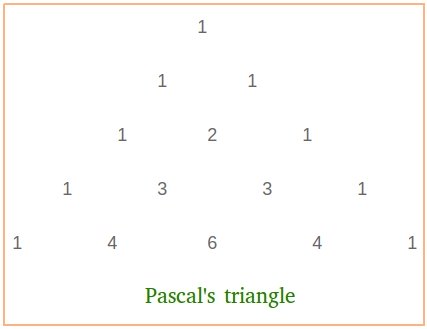
There is a nice Pascal's triangle calculator on this page that you can play with in order to see Pascal's triangle for up to 20 rows.
How Each New Row of Pascal's Triangle Is Formed
Some important things to notice:
- The first row starts with 1.
- Starting with row #2 and every single row after, the row starts with 1 and ends with 1.
- The number 2 in the third row is found by adding 1 and 1 in the second row.
- The two 3s in the fourth row are found by adding 1 and 2, and 2 and 1 in the third row.
- The number 4 in the fifth row is found by adding 1 and 3 in the fourth row. The number 6 in the fifth row is found by adding 3 and 3 in the fourth row.
Each number inside the triangle is the sum of the two numbers just above it. Every row starts and ends with 1.
You can indeed keep building more rows by doing just that. It is not that complicated. If we add another row, this is what Pascal's triangle will look like.
- Start with 1.
- Add each pair of numbers that are next to each other in row 6: 1 + 5 = 6, 5 + 10 = 15, 10 + 10 = 20, 10 + 5 = 15, 5 + 1 = 6.
- End with 1.
- Count the numbers: row 7 has 7 numbers.
Row 7: 1 6 15 20 15 6 1
Forgetting the 1 at the start or the end of the new row. Row #n always has n numbers, so a row that is one number short is missing a 1.
Row 7 is 1 6 15 20 15 6 1. What is the third number in row 8?
Show answer
21. It is the sum of the two numbers above it: 6 + 15 = 21. Row 8 is 1 7 21 35 35 21 7 1.
To watch every new number being formed, use the interactive calculator further down.
Pascal's Triangle and the Coefficients of (a + b)n
Pascal's triangle can also be obtained by pulling out the coefficients of (a + b)n.
We show the expansion of 4 binomials when n = 0, 1, 2, and 3.
You can really see the coefficients when n = 1, 2, and 3. When n = 0, it is just the number 1 that we put on top, in row #1.
Row #(n + 1) of Pascal's triangle gives the coefficients of (a + b)n. The powers of a go down by 1 and the powers of b go up by 1 from term to term.
Use row 5 (1 4 6 4 1) to expand (a + b)4.
Show answer
a4 + 4a3b + 6a2b2 + 4ab3 + b4. The coefficients are 1, 4, 6, 4, 1; the powers of a go 4, 3, 2, 1, 0 and the powers of b go 0, 1, 2, 3, 4.
Interactive Pascal's Triangle Calculator: Watch Each Row Form
Choose up to 20 rows. Click any number to see the two numbers above that add up to it, or build the next row one number at a time. Below the triangle you also get the expansion of (a + b)n.
- number above, left
- number above, right
- new number (their sum)
- 1 at each end
Summary
- Pascal's triangle starts with 1 in the first row, and every row after that starts and ends with 1.
- Each number inside the triangle is the sum of the two numbers just above it.
- Row #n has n numbers. For example, row 6 is 1 5 10 10 5 1.
- Row #(n + 1) gives the coefficients of (a + b)n; for example, row 4 (1 3 3 1) gives (a + b)3 = a3 + 3a2b + 3ab2 + b3.
Test Yourself: Interactive 10-Question Quiz
Now check what you learned. Every answer is explained, and each time you play you get new questions.
Quiz Complete!