Inverse Proportion
In an inverse proportion, when one quantity increases by a certain factor, the other quantity decreases by the same factor. Keep reading to see a real-life example of this situation.
In this lesson, you will learn
- how inverse proportion differs from direct proportion
- what happens to one quantity when the other is multiplied by a number
- how to find the constant k and use the formula y = kx
- real-life examples of inverse proportion
Direct Proportion and Inverse Proportion
Suppose x and y are variables and k is a constant. Then, y = 8x and y = −2x are examples of direct proportions.
However, y = 3x and y = −4x are examples of inverse proportions.
Is y = 7x a direct proportion or an inverse proportion?
Show answer
A direct proportion. It has the form y = kx with k = 7. An inverse proportion has x in the denominator, like y = 7x.
A Real-Life Example of Inverse Proportion
A good real-life example of inverse proportion is the speed you drive and the time it takes to travel a certain distance. Suppose you need to drive to a city that is located 200 miles away.
The following table shows the time it will take you to get to your destination based on the speed.
| Speed (miles per hour) | Time |
|---|---|
| 20 mph | 10 hours |
| 40 mph | 5 hours |
| 80 mph | 2.5 hours |
Did you make the following observations?
20 × 2 = 40 and 40 × 2 = 80
10 ÷ 2 = 5 and 5 ÷ 2 = 2.5
This means that every time you multiply the speed by 2, the time it takes to get to your destination is divided by 2 or multiplied by 12.
In general, with inverse proportion, when one quantity is multiplied by x, the other quantity is divided by x or multiplied by 1x.
Furthermore, notice the following:
20 × 10 = 200
40 × 5 = 200
80 × 2.5 = 200
200 is a constant, so let k = 200.
20, 40, or 80 is the independent variable, so let x = 20, 40, or 80
10, 5, or 2.5 is the dependent variable, so let y = 10, 5, or 2.5
We get x × y = 200 or y = 200x
In general, with inverse proportion, y = kx and we say that y is inversely proportional to x.
Thinking that any “one goes up, the other goes down” relationship is an inverse proportion. In an inverse proportion, the product x × y always stays the same. If the product changes, it is not an inverse proportion.
- More workers means less time, and the total work stays the same, so this is an inverse proportion.
- Find the constant: k = 6 × 12 = 72.
- Use y = kx with x = 9 workers: y = 729 = 8.
9 workers would take 8 days.
y is inversely proportional to x, and y = 6 when x = 4. What is y when x = 3?
Show answer
y = 8. First find k = 4 × 6 = 24. Then y = 243 = 8.
Other Real-Life Examples of Inverse Proportion
- People and timeThe number of people doing something and the time it takes to do it. As the number of people increases, the time it takes to finish decreases.
- Sharing moneySharing a specific amount of money with a certain number of people. As the number of people increases, the amount each person gets decreases.
- Price and quantitySuppose your budget is constant. The number of items you can buy is inversely proportional to the price of each item.
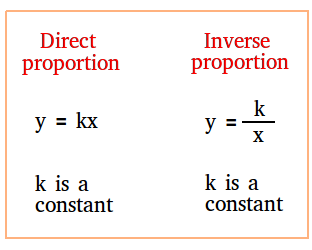
Direct Proportion and Inverse Proportion at a Glance
The figure below nicely summarizes the difference between direct proportion and inverse proportion.
Summary
- In a direct proportion, y = kx. In an inverse proportion, y = kx, where k is a constant.
- In an inverse proportion, when one quantity is multiplied by a number, the other is divided by the same number.
- The product x × y is always equal to the constant k.
- To solve a problem, find k from one pair of values, then use y = kx.
- Speed and travel time for a fixed distance is a real-life example of inverse proportion.
Test Yourself: Interactive 10-Question Quiz
Now check what you learned. Every answer is explained, and each time you play you get new questions.
Quiz complete!
Keep learning