Direct Variation
In this lesson, you will learn
- what direct variation means and how to write it as y = kx
- how to find the constant of variation k and use it to predict values
- how to tell whether an equation or a table shows direct variation
What Is Direct Variation?
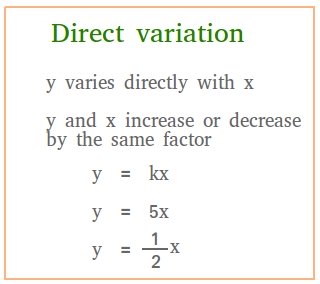
A direct variation, also called direct proportion, is a relationship between two variables x and y that can be written as y = kx, k ≠ 0.
This situation occurs when the ratio of two variables is constant.
When y = kx, we say that y varies directly with x.
When z = kt, we say that z varies directly with t.
k is called the constant of variation.
Dividing both sides of y = kx by x gives k = yx. So in a direct variation, y divided by x always gives the same number, k.
In the direct variation y = 7x, what is the constant of variation?
Show answer
7. The constant of variation is the number k that multiplies x in y = kx.
Real-Life Example: Lightning and Thunder
You are probably familiar with lightning. The distance that you are from lightning and the time it takes you to hear thunder could form a direct proportion.
Let's say you are 4 miles away from lightning and it takes you 20 seconds to hear thunder. And when you are 5 miles away, it takes you 25 seconds.
The ratio of the time it takes to hear the thunder to the distance you are from the lightning is constant since 204 = 255 = 5.
| Distance x (miles) | Time y (seconds) | Ratio yx |
|---|---|---|
| 4 | 20 | 5 |
| 5 | 25 | 5 |
The situation above represents a direct proportion and you can find the equation that relates the time it takes to hear the thunder and the distance you are from the lightning.
Finding the direct variation equation
Let x = distance from lightning and let y = time it takes to hear the thunder.
The time it takes to hear the thunder depends on the distance you are. Thus, the time it takes to hear thunder varies directly with the distance you are.
Then y = kx
Find k when x = distance from lightning = 4 and y = time it takes to hear thunder = 20.
20 = k × 4
204 = k
5 = k
Therefore, y = 5x is the direct variation equation.
Having that relationship is a good thing since you could now predict how long it will take to hear the thunder if you are 10 miles away.
When x = 10, y = 5 × 10 = 50 seconds.
Using y = 5x, how long does it take to hear the thunder when you are 3 miles from the lightning?
Show answer
15 seconds. y = 5 × 3 = 15.
Another Real-Life Example of Direct Variation: A Recipe
Example #2: A recipe for 6 cupcakes needs 1 cup of flour. The number of cupcakes you can make varies directly with the amount of flour. How many cupcakes can you make with 4 cups of flour?
Let x = amount of flour
y = number of cupcakes
Since y varies directly with x, y = kx
Find k when x = 1 and y = 6
6 = k × 1
6 = k
Therefore, y = 6x is the direct variation equation
When x = 4, y = 6 × 4 = 24
So you can make 24 cupcakes.
With the same recipe, y = 6x, how many cups of flour do you need for 30 cupcakes?
Show answer
5 cups. 30 = 6x, so x = 30 ÷ 6 = 5.
How to Solve a Direct Variation Problem
Both examples follow the same three steps:
- Use one pair of values to find k: k = yx.
- Write the equation y = kx with that number for k.
- Put in the new value of x (or of y) and solve.
- Find k: k = 186 = 3.
- Write the equation: y = 3x.
- Put in x = 11: y = 3 × 11 = 33.
y = 33
Adding instead of multiplying. When x goes from 6 to 11 (5 more), y does not go from 18 to 23. Direct variation keeps the ratio the same, not the difference: y = 3 × 11 = 33.
y varies directly with x, and y = 12 when x = 4. Find x when y = 21.
Show answer
x = 7. k = 12 ÷ 4 = 3, so y = 3x. Then 21 = 3x, and x = 7.
Which Equations Are Direct Variations?
Not every equation represents a direct variation or a direct proportion.
Examples of equations that are direct variations
- y = −4x
- y = 5x
- y = −46x
- y = 23x
- y = 100x
Equations that are not
- y = −4x + 2
- y = 5x − 57
- y = −46x + 7
- y = 23x + 3
- y = 100x + 5
An equation is a direct variation only if it can be written as y = kx with nothing added or subtracted. Then x = 0 gives y = 0, so its graph is a straight line through the origin (0, 0).
Is y = 2x − 1 a direct variation?
Show answer
No. The − 1 means it is not of the form y = kx. When x = 0, y = −1, not 0.
Summary
- y varies directly with x when y = kx, where the constant of variation k is not 0.
- In a direct variation, the ratio yx is always the same number, k.
- To solve a problem: find k from one pair of values, write y = kx, then put in the new value.
- Equations such as y = 5x + 2, with a number added or subtracted, are not direct variations.
- The graph of a direct variation is a straight line through the origin.
Test Yourself: Interactive 10-Question Quiz
Now check what you learned about direct variation. Every answer is explained, and each time you play you get new numbers.
Quiz Complete! 🎉
Keep learning