How to Write an Inequality
This lesson will show you how to write an inequality to describe a real-world situation or when a statement is given.
In this lesson, you will learn
- what "at most" and "at least" mean, and which symbol to use for each
- how to choose a variable and write a simple inequality from a sentence
- how to write an inequality with two parts, such as a fixed amount plus an amount that changes
Key Words: At Most and At Least
A few key words to keep in mind.
At most means "no more than," "less than or equal to," or "not greater than."
The math symbol that you will use for at most is ≤
At least means "no less than" or "greater than or equal to."
The math symbol that you will use for at least is ≥
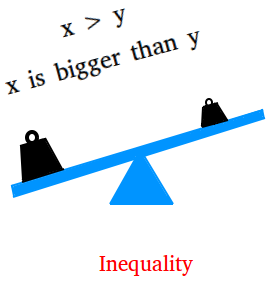
"More than" and "less than" on their own do not include the number itself. Use > for "more than" and < for "less than."
"At least" has the word "least" in it, but it does not use ≤. "At least 5" means 5 or more, so the symbol is ≥.
A ride is only for people who are at least 48 inches tall. Which symbol do you use?
Show answer
≥. "At least 48" means 48 or more. If h is a rider's height in inches, then h ≥ 48.
Easy Examples: One Variable and One Limit
Now, let us practice by writing inequalities for the following situations.
- Choose a letter for the unknown amount. Let s = number of milligrams of sodium in a serving of low-sodium food.
- Find the key words: "at most" means less than or equal to, so the symbol is ≤.
- Put the variable on the left, then the symbol, then the limit, 140.
Then, s ≤ 140
Example #2: The height of a human being is not greater than 10 feet. Write an inequality that models this situation.
Let h be the height of a human being in feet.
Then, h ≤ 10
Example #3: Foods with a high amount of fiber have at least 5 g of fiber per serving. Write an inequality that models this situation.
Let f be the number of grams of fiber per serving in high-fiber foods.
Then, f ≥ 5
Tickets for a school play cost no more than $12. Let t be the price of a ticket in dollars. Write an inequality.
Show answer
t ≤ 12. "No more than" means the price can be $12 or less.
Hard Examples: Inequalities with Two Parts
When a total is made of two parts, add the parts on the left side. Then write the symbol and the limit on the right side.
Example #4: Alfred's weekly income is at least 500 dollars with a fixed income of 200 dollars for working at the bank and making 12 dollars per hour at another job. Write an inequality that can model this situation.
Let x be the number of hours that Alfred works at the other job each week.
Fixed income + variable income ≥ 500
200 + 12x ≥ 500
Example #5: According to fire laws, a restaurant located on Jefferson Street can have no more than 75 people in it at one time. At the moment, there are 30 people in the restaurant, including those eating a meal. Write an inequality that models this situation.
The number of people that can still come inside the restaurant plus the number of people that are already inside the restaurant cannot be more than 75.
We can let x be the number of people who can still come inside the restaurant.
x + 30 ≤ 75
Do not forget the part that is already there. In Example #5, x ≤ 75 is wrong, because 30 people are already inside. The total, x + 30, is what cannot be more than 75.
A van can carry at most 1,200 pounds. The driver weighs 180 pounds. Let x be the weight of the cargo in pounds. Write an inequality.
Show answer
x + 180 ≤ 1,200. The cargo plus the driver is the total weight, and "at most" means ≤.
Summary
- "At most," "no more than" and "not greater than" mean less than or equal to: use ≤.
- "At least" and "no less than" mean greater than or equal to: use ≥.
- "More than" uses > and "less than" uses <, because the number itself is not included.
- Start by letting a letter stand for the unknown amount, and say what it means.
- When the total has two parts, such as a fixed amount plus a rate, add them on the left: 200 + 12x ≥ 500.
Test Yourself: 10-Question Quiz
Now check what you learned. Every answer is explained, and each time you play you get new questions.
Quiz Complete!