How to Solve Literal Equations
In this lesson, you will learn
- what a literal equation is
- how to solve ax = b and y = mx + b for x
- how to solve formulas such as V = lwh and 2(x + y) = z for one variable
- why solving a literal equation uses the same steps as solving an equation with numbers
What Is a Literal Equation?
Here, you will learn how to solve literal equations with some carefully chosen examples.
A literal equation is an equation that has many variables and we need to solve for one of the variables.
The first literal equation we will solve is ax = b. Study this first one below carefully!
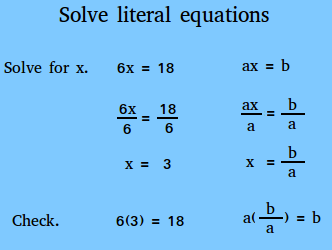
Solve a literal equation with the same steps you use with numbers: undo additions and subtractions, then undo multiplications and divisions, doing the same thing to both sides.
Solve d = rt for t.
Show answer
t = dr. Divide both sides by r, just as you would solve 20 = 4t.
Solve y = mx + b for x
Then we will show how to solve y = mx + b which is also a literal equation.
See below a more detailed guideline showing how to solve y = mx + b for x as we solve 8 = 2x + 4 for x.
y = mx + b
Subtract b from both sides
y − b = mx + b − b
y − b = mx
Divide both sides by m
y − bm = (mm)x
y − bm = 1x
y − bm = x
8 = 2x + 4
Subtract 4 from both sides
8 − 4 = 2x + 4 − 4
8 − 4 = 2x
Divide both sides by 2
8 − 42 = (22)x
8 − 42 = 1x
8 − 42 = x
We can see that the process is similar whether we are solving a literal equation or not.
All we need to do is to isolate things. For 8 − 42 = x though, we can take a step further by doing the math since we are dealing with numbers.
Therefore, x = 8 − 42 = 42 = 2
Hopefully, this example was clear enough to put you on the right track.
Dividing only one term. In y − b = mx, divide the whole left side by m: x = y − bm, not ym − b.
Solve y = mx − b for x.
Show answer
x = y + bm. Add b to both sides: y + b = mx. Then divide both sides by m.
More Examples Showing How to Solve Literal Equations
1) Solve 2a + b = d for b
2a + b = d
We need to isolate b, therefore, get rid of 2a by subtracting 2a from both sides of the equation.
2a − 2a + b = d − 2a
0 + b = d − 2a
b = d − 2a
2) Solve V = lwh for w
We need to get rid of lh. Rewrite the equation.
V = lhw
Get rid of lh by dividing both sides of the equation by lh.
Vlh = (lhlh)w
Vlh = 1w
Vlh = w
3) Solve x = a + b + c3 for c
Multiply both sides by 3.
3 × x = a + b + c3 × 3
3x = a + b + c
Subtract a from both sides.
3x − a = a − a + b + c
3x − a = 0 + b + c
3x − a = b + c
Subtract b from both sides.
3x − a − b = b − b + c
3x − a − b = 0 + c
3x − a − b = c
4) Solve 2(x + y) = z for y
First isolate x + y by getting rid of 2. To get rid of 2, divide both sides by 2.
22(x + y) = z2
1(x + y) = z2
x + y = z2
Subtract x from both sides of the equation.
x − x + y = z2 − x
0 + y = z2 − x
y = z2 − x
- Isolate 2w: subtract 2l from both sides. P − 2l = 2w.
- Isolate w: divide both sides by 2. P − 2l2 = w.
- Check with numbers: if l = 5 and w = 3, then P = 16, and 16 − 102 = 3.
w = P − 2l2
Solve A = lw for l.
Show answer
l = Aw. Divide both sides by w.
Summary
- A literal equation has several variables, and you solve it for one of them.
- Use the same steps as with numbers: undo additions and subtractions first, then multiplications and divisions.
- Whatever you do to one side, do to the other side, and divide every term, not just one.
- You can check your answer by choosing numbers for the variables.
Test Yourself: Interactive 10-Question Quiz
Now check what you learned. Every answer is explained, and each time you play you get new questions.
Quiz Complete! 🎉