Introduction to the History of Fractions
Understanding fractions is fundamental to grasping various mathematical concepts. Before delving into the history of fractions, it is beneficial to familiarize yourself with the Egyptian numeration system, as it laid the groundwork for early fractional representations. This lesson explores the evolution of fractions, tracing their origins from ancient Egypt to their modern-day notation and usage.
In this lesson, you will learn
- How the ancient Egyptians wrote fractions as sums of unit fractions
- Who gave us the way we write fractions today, and who added the fraction bar
- How people used to add, multiply and divide fractions
Egyptian Numeration System and Early Fractions
The history of fractions can be traced back to around 1600 B.C. in ancient Egypt, where an extensive treatment of fractions was documented in the Rhind Papyrus. This ancient manuscript showcased the mathematical prowess of Egyptian mathematicians, highlighting their unique approach to expressing fractions.
Unlike the ratios we use today, such as 2:5 or 25, the Egyptians did not represent fractions as simple ratios. Instead, they employed unit fractions—fractions where the numerator is 1 and the denominator is a positive integer—with only a few exceptions, such as a special symbol for 23. This method of representation was distinct and systematic, setting the foundation for their mathematical calculations.
The Rhind Papyrus was copied by a scribe named Ahmes (Ahmose) from an older text. It begins with a table that writes 2n as a sum of unit fractions for every odd number n from 3 to 101.
Understanding Unit Fractions
A unit fraction is defined as a fraction with a numerator of 1 and a positive integer as the denominator.
Examples of unit fractions include 12, 15, and 16. The Egyptians utilized these unit fractions to express more complex fractions by breaking them down into sums of unit fractions.
For instance, the fraction 118 was written using specific Egyptian symbols, as illustrated in the figure below:
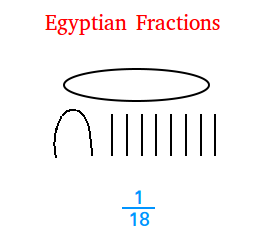
In addition to numerical symbols, the Egyptians incorporated shapes into their notation. Notably, an ellipse resembling an open mouth was used to denote fractions, adding a visual element to their mathematical expressions.
Which of these is a unit fraction: 27, 19 or 91?
Show answer
19. A unit fraction has a numerator of 1.
Adding Fractions in Ancient Egypt
One of the intriguing aspects of Egyptian mathematics is their method of adding fractions. Unlike our current approach, the Egyptians expressed sums of fractions using only unit fractions. For example, to represent 25, they would decompose it into the sum of two unit fractions:
This method ensured that each component of the sum was a unit fraction, adhering to their numerical conventions. The Egyptians also had specific symbols to represent these operations. The equation 13 + 115 would be depicted using their unique symbols, as shown below.
A notable feature in their notation was the use of the man’s feet symbol. The direction in which the feet pointed indicated the operation to be performed:
- Pointing towards the direction of writing: Indicates addition.
- Pointing away from the direction of writing: Indicates subtraction.
In the example above, the feet are pointing towards the writing direction, signifying that the fractions should be added.
- 15 is a multiple of 3, so use the common denominator 15.
- Rewrite 13 as 515.
- Add: 515 + 115 = 615.
- Simplify by dividing the top and the bottom by 3: 615 = 25.
The Egyptian sum 13 + 115 is exactly 25.
Writing 25 as 15 + 15. That sum is correct today, but the Egyptians did not repeat the same unit fraction: each part of the sum had to be a different unit fraction.
Is 12 + 16 an Egyptian way to write 23?
Show answer
Yes. 12 + 16 = 36 + 16 = 46 = 23, and the two unit fractions are different.
Transition to Modern Fraction Notation
The way we represent fractions today has evolved significantly from the ancient Egyptian system. The modern fractional notation likely has its roots in the Hindu mathematical tradition. Around A.D. 630, the Indian mathematician Brahmagupta introduced a new way of writing fractions. Brahmagupta wrote one number above the other, as we do today, but without using a bar, representing two-fourths simply as:
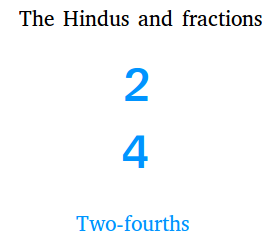
This representation marked a shift towards the more familiar form of fractions used today.
Contributions of Hindu and Arabic Mathematicians
Following the Hindu tradition, the Arab mathematicians made significant contributions to the notation of fractions. They introduced the fraction bar, which allowed for clearer and more standardized representation of fractions, such as 24. However, the use of the fraction bar was initially limited due to typesetting constraints.
The concepts of numerator and denominator—terms that describe the components of a fraction—originated from Latin writers. These terms helped in formalizing the language around fractions, making mathematical communication more precise.
The oldest known use of the fraction bar is in the work of al-Hassar, a 12th-century mathematician from North Africa. Leonardo of Pisa (Fibonacci) brought it to Europe in his book Liber Abaci in 1202.
What was missing from Brahmagupta's fractions that we use today?
Show answer
The fraction bar. He wrote the numerator above the denominator with no line between them.
Advancements in Fraction Operations
Up until the sixteenth century, mathematical operations involving fractions were relatively rudimentary. When dealing with fractions, the common denominator was typically found by simply multiplying the denominators together. For example, to add 13 and 14, the common denominator would be 12 (since 3 × 4 = 12), and the fractions would be adjusted accordingly:
However, in the seventeenth century, mathematicians began to use the least common multiple (LCM) extensively when adding and subtracting fractions. This approach made calculations more efficient by reducing the size of the denominators involved.
To add 14 and 16, which common denominator does multiplying give, and which does the LCM give?
Show answer
24 and 12. 4 × 6 = 24, but the least common multiple of 4 and 6 is 12, which keeps the numbers smaller: 312 + 212 = 512.
Multiplication of Fractions
The multiplication of fractions as we understand it today has remained largely unchanged for centuries. The process involves multiplying the numerators together and the denominators together. For example:
This method has provided a consistent and straightforward way to handle multiplication involving fractions, ensuring clarity and ease of use in mathematical computations.
Division of Fractions: A Historical Perspective
Division of fractions has a more complex history, with methods differing significantly from contemporary practices. Historically, two primary methods were employed:
1. Common Denominator Method
In this approach, mathematicians would first find a common denominator for the fractions involved, even though this step is unnecessary in modern division of fractions. For example, to divide 42 by 23, they would adjust the fractions to have a common denominator before performing the division:
2. Cross-Multiplication Method
This method multiplies the numerator of the first fraction by the denominator of the second, and the denominator of the first fraction by the numerator of the second. Using the same example:
This approach is more aligned with how we perform division of fractions today, emphasizing efficiency and simplicity.
These historical methods highlight the evolution of mathematical operations and how our current techniques have been refined over time for greater effectiveness.
Use the common denominator method to divide 34 by 18.
Show answer
6. 34 = 68, so 68 ÷ 18 = 61 = 6: with the same denominator, you just divide the numerators.
Conclusion: The Evolution of Fractions
The journey of fractions from ancient Egypt to the present day is a testament to the enduring importance of this mathematical concept. Starting with the Egyptian reliance on unit fractions and unique symbolic representations, fractions have undergone significant transformations influenced by Hindu and Arabic mathematicians. The introduction of the fraction bar, the formalization of numerator and denominator terms, and the refinement of arithmetic operations have all contributed to the sophisticated and versatile system of fractions we use today.
Understanding this historical progression not only enriches our appreciation for mathematics but also underscores the collaborative and cumulative nature of mathematical advancements across different cultures and eras. As we continue to build upon these foundations, the study of fractions remains a vital component of mathematical education and application.
Summary: A Timeline of Fractions
- c. 1600 B.C. – EgyptThe Rhind Papyrus writes fractions as sums of different unit fractions, such as 25 = 13 + 115.
- c. A.D. 628 – IndiaBrahmagupta writes the numerator above the denominator, without a bar.
- 12th century – North AfricaAl-Hassar uses the horizontal fraction bar.
- 1202 – EuropeFibonacci uses the fraction bar in Liber Abaci.
- 16th centuryA common denominator is usually found by multiplying the denominators.
- 17th century onwardThe least common multiple is used more and more to keep denominators small.
Test Yourself: Interactive 10-Question Quiz
Now check what you learned. Every answer is explained, and each time you play you get new questions.
Quiz complete!