How to Find Function Values
In this lesson, you will learn
- what it means to find a function value such as f(2)
- how to replace x with a number and simplify
- how to replace x with an expression such as 2x or 2x + 1
- how brackets keep the signs right when you substitute
What Does It Mean to Find Function Values?
Finding function values is the process of evaluating the function for given values of x.
The figure below shows how to evaluate f(x) = 6x − 5 when x = 2.
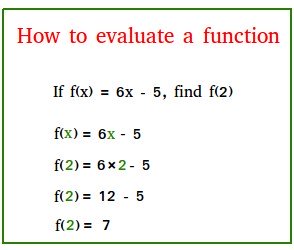
To find f(a), replace every x in the rule with a, then simplify.
Put the value you substitute in brackets, especially a negative number or an expression: (−2)2 = 4 and (2x)2 = 4x2.
If f(x) = 6x − 5, what is f(−1)?
Show answer
−11. f(−1) = 6(−1) − 5 = −6 − 5 = −11.
Example #1: Find f(0), f(−2) and f(3)
If f(x) = x2 + 4x + 3, find function values f(0), f(−2), and f(3).
f(0)
f(0) = 02 + 4(0) + 3
= 0 + 0 + 3
= 3
f(−2)
f(−2) = (−2)2 + 4(−2) + 3
= 4 − 8 + 3
= −4 + 3
= −1
f(3)
f(3) = (3)2 + 4(3) + 3
= 9 + 12 + 3
= 21 + 3
= 24
Writing −22 instead of (−2)2. Without brackets, −22 = −4, but the square of −2 is (−2)2 = 4.
If f(x) = x2 + 4x + 3, what is f(1)?
Show answer
8. f(1) = 1 + 4 + 3 = 8.
Example #2: Find g(0), g(2x) and g(−2x)
If g(x) = x2 + 5x − 12, find function values g(0), g(2x), and g(−2x).
g(0)
g(0) = 02 + 5(0) − 12
= 0 + 0 − 12
= −12
g(2x)
g(2x) = (2x)2 + 5(2x) − 12
= 4x2 + 10x − 12
g(−2x)
g(−2x) = (−2x)2 + 5(−2x) − 12
= 4x2 − 10x − 12
Squaring only the x: (2x)2 is 4x2, not 2x2. The square applies to the whole bracket.
If g(x) = x2 + 5x − 12, what is g(3)?
Show answer
12. g(3) = 9 + 15 − 12 = 12.
Example #3: Find h(0), h(−3x) and h(2x + 1)
If h(x) = 2x2 − 4x + 3, find function values h(0), h(−3x), and h(2x + 1).
h(0)
h(0) = 2 × 02 − 4(0) + 3
= 2 × 0 − 0 + 3
= 0 − 0 + 3
= 3
h(−3x)
h(−3x) = 2 × (−3x)2 − 4(−3x) + 3
= 2 × 9x2 + 12x + 3
= 18x2 + 12x + 3
h(2x + 1)
h(2x + 1) = 2 × (2x + 1)2 − 4(2x + 1) + 3
= 2 × (4x2 + 4x + 1) − 8x − 4 + 3
= 8x2 + 8x + 2 − 8x − 4 + 3
= 8x2 + 1
- Replace every x with (−1): p(−1) = 3(−1)2 − (−1) + 2.
- Do the power first: (−1)2 = 1, so 3(−1)2 = 3.
- Subtracting −1 is the same as adding 1: 3 + 1 + 2.
p(−1) = 6
If h(x) = 2x2 − 4x + 3, what is h(1)?
Show answer
1. h(1) = 2 − 4 + 3 = 1.
Summary
- Finding function values means evaluating the function for given values of x.
- To find f(a), replace every x with a and simplify.
- Use brackets when you substitute, so that (−2)2 = 4 and (2x)2 = 4x2.
- You can substitute an expression such as 2x or 2x + 1; the answer is then an expression in x.
- f(0) of a polynomial is its constant term.
Test Yourself: Interactive 10-Question Quiz
Now check what you learned. Every answer is explained, and each time you play you get new questions.
Quiz Complete! 🎉