Division of Integers
Division of Integers
In this lesson, you will learn
- how division is linked to multiplication
- what the dividend, divisor and quotient are
- the sign rules for dividing positive and negative integers
- what happens when zero is part of a division
What Division of Integers Means
Division of integers is the opposite operation of multiplying integers. It is the process by which one is trying to determine how many times a number is contained in another.
Say for instance you do 42 ÷ 6 as shown in the figure below. You are trying to find out how many times 6 is contained in 42.

Since 6 × 7 = 42, 6 is contained in 42 seven times. Thus, 42 ÷ 6 = 7
Now, it is very important to make the following observations:
In other words, if the product 4 × 5 = 20, then dividing the product, which is 20, by 4 gives you back 5.
By the same token, dividing the product or 20 by 5 gives you back 4. Having said that, we can use this fact to find the rule for dividing integers.
Use multiplication to find 56 ÷ 8.
Show answer
7. Since 8 × 7 = 56, 8 is contained in 56 seven times.
The Rules for Dividing Integers
Now, let us see how the multiplication facts give us the rules. Since we know that 2 × 6 = 12, then 12 ÷ 6 = 2.
12, 6, and 2 are positive, so we can conclude the following:
positive ÷ positive = positive
Since we know that 2 × −6 = −12, then −12 ÷ −6 = 2.
−12 and −6 are negative, but 2 is positive, so we can conclude the following:
negative ÷ negative = positive
In our previous example, notice also that −12 ÷ 2 = −6
−12 is negative, 2 is positive, and −6 is negative, so we can conclude the following:
negative ÷ positive = negative
Finally, consider −2 × −6 = 12
Then, 12 ÷ −2 = −6
12 is positive, −2 is negative, and −6 is negative, so we can conclude the following:
positive ÷ negative = negative
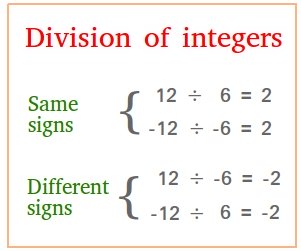
Notice also that the rule for division of integers is the same as the rule for multiplying integers. Therefore, if you remember the rule for multiplying integers, you already know it for division.
In a nutshell, here is the most important stuff that you need to remember from this lesson about division of integers:
The division of two integers with the same signs is positive
The division of two integers with different signs is negative
Using the rule for adding integers, where the answer takes the sign of the number farther from zero. In division, only the two signs matter: −20 ÷ 4 = −5, and −20 ÷ −4 = 5, even though 20 is the bigger number in both.
Zero divided by any non-zero integer is 0, and 0 has no sign: 0 ÷ −7 = 0. Dividing by zero is undefined: −7 ÷ 0 has no answer, because no number times 0 gives −7.
- Divide the numbers without their signs: 72 ÷ 8 = 9.
- Look at the signs: −72 and −8 are both negative, so the signs are the same.
- Same signs give a positive answer, so the quotient is 9.
- Check with multiplication: quotient × divisor = 9 × −8 = −72, which is the dividend.
−72 ÷ −8 = 9
What is 45 ÷ −9?
Show answer
−5. 45 ÷ 9 = 5, and the signs are different, so the answer is negative. Check: −5 × −9 = 45.
A Picture Summary of the Rules
Need a little bit more help in order to understand the rule above about division of integers? Here is a summary!
Without working out the answer, is −96 ÷ 12 positive or negative?
Show answer
Negative. −96 is negative and 12 is positive. Different signs give a negative answer (it is −8).
Summary
- Division is the opposite of multiplication: quotient × divisor = dividend.
- Same signs give a positive quotient: positive ÷ positive and negative ÷ negative are positive.
- Different signs give a negative quotient: positive ÷ negative and negative ÷ positive are negative.
- The sign rules for division are the same as for multiplication.
- 0 divided by a non-zero integer is 0, and dividing by 0 is undefined.
Test Yourself: 10-Question Quiz
Now check what you learned. Every answer is explained, and each time you play you get new questions.
Quiz Complete!
Keep learning