Adding Integers using an Interactive Number Line or the Rules for Addition of Integers
Adding integers is the process of getting the sum of two, three, or more integers. The sum of two or more integers could become smaller, bigger, or just equal to zero.
In this lesson, you will learn
- how to add integers by moving left or right on a number line
- the rule for adding integers with the same sign
- the rule for adding integers with different signs, even for large numbers
Video: Adding Integers
Take the Integer Car for a Spin: Interactive Number Line
Start at the first number, then move according to the second number. Adding a positive number means moving right on the number line. Adding a negative number means moving left.
Three Ways to Add Integers
The addition of integers could be performed using any of the following methods:
- Using a number line
- Using the rules for adding integers shown in the figure below
- Using chips or counters to model the integers
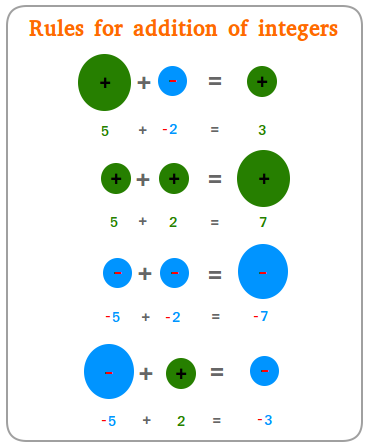
The first two methods will be covered here in this lesson. See our related topics below if you want to learn how to add integers using chips or counters.
Adding Integers Using a Number Line
A number line is a good way to start when learning how to add integers. It will help you think through problems and approach them with intuition. As a result, the rules for addition of integers will make more sense and they will also be easier to remember.
Here are the two main things to remember when adding integers with a number line:
If you add a positive number, move in the positive direction (to the right).
If you add a negative number, move in the negative direction (to the left).
- Start at 2 and move 6 units to the right.
- Since you stopped at 8, the answer is 8.

2 + 6 = 8
Notice that you will get the same answer if you start at 6 and move 2 units to the right.
Example #2. Add: −2 + 8
Start at −2 and move 8 units to the right. Since you end up at 6, the answer is 6.

−2 + 8 = 6
Notice that you will get the same answer if you start at 8 and move 2 units to the left.
Example #3. Add: 4 + (−7)
Start at 4.
As stated above, the number you are adding to 4 is a negative number (−7 is negative), so you have to move 7 units to the left.
After you do that, you will end up at −3, so the answer is −3.

4 + (−7) = −3
Notice that you will get the same answer if you start at −7 and move 4 units to the right.
Example #4. Add: −2 + (−6)
Start at −2.
Once again, the number you are adding is a negative number (−6 is negative), so you will move 6 units to the left.
You will end up at −8, so the answer is −8.

−2 + (−6) = −8
Notice that you will get the same answer if you start at −6 and move 2 units to the left.
Other examples showing how to add integers using a number line
- −1 + 8 = 7 (Start at −1 and move 8 units to the right.)
- 4 + (−4) = 0 (Start at 4 and move 4 units to the left.)
- 7 + (−9) = −2 (Start at 7 and move 9 units to the left.)
- −5 + 3 = −2 (Start at −5 and move 3 units to the right.)
Use a number line to add −6 + 4.
Show answer
−2. Start at −6 and move 4 units to the right. You stop at −2.
Problems that can arise when using a number line to add integers
What if you want to find the sum of the following integers?
- −78 + 90
- −520 + (−144)
- −240 + 115
A couple of problems can come up:
- First, your number line may not fit in your notebook.
- Second, even if you could manage to fit the number line somewhere, since the numbers are so big, it will be very inconvenient or take a long time to count.
For example, starting from −78 and moving 90 units to the right is very inconvenient. This is the reason that we need rules.
Rule for Adding Integers with the Same Sign
Rule #1: When adding integers with the same sign, add their absolute values. The sum has the same sign as the addends.
For example, if you add two negative integers, the sign of the sum is still negative. Similarly, if you add two positive integers, the sign of the sum is still positive.
Example #4 revisited. Add: −2 + (−6)
Add the absolute values:
Absolute value of −2 = |−2| = 2
Absolute value of −6 = |−6| = 6
|−2| + |−6| = 2 + 6 = 8
The sum has the same sign as the addends. Since the sign of the addends is negative (−), the sign of the sum is also negative (−).
−2 + (−6) = −8
Rule for Adding Integers with Different Signs
Rule #2: When adding integers with different signs, find the difference of their absolute values. The sum has the same sign as the addend with the greater absolute value.
Example #3 revisited. Add: 4 + (−7)
Find the absolute values:
Absolute value of 4 = |4| = 4
Absolute value of −7 = |−7| = 7
|−7| − |4| = 7 − 4 = 3
The addend with the greater absolute value is −7, and −7 has a negative sign. Therefore, the sign of the sum is negative (−).
4 + (−7) = −3
Adding the absolute values when the signs are different. 4 + (−7) is not −11 or 11. When the signs are different, subtract the absolute values: 7 − 4 = 3, and the answer is −3.
Add: 9 + (−15)
Show answer
−6. The signs are different, so subtract: 15 − 9 = 6. −15 has the greater absolute value, so the sum is negative.
Adding Integers Using the Rules for Addition of Integers
Earlier, we mentioned that it will be hard to do the following additions using a number line. Let us use the rules to do them now!
1) −78 + 90
|−78| = 78 and |90| = 90
90 − 78 = 12
The addend with the greater absolute value is 90. Therefore, the sign of the sum is positive (+).
−78 + 90 = 12
2) −520 + (−144)
|−520| = 520 and |−144| = 144
520 + 144 = 664
The sum has the same sign as the addends. Since the sign of the addends is −, the sign of the sum is negative (−).
−520 + (−144) = −664
3) −240 + 115
|−240| = 240 and |115| = 115
240 − 115 = 125
The addend with the greater absolute value is −240. Therefore, the sign of the sum is negative (−).
−240 + 115 = −125
Other topics related to integers are modeling integers with chips or counters, integers and inductive reasoning, and consecutive integers. If you need a refresher, read What are integers?
Summary
- On a number line, start at the first number. Adding a positive number moves you right, and adding a negative number moves you left.
- Same signs: add the absolute values and keep the sign.
- Different signs: subtract the absolute values and use the sign of the addend with the greater absolute value.
- A number plus its opposite is 0, for example 4 + (−4) = 0.
- Use the rules when the numbers are too big for a number line.
Integer Road Trip: Interactive 10-Question Driving Quiz
Now check what you learned. For each question, drive the car to the first number, drive it the right way for the second number, then type the answer. Every answer is explained, and each time you play you get new questions.
Quiz complete!