Classification of Numbers
Classification of Numbers
The chart below shows the classification of numbers. The chart will make things crystal clear. Study it carefully and then see below some important definitions and observations you need to make from the chart. Take the quiz below to see how much you know.
In this lesson, you will learn
- the natural numbers, whole numbers and integers, and how they are different
- what fractions and rational numbers are
- how irrational numbers and rational numbers together make the real numbers
- what complex numbers and imaginary numbers are
Chart Showing the Different Types of Numbers
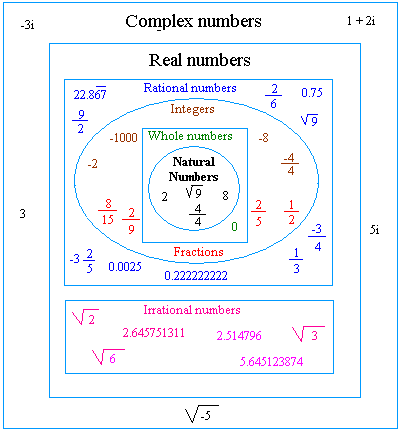

Each set in the chart is inside a bigger set. Every natural number is also a whole number, an integer, a rational number, a real number and a complex number.
Natural Numbers, Whole Numbers and Integers
Natural Numbers
The natural numbers, also called positive integers, are the counting numbers 1, 2, 3, 4, 5, 6, ...
The symbol that we use to represent the counting numbers is ℕ or N.
Observation #1:
Notice that it is OK to say that √(9) is also a natural number although it does not look like it. It is because √(9) = 3. √(9) is just another way to write the number 3.
The natural numbers can be further broken down into prime numbers and composite numbers, plus the number 1, which is neither prime nor composite.
For example, 5 is a prime number, but 12 is a composite number.
Whole Numbers
The whole numbers are the numbers 0, 1, 2, 3, 4, 5, 6, ...
The symbol that we use to represent the whole numbers is W.
Observation #2:
Notice that the only difference between the natural numbers and the whole numbers is the zero.
Whole numbers = natural numbers and the number zero
The whole numbers can be further broken down into prime numbers and composite numbers, plus the numbers 0 and 1, which are neither prime nor composite.
For example, 7 is a prime number, but 14 is a composite number.
Integers
The integers are the numbers ..., −6, −5, −4, −3, −2, −1, 0, 1, 2, 3, 4, 5, 6, ...
The symbol that we use to represent the integers is ℤ or Z.
Observation #3:
Notice that the difference between whole numbers and integers is the negative numbers.
Integers = whole numbers and the negative of the whole numbers.
The negative of the whole numbers (..., −6, −5, −4, −3, −2, −1) are called negative integers and the positive of the whole numbers (1, 2, 3, 4, 5, 6, ...) are also called positive integers. Zero (0) is neither positive nor negative.
The integers can be further broken down into even numbers and odd numbers.
Example: 4 and −4 are even numbers. 5 and −5 are odd numbers.
Thinking 0 is a natural number. The natural numbers start at 1. Zero is the first whole number.
Is −3 a whole number? Is it an integer?
Show answer
Not a whole number, but an integer. Whole numbers are never negative; the integers include the negative numbers.
Fractions and Rational Numbers
Fractions
Fractions are numbers that can be expressed in the form ab, in which a and b are whole numbers and b is not equal to zero.
Examples of fractions are 12, 4, 13, 1, 12, 155, and 53.
A fraction can be written as a terminating decimal or as a non-terminating repeating decimal.
Example: In decimal form, 12 = 0.5 and 0.5 is a terminating decimal. In decimal form, 13 = 0.333... and 0.333... is a non-terminating repeating decimal.
Observation #4:
All integers are fractions. Not all fractions are integers.
Example: 16 is an integer and can be written as 161 to make it a fraction.
However, 13 = 0.333... is not an integer.
Rational Numbers
Rational numbers are numbers that can be written in the form pq, in which p and q are integers and the denominator q is not equal to zero.
Examples of rational numbers are 12, 4, −13, 1, 12, −154, 53, ...
The symbol that we use to represent the rational numbers is ℚ or Q.
Observation #5:
Rational numbers = Integers and fractions
A fraction is a rational number. However, a rational number may not be a fraction.
For example, 45 is both a fraction and a rational number. However, −45 is a rational number, but not a fraction. A fraction cannot have a negative sign. Once you put a negative sign next to a fraction, you must call it a rational number.
Is 0.75 a rational number?
Show answer
Yes. 0.75 = 34, a quotient of two integers. Every terminating decimal is rational.
Irrational Numbers and Real Numbers
Irrational Numbers
Irrational numbers are numbers that cannot be written as common fractions or as a rational number.
The symbol that we use to represent the irrational numbers is P.
Examples of irrational numbers are √(7), √(3), 2.2248795661174268..., and pi that is equal to 3.14...
Another way to see them is that they are neither repeating decimals nor terminating decimals. Irrational numbers are non-terminating, non-repeating decimals.
Observation #6:
Notice that √(16) is not an irrational number since √(16) is equal to 4. A square root sign does not mean it is always irrational.
Thinking a long decimal that stops is irrational. A decimal that ends, such as 2.645751311, is a terminating decimal, so it is rational. An irrational number never ends and never repeats, which is why we write "..." after its digits.
Real Numbers
When you put together the set of rational numbers and the set of irrational numbers, you get the set of real numbers.
The symbol that we use to represent the real numbers is ℝ or R.
Examples of real numbers are 3, 14, −8, √(2), 5.47853997521, 23, 4.666666666, 0.8, 30.15, and 5.26
Observation #7:
Why are real numbers called "real"? Because some numbers are not real. For example, negative infinity (−∞) and positive infinity (∞) are not real numbers. The square root of a negative number such as √(−1) is not a real number either.
- −7 is negative, so it is not a natural number or a whole number.
- −7 is an integer: it is the negative of the whole number 7.
- Every integer is a rational number (−7 = −71), so −7 is rational, not irrational.
- Every rational number is a real number, and every real number is a complex number.
Answer: integer, rational number, real number and complex number
Is √(25) rational or irrational?
Show answer
Rational. √(25) = 5, which is a natural number, so it is also rational.
Complex Numbers
Complex numbers are numbers that can be written in the form a + bi, in which a and b are real numbers. a is called the real part and b is called the imaginary part.
By definition √(−1) is equal to i
The difference between complex numbers and real numbers is that complex numbers give solutions for the following expressions and more!
√(−1), √(−7), √(1 − 8), √(−25) = 5i, etc...
The symbol that we use to represent the complex numbers is ℂ.
Observation #8:
Notice that in our chart above, we included 3 as a complex number. This could happen if the imaginary part or b is equal to zero. On the other hand, if a is equal to zero, and b is not, you are dealing with imaginary numbers. For example, i, −2i, and 32i are imaginary numbers.
Among the different types of numbers, fractions are among the toughest to understand.
What is √(−16)?
Show answer
4i. √(−16) = √(16) × √(−1) = 4 × i = 4i.
Summary
- Natural numbers: 1, 2, 3, ... Whole numbers: 0, 1, 2, 3, ... Integers: ..., −2, −1, 0, 1, 2, ...
- Rational numbers can be written as pq with integers p and q (q ≠ 0). Their decimals stop or repeat.
- Irrational numbers, such as √(2) and pi, have decimals that never stop and never repeat.
- Rational and irrational numbers together make the real numbers.
- Complex numbers have the form a + bi, where i = √(−1). Every real number is a complex number with b = 0.
Test Yourself: 10-Question Quiz
Now check what you learned. Every answer is explained, and each time you play you get new questions.
Quiz Complete!