Area Formula
The area of a flat shape is the amount of surface it covers. An area formula tells you how to calculate it from measurements such as side lengths, height or radius. Area is always measured in square units, such as square inches (in²), square feet (ft²) or square meters (m²).
Area formulas at a glance
| Shape | Area formula | Where |
|---|---|---|
| Square | A = s² | s = side |
| Rectangle | A = b × h | b = base (length), h = height (width) |
| Triangle | A = (b × h) ÷ 2 | b = base, h = height |
| Parallelogram | A = b × h | b = base, h = height |
| Trapezoid | A = h(b₁ + b₂) ÷ 2 | b₁, b₂ = parallel sides, h = height |
| Rhombus or kite | A = (d₁ × d₂) ÷ 2 | d₁, d₂ = diagonals |
| Circle | A = πr² | r = radius, π ≈ 3.14 |
| Ellipse | A = πab | a, b = semi-major and semi-minor axes |
The height in these formulas is always measured at a right angle (90°) to the base, not along a slanted side.
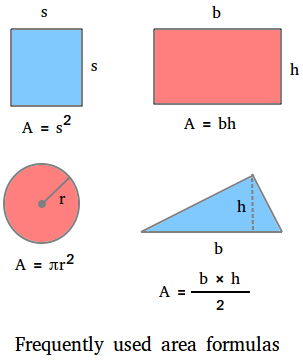
The chart below shows the four formulas used most often in class and in real life:
Area of a square
A square has four equal sides. Its area is the length of one side multiplied by itself.
A = s² = s × s
Area of a rectangle
The area of a rectangle is its base times its height. You will also see this written as length times width.
A = b × h = length × width
Area of a triangle
The area of a triangle is half the product of its base and height. Two copies of the same triangle fit together to make a parallelogram, which is why the formula divides by 2.
A = (b × h) ÷ 2
For other ways to find a triangle's area, see Heron's formula and the area of an equilateral triangle.
Area of a parallelogram
The area of a parallelogram is its base times its height. Cut off a triangle from one end, move it to the other end, and the parallelogram becomes a rectangle with the same base and height.
A = b × h
See the lesson about the parallelogram to learn more.
Area of a trapezoid
A trapezoid has two parallel sides, called bases. Its area is the height times the average of the two bases.
A = h(b₁ + b₂) ÷ 2
See the lesson about the area of a trapezoid to learn more.
Area of a rhombus or kite
The diagonals of a rhombus or a kite cross at a right angle. The area is half the product of the two diagonals.
A = (d₁ × d₂) ÷ 2
Area of a circle
The area of a circle is π times the square of the radius. The number π (pi) is about 3.14. It never ends or repeats, so 3.14 is an approximation.
A = πr²
See the lesson about the area of a circle to learn more.
Area of an ellipse
An ellipse is a stretched circle. Its area is π times the semi-major axis (half the longest width) times the semi-minor axis (half the shortest width). These are also called the major and minor radius.
A = πab
When a = b, the ellipse is a circle, and the formula becomes πr².
Common mistakes:
- Using a slanted side instead of the height in a triangle, parallelogram or trapezoid.
- Using the diameter instead of the radius in πr². Halve the diameter first.
- Mixing units, such as feet and inches. Convert everything to the same unit first.
- Forgetting that the answer is in square units.
Examples
Example 1: A rectangular backyard is 50 feet long and 40 feet wide. What is its area?
A = length × width = 50 ft × 40 ft = 2,000 ft²
Example 2: The adjacent sides of a parallelogram are 12 cm and 15 cm. The height to the 12 cm base is 6 cm. Find the height to the 15 cm base.
First find the area using the 12 cm base: A = 12 × 6 = 72 cm².
The area is the same whichever side you use as the base, so 72 = 15 × h.
Divide both sides by 15: h = 72 ÷ 15 = 4.8 cm
Example 3: The diameter of a circle is 9 inches. What is its area?
The radius is half the diameter: r = 9 ÷ 2 = 4.5 in.
A = πr² = π × 4.5² = 20.25π
Using π ≈ 3.14: A ≈ 3.14 × 20.25 = 63.585 ≈ 63.6 in²
Example 4: A trapezoid has bases of 6 m and 10 m and a height of 4 m. What is its area?
A = h(b₁ + b₂) ÷ 2 = 4 × (6 + 10) ÷ 2 = 4 × 16 ÷ 2 = 32 m²
Practice problems
Pick an answer for each question. You'll see right away whether it's correct, with an explanation.
1. What is the area of a square with sides of 7 cm?
A = s² = 7 × 7 = 49 cm². (28 cm is the perimeter: 4 × 7.)
2. A triangle has a base of 10 m and a height of 6 m. What is its area?
A = (b × h) ÷ 2 = (10 × 6) ÷ 2 = 60 ÷ 2 = 30 m². Don't forget to divide by 2.
3. A circle has a radius of 5 ft. Using π ≈ 3.14, what is its area?
A = πr² ≈ 3.14 × 5² = 3.14 × 25 = 78.5 ft². (31.4 is the circumference, 2πr.)
4. A trapezoid has bases of 8 in and 12 in and a height of 5 in. What is its area?
A = h(b₁ + b₂) ÷ 2 = 5 × (8 + 12) ÷ 2 = 5 × 20 ÷ 2 = 50 in².
5. A kite has diagonals of 8 cm and 9 cm. What is its area?
A = (d₁ × d₂) ÷ 2 = (8 × 9) ÷ 2 = 72 ÷ 2 = 36 cm².
6. A room is 3 m wide and 4 m long. How should you write its area?
A = 3 m × 4 m = 12 m². Multiplying meters by meters gives square meters, so area is always in square units. (14 m is the perimeter.)