Angle Bisector Theorem
In this lesson, you will learn
- what the angle bisector theorem says
- why the distance from a point to a side is measured along a perpendicular segment
- how to use the theorem to write and solve an equation
What the Angle Bisector Theorem Says
The bisector of an angle is the ray that divides the angle into two equal angles.
The angle bisector theorem states the following: If a point is on the bisector of an angle, then the point is equidistant from the sides of the angle.
For example, take a look at the angle below shown with two blue rays.
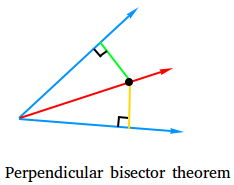
The red line is the angle bisector and the black point is on the angle bisector. Since the black point is on the angle bisector, the black point is equidistant from the sides of the angle.
We illustrate this fact with the green and yellow segments. The length of the green segment is the same as the length of the yellow segment.
The distance from a point to a side is the length of the perpendicular segment from the point to that side. That is why the green and yellow segments meet the sides at right angles.
Point P is on the bisector of an angle. P is 6 cm from one side of the angle. How far is P from the other side?
Show answer
6 cm. A point on the bisector is the same distance from both sides.
Using the Angle Bisector Theorem to Solve a Geometry Problem
Take a look at the diagram below and find the length of segment CD.
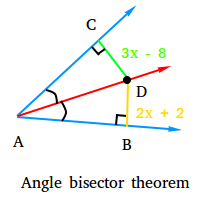
From the diagram, you can see that D is on the bisector of angle CAB.
Therefore, DC = DB
3x − 8 = 2x + 2
3x − 2x − 8 = 2x − 2x + 2
3x − 2x − 8 = 0 + 2
x − 8 = 2
x − 8 + 8 = 2 + 8
x + 0 = 10
x = 10
CD = 3x − 8 = 3(10) − 8 = 30 − 8 = 22
- D is on the bisector, so the two distances are equal: 5x − 3 = 2x + 9.
- Subtract 2x from both sides: 3x − 3 = 9.
- Add 3 to both sides: 3x = 12, so x = 4.
- Put x = 4 into either expression: 5(4) − 3 = 17, and 2(4) + 9 = 17 checks it.
The distance is 17.
Stopping at x. The question asks for a length, so put the value of x back into the expression. Here x = 10, but CD = 22.
D is on the bisector of angle CAB, DC = 4x + 1 and DB = 2x + 11. Find DC.
Show answer
DC = 21. 4x + 1 = 2x + 11 gives 2x = 10, so x = 5, and DC = 4(5) + 1 = 21.
Summary
- The bisector of an angle divides it into two equal angles.
- Angle bisector theorem: a point on the bisector of an angle is equidistant from the sides of the angle.
- The distance from a point to a side is measured along the perpendicular segment.
- To solve a problem, set the two distances equal, solve for x, then put x back in to find the length.
Test Yourself: Interactive 10-Question Quiz
Now check what you learned about the angle bisector theorem. Every answer is explained, and each time you play you get new numbers.
Quiz Complete! 🎉
Keep learning