Angle Bisector
In this lesson, you will learn
- what an angle bisector is
- how an angle bisector splits an angle into two equal angles
- what an angle bisector of a triangle is
- how to use a bisector to find a missing angle or solve for x
What Is an Angle Bisector?
An angle bisector is a ray that divides an angle into two congruent angles or two angles that have the same measure.
For example, in the figure below, ray OB shown in red is an angle bisector and it divides angle AOC into two congruent angles.
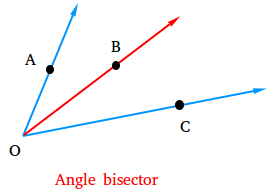
These two congruent angles are angle AOB and angle COB.
In other words,
Notice that segment OB lies within ray OB and has the same endpoint as ray OB. Therefore, it is perfectly ok to say that the ray or the segment bisects angle AOC.
Learn how to find an angle bisector by reading this lesson.
Each of the two angles is half of the whole angle: m∠AOB = m∠COB = 12 m∠AOC.
Ray OB bisects angle AOC, and m∠AOC = 84°. What is m∠AOB?
Show answer
42°. The bisector splits 84° into two equal angles: 84° ÷ 2 = 42°.
Interactive Angle Bisector Visualization
Instructions
- Drag the blue points on the rays to change the angle. On a phone, touch a point and slide your finger.
- Use the slider or type a number to set an exact angle.
- The red ray is the angle bisector. It divides the angle into two equal parts.
- For angles greater than 180°, the bisector divides the reflex angle.
Angle Bisector of a Triangle
An angle bisector of a triangle is a segment that bisects an angle of that triangle and extends to the opposite side.
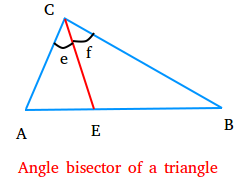
In triangle ABC shown above, segment CE is an angle bisector for that triangle.
Segment CE bisects angle ACB and creates angle ACE and angle BCE that are congruent.
In other words,
You could also say that m∠e = m∠f
Thinking that the angle bisector of a triangle always meets the opposite side at its midpoint. It splits the angle in half, not the side: point E is usually not the middle of AB.
In triangle ABC, m∠ACB = 70° and CE bisects angle ACB. What is m∠BCE?
Show answer
35°. 70° ÷ 2 = 35°, and m∠ACE is 35° too.
Using an Angle Bisector to Solve for x
Since the two angles made by a bisector are equal, you can set their measures equal and solve.
- The two angles are equal: 3x + 5 = 5x − 11.
- Subtract 3x from both sides: 5 = 2x − 11.
- Add 11 to both sides: 16 = 2x, so x = 8.
- Each angle is 3(8) + 5 = 29°, and 5(8) − 11 = 29° checks it.
- The whole angle is twice that: m∠AOC = 2 × 29° = 58°.
x = 8 and m∠AOC = 58°
Ray OB bisects angle AOC, m∠AOB = (2x + 10)° and m∠BOC = 40°. What is x?
Show answer
x = 15. 2x + 10 = 40, so 2x = 30 and x = 15.
Summary
- An angle bisector is a ray that divides an angle into two congruent angles.
- If ray OB bisects angle AOC, then m∠AOB = m∠COB, and each is half of m∠AOC.
- A segment such as OB can also bisect the angle.
- An angle bisector of a triangle goes from a vertex to the opposite side and splits that angle in half.
- To solve for x, set the two equal angles equal to each other.
Test Yourself: Interactive 10-Question Quiz
Now check what you learned about angle bisectors. Every answer is explained, and each time you play you get new numbers.
Quiz Complete! 🎉