Absolute Value Function
In this lesson, you will learn
- what an absolute value function is and how to find m, b and c in f(x) = |mx + b| + c
- how to find the vertex of an absolute value function
- why the graph of an absolute value function looks like a V
What Is an Absolute Value Function?
An absolute value function is a function of the form f(x) = |mx + b| + c, where m ≠ 0.
For example, f(x) = |2x − 3| + 1 is an absolute value function with m = 2, b = −3 and c = 1.
Forgetting the sign of b or c. In |2x − 3| + 1, the inside is 2x + (−3), so b = −3, not 3. In the same way, |x| − 8 has c = −8.
In f(x) = |5x + 2| − 7, what are m, b and c?
Show answer
m = 5, b = 2 and c = −7. The number in front of x is m, the number added inside the bars is b, and the number added outside the bars is c. Subtracting 7 is the same as adding −7.
Finding the Vertex of an Absolute Value Function
The vertex of a function is a point where the function reaches a minimum or a maximum.
The vertex of f(x) = |mx + b| + c is located at (−bm, c).
For example, using the function f(x) = |2x − 3| + 1, the vertex is located at (−(−3)2, 1) or (32, 1).
(32, 1) is the same as (1.5, 1).
The x-coordinate of the vertex is the value of x that makes the inside of the bars equal to 0. Solving mx + b = 0 gives x = −bm.
- Match the function with |mx + b| + c: m = 4, b = −8 and c = −3.
- Find the x-coordinate: −bm = −(−8)4 = 84 = 2.
- The y-coordinate is c, so it is −3.
- Check: when x = 2, y = |4 × 2 − 8| − 3 = |0| − 3 = −3.
The vertex is (2, −3).
Using bm instead of −bm. For |4x − 8| − 3, bm = −2, but the vertex is at x = 2. The minus sign in front of b changes the sign.
What is the vertex of y = |x + 1|?
Show answer
(−1, 0). Here m = 1, b = 1 and c = 0, so −bm = −11 = −1 and the y-coordinate is 0.
The Graph of an Absolute Value Function
Looking at the graph below, we can clearly see that the vertex is located at (1.5, 1) and it is a minimum.
The graph of f(x) = |2x − 3| + 1 is shown below.
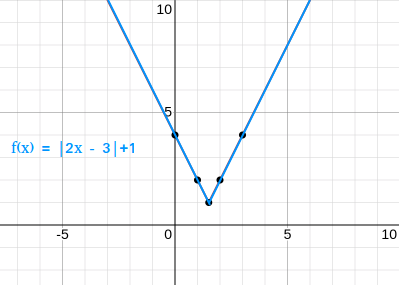
Just like the graph above, graphs of absolute value functions look like angles.
For f(x) = |mx + b| + c, the vertex is always the lowest point (a minimum). The value of |mx + b| is never negative, so f(x) is never smaller than c.
What is the smallest value that f(x) = |x − 5| + 2 can have?
Show answer
2. The smallest value of |x − 5| is 0 (when x = 5), so the smallest value of f(x) is 0 + 2 = 2. The vertex is (5, 2).
Other Examples of Absolute Value Functions
1. y = |x|
m = 1, b = 0, and c = 0
2. y = |x + 1|
m = 1, b = 1, and c = 0
3. y = |4x − 8| − 3
m = 4, b = −8, and c = −3
4. y = |−x|
m = −1, b = 0, and c = 0
5. y = |−x| − 8
m = −1, b = 0, and c = −8
6. y = |−3x + 5| − 4
m = −3, b = 5, and c = −4
For y = |−2x + 6| − 1, find m, b, c and the vertex.
Show answer
m = −2, b = 6, c = −1 and the vertex is (3, −1). The x-coordinate is −6−2 = 3 and the y-coordinate is c.
Summary
- An absolute value function has the form f(x) = |mx + b| + c, where m ≠ 0.
- m is the number in front of x, b is the number added inside the bars, and c is the number added outside. Keep their signs.
- The vertex is at (−bm, c). Its x-coordinate makes the inside of the bars equal to 0.
- The graph looks like a V (an angle), and the vertex is its lowest point.
Test Yourself: 10-Question Quiz
Now check what you learned. Every answer is explained, and each time you play you get new questions.
Quiz Complete!