4th Grade Math Concepts
Find here many important 4th grade math concepts taught in 4th grade. Teachers, parents, and math tutors can also use them as a guideline to illustrate a math lesson or to teach important skills that kids are supposed to know in 4th grade math.
On this page, you will learn
- Prime and composite numbers, factor pairs and estimation
- How to subtract and multiply with an algorithm and use the order of operations
- How to compare, add and decompose fractions, and read decimals to hundredths
- Rays, angles, symmetry, perimeter and area
Whole numbers, factors and estimation
Read whole numbers
Which number can be read as six thousand, four hundred eighty-seven?
- A. 64087
- B. 6087
- C. 6487
- D. 8764
Number line
A straight line on which we put 0 and counting numbers.

Example of prime numbers
A prime number is a number that has only 2 factors, 1 and the number itself. 7 is a prime number because only 1 and 7 can be multiplied to get 7
5, 7, and 13
Composite number
A number with more than 2 factors. Factors of 8 are 1, 2, 4, and 8. 8 is a composite number since it has 4 factors or 4 numbers that can divide it evenly.
12, 9 and 8 are composite numbers.
Factor pairs
A factor pair refers to a set of two numbers when multiplied will yield a specific product.
Factor pairs of 12 are (1, 12), (2, 6), and (3, 4)
Reasonableness
There is no need to do the math. Instead use estimation to eliminate answers that are unreasonable.
What is the product of 47 times 33?
- A. 4514
- B. 1551
- C. 2947
- D. 8114
50 times 30 = 1500, therefore, the answer is 1551
Pattern
What is the next number in the list?
12 15 18
The number 1 is neither prime nor composite, because it has only one factor: 1.
Is 9 a prime number or a composite number?
Show answer
Composite. 9 has 3 factors: 1, 3 and 9. A prime number has only 2.
Subtraction, multiplication and equations
- Ones: 6 is smaller than 8, so regroup 1 ten. The 5 tens become 4 tens, and the 6 ones become 16 ones. 16 − 8 = 8.
- Tens: 4 is smaller than 9, so regroup 1 hundred. The 4 hundreds become 3 hundreds, and the 4 tens become 14 tens. 14 − 9 = 5.
- Hundreds: 3 − 3 = 0.
456 − 398 = 58
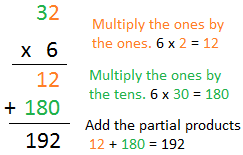
Algorithm for multiplication
Multiplicative comparison
John has 4 tennis balls.
Peter has 5 times as many tennis balls as John.
How many tennis balls do they have together?
Peter has 5 times 4 = 20. Together they have 20 + 4 = 24
Order of operations
3 + (2 + 4) × 5
Do parentheses: 3 + 6 × 5
Do multiplication: 3 + 30
Add: 33
Equation
A mathematical sentence with an equal sign. The equal sign separates the left side from the right side. The amount on the left side of the equation is always equal to the amount on the right side.
4 + 6 = 10
1 + 12 = 13
20 = 9 + 11
Solve an equation
What is the value of b in the equation below?
5 + b = 12
Since 5 + 7 = 12, b = 7
Working from left to right without the order of operations. In 3 + 6 × 5, adding first gives 9 × 5 = 45, which is wrong. Multiply first: 3 + 30 = 33.
Evaluate 2 + (3 + 1) × 4.
Show answer
18. Parentheses first: 3 + 1 = 4. Then multiply: 4 × 4 = 16. Then add: 2 + 16 = 18.
Fractions
Proper fraction
Numerator is smaller than denominator
Improper fraction
Numerator is bigger than or equal to the denominator.

Mixed number
A mixed number has 2 parts. First it has a whole number that is 2. Second, it has a fraction that is 45.

Add mixed numbers


Common denominator
Multiples of 3 are 3, 6, 9, 12, 15, ...
Multiples of 4 are 4, 8, 12, 16, ...
The common denominator is the least common multiple, or 12.

Equivalent fractions

Benchmark fractions in 4th grade math
Fractions that are used frequently to do estimation.

Decompose a fraction
35 = 15 + 15 + 15
Is 77 a proper fraction or an improper fraction?
Show answer
Improper. Its numerator is equal to its denominator, so it is not smaller.
Decimals
Decimal notation for fractions

Decimal
10.50 5.25 61.0 0.40 .333
Decimal point
The decimal point is the dot (.) separating the whole number from the fraction in the decimal notation.

Tenth and hundredth
Tenth: one of the equal parts when a whole is divided into 10 equal parts.
Hundredth: one of the equal parts when a whole is divided into 100 equal parts.

Tenths
The tenths place is shown in red. The 2 means that 2 parts are colored out of 10.
8.29
Hundredths
The hundredths place is shown in red. The 9 means that 9 parts are colored out of 100.
8.29
Comparing decimals
Put the following decimals in order from greatest to least.
4.23 4.24 4.2 4.30 4.19
Answer:
4.30 4.24 4.23 4.20 4.19
Thinking that 4.19 is greater than 4.3 because 19 is greater than 3. Compare the tenths first: 4.3 has 3 tenths and 4.19 has only 1 tenth. Writing 4.3 as 4.30 makes this easier to see.
In 5.63, which digit is in the tenths place?
Show answer
6. The first digit after the decimal point is the tenths place. The 3 is in the hundredths place.
Geometry
Ray
A ray has one endpoint where it starts and it extends forever on the other side.

Intersecting lines

Right triangle
A right triangle has one right angle.

Obtuse angle
An angle bigger than 90 degrees

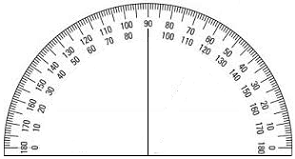


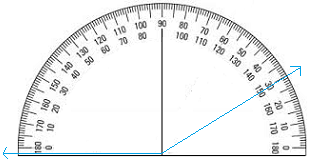
Measure of an angle
The angle on the right measures 150 degrees
Arc
An arc is a part of a circle. The arc is shown in orange.

Circle
In a circle, you can put points anywhere on the purple arc. These points will be at the same distance from the fixed black point called center.

Congruent shapes
Shapes are congruent when they have the same shape and size.

Line of symmetry

An angle measures 120 degrees. Is it an obtuse angle?
Show answer
Yes. 120 degrees is bigger than 90 degrees.
Perimeter, area and measurement
Formulas
Area and perimeter of a rectangle
Perimeter

Perimeter = 2 × length + 2 × width
= 2 × 6 + 2 × 2
= 12 + 4
= 16
Area = 6 × 2 = 12
1 ounce
Each of these has a mass of about 1 ounce:
- A slice of bread
- A CD without the case
- 2 or 3 strawberries, depending on the size
A rectangle is 5 cm long and 3 cm wide. What are its area and its perimeter?
Show answer
Area 15 cm², perimeter 16 cm. Area = 5 × 3 = 15. Perimeter = 2 × 5 + 2 × 3 = 10 + 6 = 16.
Things to keep in mind about the 4th grade math concepts on this page
1. Make sure that students understand most of the math skills above taught in 4th grade math. If you would like to measure their understanding of math skills taught in 4th grade math, please check this 4th grade math test.
2. These 4th grade math concepts are in line with 4th grade math common core state standards.
Summary
- A prime number has exactly 2 factors, and a composite number has more than 2.
- Estimate first to check whether an answer is reasonable: 47 × 33 is close to 50 × 30 = 1500.
- Follow the order of operations: parentheses, then multiplication, then addition.
- A fraction is improper when its numerator is bigger than or equal to its denominator. To compare fractions, rewrite them with a common denominator.
- In a decimal, the first digit after the decimal point is tenths and the second is hundredths.
- For a rectangle, area = length × width and perimeter = 2 × length + 2 × width.
Test Yourself: 10-Question Quiz
Now check what you learned. Every answer is explained, and each time you play you get new questions.
Quiz complete!
Keep learning