3rd Grade Math Concepts
Find here many important 3rd grade math concepts taught in 3rd grade. Teachers, parents, and math tutors can also use them as a guideline to illustrate a math lesson or to teach important skills that kids are supposed to know in 3rd grade math.
On this page, you will learn
- The meaning of key 3rd grade math words, such as factor, product, divisor and quotient
- The identity and commutative properties of addition and multiplication
- Place value, rounding and fractions
- Shapes, perimeter, area and units of length and mass
Numbers and place value
Standard form
The standard form is the base 10 numeration system or the usual way of writing numbers.
24577
Expanded form
The expanded form shows the place value of each digit.
478 = 400 + 70 + 8
Word form of numbers
For example, the word form of 24652 is "twenty-four thousand, six hundred fifty-two"
Round a number
28 is closer to 30, so the nearest 10 is 30.
28 rounded to the nearest 10 is 30.
23 is closer to 20, so the nearest 10 is 20.
23 rounded to the nearest 10 is 20.

Not knowing what to do with a number that ends in 5. A number such as 25 is exactly halfway between 20 and 30. The rule is to round it up, so 25 rounded to the nearest 10 is 30.
Round 64 to the nearest 10.
Show answer
60. 64 is closer to 60 than to 70.
Properties of addition and multiplication
Identity property of addition
Any number plus zero is equal to the number
5 + 0 = 5
2 + 0 = 2
Identity property of multiplication
Any number multiplied by one is equal to the number.
5 × 1 = 5
2 × 1 = 2
Commutative property of addition
The order in which two numbers are added in an addition problem does not matter.

1 + 2 = 2 + 1 = 3
Commutative property of multiplication
The order in which two numbers are multiplied in a multiplication problem does not matter.
6 × 2 = 2 × 6

Mixing up the two identity properties. Adding 0 leaves a number the same, and multiplying by 1 leaves a number the same. Multiplying by 0 does not: any number times 0 is 0.
Which property does 7 × 1 = 7 show?
Show answer
The identity property of multiplication. Multiplying a number by 1 gives the same number.
Adding with the addition algorithm
Addition algorithm
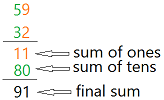
Algorithm for adding 28 and 14
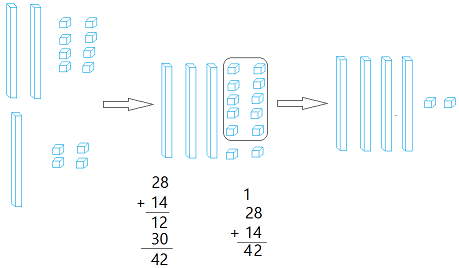
- Add the ones: 8 + 4 = 12.
- Add the tens: 20 + 10 = 30.
- Add the two sums: 12 + 30 = 42.
28 + 14 = 42
Use the addition algorithm to add 47 + 25.
Show answer
72. Ones: 7 + 5 = 12. Tens: 40 + 20 = 60. Then 12 + 60 = 72.
Multiplication and division words
Factors
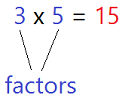
A factor is a number that is multiplied by one or more numbers. For example, in 3 × 5, 5 is a factor since 5 is multiplied by 3. By the same token, 3 is also a factor since it is multiplied by 5.
Product
The answer to a multiplication problem. For example, the product of 3 times 5 is 15.

Division
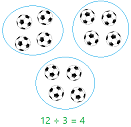
12 ÷ 3
Share 12 soccer balls with 3 friends equally.
Just make 3 equal groups with 12.
The number of balls in each group is the answer.
Dividend
The number that will be divided is the dividend. For example, if 48 is divided by 6, 48 is the dividend.

Divisor
The number that is used to divide. For example if 6 is used to divide 48, 6 is the divisor.

Quotient
The answer to a division problem. For example, when you divide 48 by 6, the answer is 8. So 8 is the quotient.

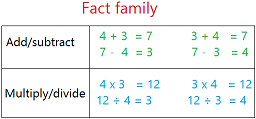
Fact family
A group of 3 numbers that are related in a special way. Doing math with 2 numbers always gives the last number.
Mixing up the dividend and the divisor. In 48 ÷ 6, the dividend is the number being divided (48), and the divisor is the number you divide by (6).
In 35 ÷ 7 = 5, which number is the quotient?
Show answer
5. The quotient is the answer to a division problem.
Expressions and order of operations
Evaluate
Find the value of an expression.
Evaluate 2n + 5 when n = 3
2 × 3 + 5 = 6 + 5 = 11
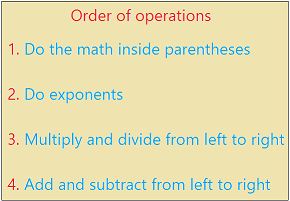
Order of operations
The proper way to do the math or rule to follow when a math problem has a combination of different operators (+, −, ×, etc.).
Evaluate 3n + 4 when n = 2.
Show answer
10. 3 × 2 + 4 = 6 + 4 = 10.
Fractions
Fraction
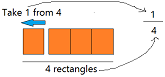
Divide a rectangle into 4 equal smaller rectangles.
Take 1 rectangle out of 4. The fraction is 14.
Unit fraction
A fraction whose numerator is equal to 1. The denominator can be equal to any number.

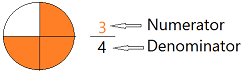
Three fourths
The circle has 4 parts. 3 parts of the circle are shaded.
The numerator is 3 and the denominator is 4.
Equivalent fractions
Equivalent fractions are fractions that have the same value, but have different numerators and denominators.

Is 15 a unit fraction?
Show answer
Yes. Its numerator is 1.
Geometry
Point
A point is an exact location on a piece of paper represented with a single dot
•
Segment
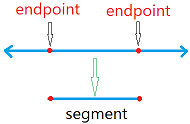
A segment is a portion of a line and it has 2 endpoints.
Parallel lines
Parallel lines never meet no matter how long you extend the lines

Pentagon
A figure that has 5 sides is called a pentagon.

Perimeter
The perimeter is the distance around a closed figure.

Perimeter = 2 cm + 2 cm + 4 cm + 3 cm
= 4 cm + 4 cm + 3 cm
= 8 cm + 3 cm
= 11 cm
Area
The amount of space inside a 2-dimensional object.

Pattern
What is the next shape? The next shape is the green heart.
☺ ♥ ♥ ♦ ☺ ♥
Mixing up perimeter and area. Perimeter is the distance around a figure, so you add the side lengths. Area is the space inside, measured in square units.
Each side of a square is 3 cm long. What is its perimeter?
Show answer
12 cm. 3 cm + 3 cm + 3 cm + 3 cm = 12 cm.
Measurement
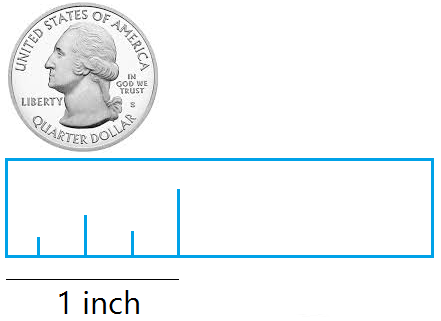
1 inch
1 inch is about the size of a quarter.
1 foot = 12 inches
Gram / kilogram
1 gram is about the mass of 1 paperclip.
1000 grams = 1 kg
About 1000 paperclips will be equivalent to 1 kg.
1 large book could also have a mass of 1 kg.

How many grams are in 2 kg?
Show answer
2000 grams. 1 kg = 1000 grams, so 2 kg = 2 × 1000 = 2000 grams.
Things to keep in mind about the 3rd grade math concepts on this page
1. Make sure that students understand most of the 3rd grade math concepts above taught in 3rd grade math. If you would like to measure their understanding of these math skills taught in 3rd grade math, please check this 3rd grade math test.
2. These 3rd grade math concepts are in line with 3rd grade math common core state standards.
Summary
- A number can be written in standard form (478), expanded form (400 + 70 + 8) or word form.
- To round to the nearest 10, pick the ten the number is closer to. A number ending in 5 rounds up.
- Adding 0 or multiplying by 1 leaves a number the same, and changing the order of two numbers does not change a sum or a product.
- In 3 × 5 = 15, 3 and 5 are factors and 15 is the product. In 48 ÷ 6 = 8, 48 is the dividend, 6 is the divisor and 8 is the quotient.
- A fraction names equal parts of a whole. A unit fraction has a numerator of 1.
- Perimeter is the distance around a figure, and area is the space inside it.
Test Yourself: 10-Question Quiz
Now check what you learned. Every answer is explained, and each time you play you get new questions.
Quiz complete!
Keep learning