Work word problems in physics
Work Word Problems in Physics
These work word problems will show how to calculate the work when the force applied to the object and the displacement of the object are known. You will therefore use the formula w = F × d
In this lesson, you will learn
- how to find work with the formula w = F × d
- why you change kilometers to meters before you use the formula
- how the work changes when the force or the distance changes
- why work can be negative when the force and the movement point in opposite directions
Finding Work With w = F × d
Work is measured in joules (J). 1 joule is the work done by a force of 1 newton over 1 meter, so 1 J = 1 N·m. Always write the distance in meters.
Problem #1:
How many joules of work are done against a cart when a force of 50 N pushes it 1 kilometer away?
Solution:
First convert 1 kilometer to meter. 1 kilometer = 1000 meters.
Then, use the formula w = F × d
w = 50000 joules
Forgetting to change kilometers to meters, or using 1 km = 100 m. There are 1,000 meters in 1 kilometer. If you use 1 instead of 1,000, your answer is 1,000 times too small.
- Change the distance to meters: 3 km = 3 × 1,000 = 3,000 m.
- Use the formula: w = F × d = 120 N × 3,000 m.
- Multiply: 120 × 3,000 = 360,000, so w = 360,000 N·m.
- Since 1 N·m = 1 J, the work is 360,000 joules.
Answer: 360,000 J
A force of 30 N pushes a box 2 kilometers. How much work is done?
Show answer
60,000 J. 2 km = 2,000 m, and 30 N × 2,000 m = 60,000 N·m = 60,000 J.
How the Work Changes When F or d Changes
Problem #2:
Work of 2000 J is required to push an object.
1) Give 2 examples of what F and d could be.
2) How much work is required to push the same object if the distance pushed is 3 times bigger?
3) How much work is required if the force is doubled?
Solution
1) Examples of what F and d could be
2) Pick F = 50 N and d = 40 meters.
If the distance is 3 times bigger, d = 3 times 40 = 120 meters
When the distance is tripled, the work is also tripled
3) Pick F = 200 N and d = 10 meters
If F is 2 times bigger, F = 2 times 200 = 400
When the force is doubled, the work is also doubled
If you multiply the force or the distance by a number, the work is multiplied by the same number. To find a missing force or distance, divide the work by the other one: d = w ÷ F and F = w ÷ d.
Pushing a crate 15 meters takes 600 J of work. What force is used? How much work is needed to push it 30 meters with the same force?
Show answer
40 N and 1,200 J. F = 600 ÷ 15 = 40 N. The distance is 2 times bigger, so the work is 2 × 600 = 1,200 J.
Positive and Negative Work: A Tug of War
Problem #3:
In a tug of war, team x pulled team y with a force of 10000 N a distance of 50 meters. Team y did not win because they were only able to exert a force of 8000 N. Calculate the work of each team.
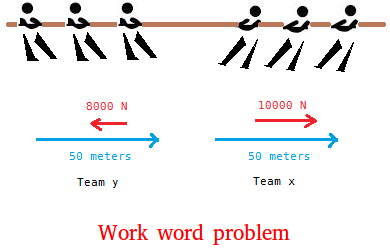
Since the direction may or may not be the same, we will use the formula w = F × d × cos(θ), where θ is the angle between the force and the direction of movement.
The picture above shows the force and direction for both teams.
For team x, the angle between the force and the direction is 0 degrees.
w = 500000 joules
For team y, the angle between the force and the direction is 180 degrees.
w = −400000 joules
Notice that the work is negative for team y.
This is going to be the case when the direction of the force is opposite to the direction of movement.
A sled slides 20 meters forward while friction pulls back on it with a force of 30 N. What is the work done by friction?
Show answer
−600 J. Friction points opposite to the movement, so the angle is 180° and cos(180°) = −1. w = 30 × 20 × (−1) = −600 J.
Summary
- Work equals force times distance: w = F × d.
- Use newtons for the force and meters for the distance. Then the work is in joules (1 J = 1 N·m).
- Multiplying the force or the distance by a number multiplies the work by the same number.
- To find a missing force or distance, divide the work by the other one.
- When the force points opposite to the movement, use w = F × d × cos(180°). The work is negative.
Practice: Solve 5 Work Word Problems
Now solve some problems yourself. Problems 1 and 2 walk you through every step. Problem 3 has fewer steps. In problems 4 and 5, you follow the key steps and find every answer yourself. You can skip a problem at any time, and each time you play you get new problems.
Practice Complete!
Keep learning