What Is Number Theory?
In this lesson, you will learn
- What number theory studies: the patterns in whole numbers
- The key topics: primes, factors, multiples, LCM, GCF and divisibility
- How to use the LCM and divisibility rules to solve real problems
Number Theory: Finding Patterns in Numbers
Number theory, a branch of pure mathematics, is dedicated to understanding the properties and patterns that arise within the set of positive integers.
At its core, number theory helps us discover the beautiful, logical structures hidden within numbers, revealing why they behave in certain ways and how they relate to each other. At its best, number theory can help to protect your privacy and financial information.
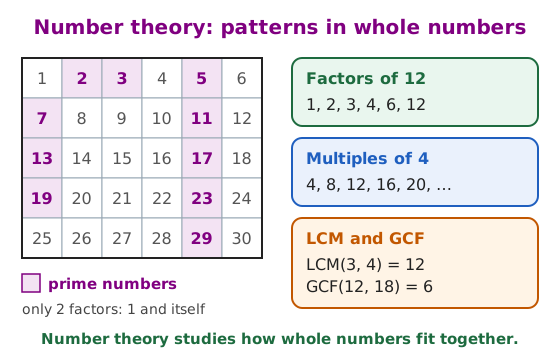
Number theory is all about finding patterns and making sense of them. For instance, if you see a sequence like 2, 4, 6, 8, and 10, it's easy to predict that the next number will be 12 because each term increases by two. Or if you see a pattern in multiplication, such as 2 × 1, 2 × 2, 2 × 3, and so on, you recognize that the next one is simply 2 × 4. Identifying these patterns allows us to predict, understand, and manipulate numbers in ways that simplify many aspects of both mathematics and everyday life.
What is the next number in the pattern 5, 10, 15, 20, …?
Show answer
25. Each term increases by 5: these are the multiples of 5.
Topics in Number Theory
Here are some of the key topics that fall under number theory and how they play a role in helping us uncover number patterns:
- Prime and composite numbers: A prime number is a number greater than 1 that has no divisors other than 1 and itself, while a composite number has more than two divisors. Recognizing these types of numbers is essential in understanding the building blocks of all integers.
- Least common multiple (LCM): This is the smallest number that is a multiple of two or more given numbers. LCM is useful in situations where you need to find a common period, such as aligning schedules or arranging events that recur at different intervals.
- Greatest common factor (GCF): The GCF is the largest number that divides two or more numbers without leaving a remainder. It is useful in dividing things into equal parts or reducing fractions to their simplest form.
- Finding multiples: Multiples are numbers that result from multiplying a given number by whole numbers (1, 2, 3, etc.). Recognizing multiples is helpful in categorizing numbers and setting up recurring events.
- Divisibility tests: These are quick, rule-based ways to determine whether one number can be divided by another without performing the division. Divisibility tests save time and effort, especially with large numbers.
- Counting factors: Counting factors helps in understanding the divisibility of numbers, which is useful in organizing items, grouping, or dividing quantities evenly.
- Using sets to describe patterns: Using sets allows us to group numbers that share common properties, making it easier to recognize patterns and draw conclusions about relationships among numbers.
Thinking that 1 is a prime number. A prime number has exactly two factors, 1 and itself. The number 1 has only one factor, so it is neither prime nor composite.
Each of these concepts has practical applications and helps solve real-world problems by making calculations easier and more predictable. Let's look at some examples that bring these ideas to life.
Problem Example #1: Clowns Waving in Synchrony
Imagine three clowns at a circus:
- The first clown waves every 3 minutes.
- The second clown waves every 4 minutes.
- The third clown waves every 5 minutes.
Click on the Start Waving button to see this in action! So that you do not have to wait an hour, the clowns in the animation wave every few seconds instead of every few minutes, in real time. You can also choose 2 to 6 clowns and how often each clown waves.
If they all start waving at the same time, when will they all wave together again? This problem is a great opportunity to use the least common multiple. By finding the LCM of 3, 4, and 5, you determine when all three intervals will align:
Thus, all three clowns will wave at the same time again after 60 minutes.
3, 4 and 5 share no common factor other than 1, so their LCM is simply their product: 3 × 4 × 5 = 60. When the numbers share a factor, the LCM is smaller than the product, such as LCM(4, 6) = 12, not 24.
Problem Example #2: Least Number of Marbles
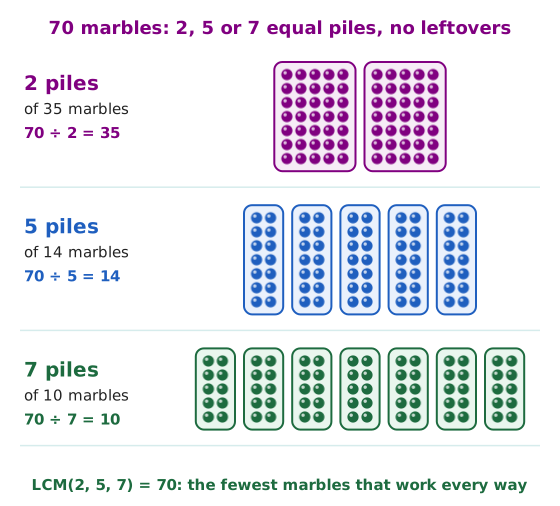
Imagine you have a collection of marbles and need to arrange them in different ways, avoiding leftovers. Here's the problem:
- You need to divide the marbles into 2 equal piles with no extras.
- You also need to be able to split them into 5 equal piles with no leftovers.
- Finally, you want to place them in 7 equal piles without any remaining.
Rather than experimenting with different numbers, you can find the least common multiple (LCM) of 2, 5, and 7 to quickly arrive at the answer: LCM(2, 5, 7) = 70.
So, you need at least 70 marbles to meet all these requirements, since 70 is the smallest number divisible by 2, 5, and 7 without any remainder.
Problem Example #3: Dividing Money with Divisibility Rules
Your father offers to give you some money if you meet two conditions:
- You should be able to share the money among either 2, 3, or 6 people.
- The total amount must be under 100 dollars.
This problem requires divisibility rules, which help us find numbers that can be divided by 2, 3, and 6 with no leftovers. A number divisible by 2 and by 3 is also divisible by 6, so the amount must be a multiple of 6. By applying these rules, you can find possible solutions that satisfy both conditions:
Possible solutions: 6, 12, 18, 24, 30, 36, 42, 48, 54, 60, 66, 72, 78, 84, 90 and 96 dollars.
These amounts allow you to share the money evenly among 2, 3, or 6 people without leftovers, and they're all less than 100 dollars.
- Divisibility by 2: the last digit, 4, is even, so yes.
- Divisibility by 3: the sum of the digits is 8 + 4 = 12, and 12 is divisible by 3, so yes.
- Divisibility by 6: 84 is divisible by both 2 and 3, so yes: 84 ÷ 6 = 14.
84 dollars can be shared evenly among 2, 3 or 6 people.
Can 75 dollars be shared evenly among 6 people?
Show answer
No. 75 is odd, so it is not divisible by 2, and therefore not by 6 (75 ÷ 6 = 12 remainder 3).
The Importance of Patterns in Number Theory
Patterns in number theory are more than just sequences; they represent deeper relationships and properties that govern how numbers interact. For example, understanding prime numbers is crucial for cryptography, which secures digital communications. Similarly, knowing the LCM and GCF helps in optimizing tasks such as resource allocation and scheduling.
Real-Life Applications
- Scheduling events: When planning events that occur at different intervals, LCM helps determine the next time all events will coincide.
- Resource distribution: GCF is used to divide resources into the largest possible equal parts without leftovers.
- Cryptography: Prime numbers form the basis of many encryption algorithms, ensuring secure data transmission.
- Organizing groups: Counting factors assists in grouping people or items into balanced teams or categories.
You have 12 red and 18 blue beads. What is the largest number of identical bags you can make with no beads left over?
Show answer
6 bags. GCF(12, 18) = 6, so each bag gets 2 red and 3 blue beads.
Summary
- Number theory studies the properties and patterns of whole numbers.
- A prime number has exactly two factors, 1 and itself; a composite number has more than two.
- The LCM is the smallest common multiple; use it when events or groups must line up.
- The GCF is the largest common factor; use it to split things into the largest equal groups.
- Divisibility rules tell you quickly whether a number divides evenly, without doing the division.
Test Yourself: Interactive 10-Question Quiz
Now check what you learned. Every answer is explained, and each time you play you get new questions.
Quiz Complete!
Keep learning