What is a logarithm?
What Is a Logarithm?
In mathematics, the logarithm to the base b of a positive number y is defined as follows:
Read logb y as “log base b of y”.
Just like we saw in the lesson about the exponential function, b is not equal to 1 and b is bigger than zero.
Notice that the exponent x in bx is the logarithm in logb y = x.
In this lesson, you will learn
- What a logarithm means in easy terms
- The difference between the common logarithm and the natural logarithm
- How to write an exponential equation in logarithm form
- How logarithms are used, including the Richter scale for earthquakes
What Is a Logarithm in Easy Terms?
Whenever you are looking for the logarithm, you are looking for an exponent, or the number that tells how many times the base is multiplied by itself.
- The base is 5, so ask: what exponent do I put on 5 to get 25?
- 52 = 5 × 5 = 25
log5 25 = 2
- The base is 2, so ask: what exponent do I put on 2 to get 16?
- 24 = 2 × 2 × 2 × 2 = 16
log2 16 = 4
What is log3 81?
Show answer
4. 34 = 3 × 3 × 3 × 3 = 81.
Types of Logarithms
There are two types of logarithms you will use most often: the common logarithm and the natural logarithm.
What is a common logarithm?
A common logarithm is a logarithm that uses base 10.
The common logarithm can be written as log10 y or simply log y. When no base is written, the base is 10.
For example, log10 1000 = 3 because 103 = 1000.
What is a natural logarithm?
A natural logarithm, also called natural log, is a logarithm that uses base e, where e ≈ 2.718281828…
The natural logarithm is written ln y.
What is ln 10? You are looking for a number x such that (2.718281828…)x = 10.
You should use a calculator to find the natural log of a number. This lesson shows how to find the natural log using a calculator. With a calculator, ln 10 ≈ 2.3026.
Thinking log y and ln y are the same. log y uses base 10, while ln y uses base e. For example, log 10 = 1, but ln 10 ≈ 2.3026.
What is log 100?
Show answer
2. No base is written, so the base is 10, and 102 = 100.
Writing in Logarithm Form Using the Exponential Form
The table below shows the same fact written in exponential form and in logarithmic form. The exponent (in red) becomes the answer of the logarithm.
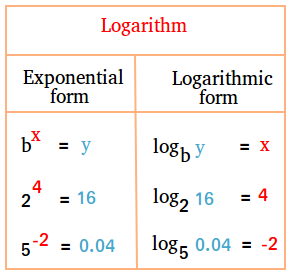
- Write the definition: y = bx means logb y = x
- Substitute: y = 49, b = 7 and x = 2
log7 49 = 2
- Write the definition: y = bx means logb y = x
- Substitute: y = 18, b = 12 and x = 3
log1/2 18 = 3
Write 25 = 32 in logarithm form.
Show answer
log2 32 = 5. The base 2 stays the base, and the exponent 5 is the answer of the logarithm.
What Is a Logarithm Used For?
Scientists use logarithms to:
- measure acidity in substances (pH)
- find the magnitude of earthquakes
- find interest rates
Logarithm, earthquake, and the Richter scale
The Richter scale is commonly used to measure the magnitude of an earthquake. Adding 1 to the magnitude makes the earthquake 10 times more powerful.
An earthquake of magnitude 7 is 1000 times more powerful than an earthquake of magnitude 4 since 107104 = 107 − 4 = 103 = 1000.
Problem: An earthquake of magnitude 7.9 is 11,600 times as strong as an earthquake in the Caribbean. Find the magnitude of the earthquake in the Caribbean.
- Let x be the magnitude of the earthquake in the Caribbean.
- 107.910x = 11,600
- 107.9 − x = 11,600
- Write it in logarithm form: log10 11,600 = 7.9 − x
- Use a calculator: 4.0645 ≈ 7.9 − x
- x ≈ 7.9 − 4.0645 = 3.8355
The earthquake in the Caribbean had a magnitude of about 3.8.
How many times more powerful is an earthquake of magnitude 6 than an earthquake of magnitude 4?
Show answer
100 times. 106 − 4 = 102 = 100.
What Is a Logarithm? FAQs
What is the logarithm of a number?
The logarithm of a number is simply an exponent, or the number of times a base is multiplied by itself to get the number. For example, log6 36 = 2. In other words, the base 6 must be multiplied by itself twice (the exponent is 2) to get 36.
What is a logarithm with base 10 called?
The logarithm with base 10 is called the common logarithm or the decimal logarithm. For example, log10 1000 = 3 is a common logarithm.
Can a logarithm be negative?
Yes, a logarithm can be negative. For example, log4 0.25 = −1. In other words, 4−1 = 14 = 0.25.
While the logarithm (the exponent) can be negative, you cannot take the logarithm of a negative number. For example, log10 (−100) does not exist. Check this lesson to learn more.
Summary
- If y = bx, then logb y = x, where b > 0 and b ≠ 1.
- A logarithm is an exponent: it tells what power of the base gives the number.
- The common logarithm uses base 10 and is written log y.
- The natural logarithm uses base e ≈ 2.718 and is written ln y.
- To change exponential form to logarithm form, the base stays the base and the exponent becomes the answer.
- A logarithm can be negative, but you cannot take the logarithm of a negative number or zero.
- On the Richter scale, each increase of 1 in magnitude means 10 times more powerful.
Test Yourself: 10-Question Quiz
Now check what you learned. Every answer is explained, and each time you play you get new questions.
Quiz complete!