Six Ways of Writing Decimals
In this lesson, you will learn
- The six number forms of a decimal: standard, word, short word, expanded, exponential and scientific form
- How each digit's place value turns into a power of 10
- How to switch between the forms
The Six Number Forms of Decimals
Number forms of decimals are the different ways of writing decimals. See below the six different ways of writing the same decimal number.
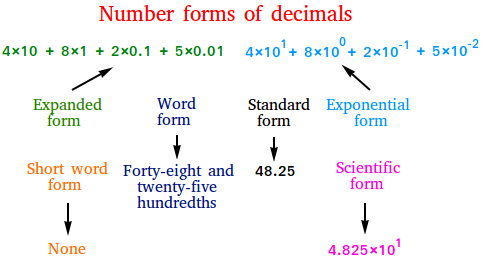
The following table shows the number forms for the decimal number 36.2418. The figure above does not have a short word form for 48.25. However, we do have a short word form for the number 36.2418.
| Number forms | Example |
|---|---|
| Standard form | 36.2418 |
| Word form or written form | thirty-six and two thousand four hundred eighteen ten-thousandths |
| Short word form | 36 and 2418 ten-thousandths |
| Expanded form | (3 × 10) + (6 × 1) + (2 × 0.1) + (4 × 0.01) + (1 × 0.001) + (8 × 0.0001) |
| Exponential form | (3 × 101) + (6 × 100) + (2 × 10⁻¹) + (4 × 10⁻²) + (1 × 10⁻³) + (8 × 10⁻⁴) |
| Scientific form | 3.62418 × 101 |
The short word form writes the whole-number part and the digits after the decimal point with numerals, and only the last place value in words. It saves the most space when a number is long.
Each place has its own power of 10: ones = 100, tens = 101, hundreds = 102, and after the decimal point tenths = 10−1, hundredths = 10−2, thousandths = 10−3, and so on.
In scientific form, the number in front of × must be at least 1 and less than 10. So 36.2418 is 3.62418 × 101, not 36.2418 × 100 or 0.362418 × 10².
Write (4 × 10) + (3 × 1) + (6 × 0.1) + (2 × 0.01) in standard form.
Show answer
43.62. 4 tens, 3 ones, 6 tenths and 2 hundredths.
More Examples Showing the Six Ways of Writing Decimals
Example #1: Show the six different ways of writing 74.5961
Solution
Standard form: 74.5961
Word form: Seventy-four and five thousand nine hundred sixty-one ten-thousandths
Short word form: 74 and 5961 ten-thousandths
Expanded form: (7 × 10) + (4 × 1) + (5 × 0.1) + (9 × 0.01) + (6 × 0.001) + (1 × 0.0001)
Exponential form: (7 × 101) + (4 × 100) + (5 × 10⁻¹) + (9 × 10⁻²) + (6 × 10⁻³) + (1 × 10⁻⁴)
Scientific form: 7.45961 × 101
Example #2: Show the six different ways of writing 681.96743
Solution
Standard form: 681.96743
Word form: Six hundred eighty-one and ninety-six thousand seven hundred forty-three hundred-thousandths
Short word form: 681 and 96743 hundred-thousandths
Expanded form: (6 × 100) + (8 × 10) + (1 × 1) + (9 × 0.1) + (6 × 0.01) + (7 × 0.001) + (4 × 0.0001) + (3 × 0.00001)
Exponential form: (6 × 10²) + (8 × 101) + (1 × 100) + (9 × 10⁻¹) + (6 × 10⁻²) + (7 × 10⁻³) + (4 × 10⁻⁴) + (3 × 10⁻⁵)
Scientific form: 6.8196743 × 10²
- Move the decimal point so that only one nonzero digit is in front of it: 2.158.
- You moved it 2 places to the left, so multiply by 102: 215.8 = 2.158 × 10².
- For the short word form, the last digit 8 is in the tenths place: 215 and 8 tenths.
Scientific form: 2.158 × 10². Short word form: 215 and 8 tenths.
What is the scientific form of 52.7?
Show answer
5.27 × 101. 5.27 is between 1 and 10, and moving the decimal point 1 place to the left means × 101.
Summary
- Standard form is the number written with digits, such as 36.2418.
- Word form writes the number in words; the word "and" stands for the decimal point.
- Short word form uses numerals and names only the last place value: 36 and 2418 ten-thousandths.
- Expanded form writes each digit times its place value; exponential form writes each place value as a power of 10.
- Scientific form is a number from 1 to less than 10 times a power of 10, such as 3.62418 × 101.
Test Yourself: Interactive 10-Question Quiz
Now check what you learned. Every answer is explained, and each time you play you get new questions.
Quiz Complete!