Types of Polygons
Types of Polygons
In this lesson, you will learn
- What a polygon is and how polygons are named by their number of sides
- The sides, diagonals and angle sum of polygons from the triangle to the dodecagon
- The difference between regular and irregular polygons
- How to tell convex, concave and equiangular polygons apart
What Is a Polygon? Names of Polygons by Number of Sides
There are many different types of polygons. To explore them all along with their properties can be a course in itself.
Basically, a polygon is a closed plane figure made of three or more straight sides.
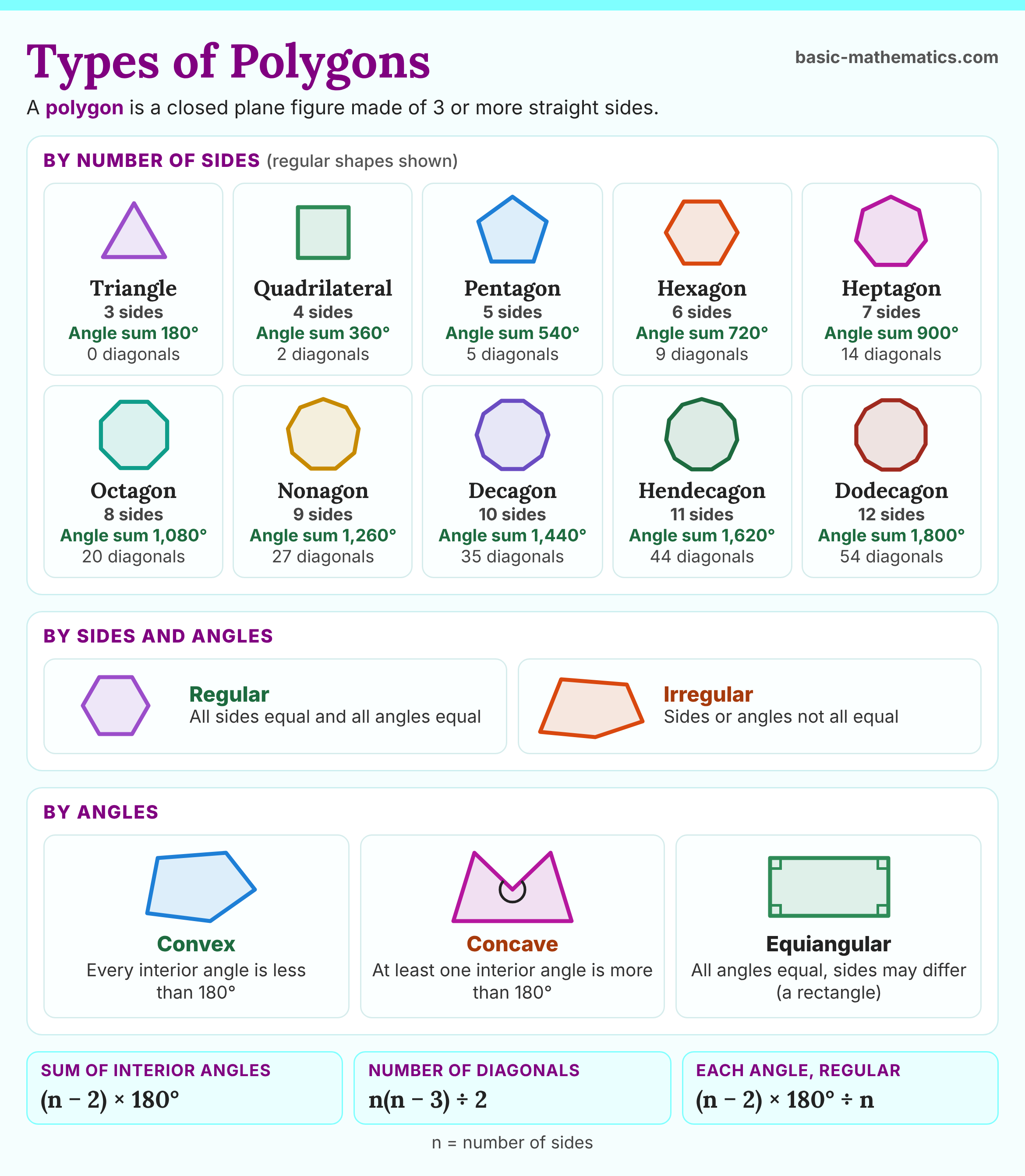
| Number of sides | Name of polygon |
|---|---|
| 3 | triangle |
| 4 | quadrilateral |
| 5 | pentagon |
| 6 | hexagon |
| 7 | heptagon |
| 8 | octagon |
| 9 | nonagon |
| 10 | decagon |
| 11 | hendecagon |
| 12 | dodecagon |
The number of sides, the number of vertices and the number of interior angles of a polygon are always the same.
A polygon has 9 sides. What is it called?
Show answer
A nonagon. "Nona" means nine.
Examples of Polygons and Their Properties
Triangle
A triangle has the following basic properties:
- 3 sides and 3 vertices
- No diagonals
- Sum of the interior angles is 180 degrees
Quadrilateral
A quadrilateral has the following basic properties:
- Four sides and four vertices
- Two diagonals
- Sum of the interior angles is 360 degrees
Pentagon
A pentagon has the following basic properties:
- Five sides and five vertices
- Five diagonals
- Sum of the interior angles is 540 degrees
Hexagon
A hexagon has the following basic properties:
- Six sides and six vertices
- Nine diagonals
- Sum of the interior angles is 720 degrees
Heptagon
A heptagon has the following basic properties:
- Seven sides and seven vertices
- Fourteen diagonals
- Sum of the interior angles is 900 degrees
Octagon
An octagon has the following basic properties:
- Eight sides and eight vertices
- Twenty diagonals
- Sum of the interior angles is 1080 degrees
Nonagon
A nonagon has the following basic properties:
- Nine sides and nine vertices
- Twenty-seven diagonals
- Sum of the interior angles is 1260 degrees
Decagon
A decagon has the following basic properties:
- Ten sides and ten vertices
- Thirty-five diagonals
- Sum of the interior angles is 1440 degrees
Dodecagon
A dodecagon has the following basic properties:
- Twelve sides and twelve vertices
- Fifty-four diagonals
- Sum of the interior angles is 1800 degrees
For a polygon with n sides:
- An octagon has 8 sides, so n = 8.
- Sum of the interior angles: (8 − 2) × 180° = 6 × 180° = 1080°.
- Number of diagonals: 8 × (8 − 3) ÷ 2 = 8 × 5 ÷ 2 = 20.
An octagon has an angle sum of 1080° and 20 diagonals, as in the list above.
Counting the sides as diagonals. A diagonal joins two vertices that are not next to each other, so the sides do not count. That is why a triangle has no diagonals.
What is the sum of the interior angles of a hendecagon (11 sides)?
Show answer
1620°. (11 − 2) × 180° = 9 × 180° = 1620°.
Types of Polygons Based on Their Sides and Angles: Regular and Irregular
If we classify polygons based on their sides and angles, then the polygons are either regular polygons or irregular polygons.
Regular polygons
If a polygon is a regular polygon, all sides are the same and all interior angles are the same.
See below some examples of regular polygons. Starting from left to right and from top to bottom, the regular polygons shown below are the equilateral triangle, the square, the regular pentagon, the regular hexagon, the regular heptagon, the regular octagon, the regular nonagon, and the regular decagon.
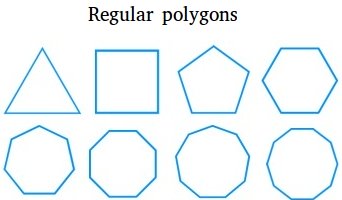
A square is a regular polygon because the sides are equal and each of the four interior angles is equal to 90 degrees.
In a regular polygon with n sides, each interior angle = (n − 2) × 180° ÷ n. For example, each angle of a regular hexagon is 720° ÷ 6 = 120°.
Irregular polygons
If a polygon is an irregular polygon, the sides are not all the same or the interior angles are not all the same.
See below some examples of irregular polygons.
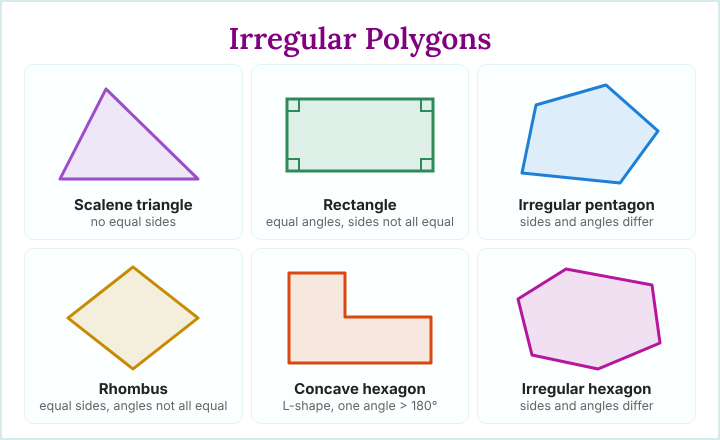
For example, a rectangle is an irregular polygon because only opposite sides are equal although each of the four interior angles is equal to 90 degrees.
Calling a polygon regular because its angles are equal, or because its sides are equal. A regular polygon needs both. A rectangle has equal angles and a rhombus has equal sides, but neither is regular unless it is a square.
A pentagon has five sides of 6 cm, but its angles are not all the same. Is it regular?
Show answer
No, it is irregular. Its sides are equal, but a regular polygon also needs all angles equal.
Types of Polygons Based on Their Angles: Convex, Concave and Equiangular
Polygons can be classified based on the size of the interior angle made by adjacent sides.
If there is an interior angle that is bigger than 180 degrees, the polygon is a concave polygon.
If no interior angle is bigger than 180 degrees, the polygon is a convex polygon.
See the lessons about convex polygons and concave polygons to learn more.
If you can build a polygon so that all interior angles are equal, then the polygon is an equiangular polygon. Notice that the sides of the polygon may not be the same. A rectangle is an equiangular polygon.
One interior angle of a hexagon measures 210°. Is the hexagon convex or concave?
Show answer
Concave. 210° is bigger than 180°, so the polygon "caves in" at that vertex.
More Types of Triangles and Quadrilaterals
A triangle can be further classified into many different types such as scalene triangle, equilateral triangle, isosceles triangle, and so on. See the lesson about types of triangles to learn more.
A quadrilateral can be further classified into many different types such as rectangle, parallelogram, rhombus, trapezoid, and so on. See the lesson about types of quadrilaterals to learn more.
Polygons are all around. Take a close look around you in your house, at the workplace, or in an amusement park, and you will find many real-life examples of polygons.
Summary
- A polygon is a closed plane figure made of three or more straight sides.
- Polygons are named by their number of sides: triangle (3), quadrilateral (4), pentagon (5), hexagon (6), heptagon (7), octagon (8), nonagon (9), decagon (10), hendecagon (11), dodecagon (12).
- For n sides, the angle sum is (n − 2) × 180° and the number of diagonals is n(n − 3) ÷ 2.
- A regular polygon has all sides equal and all angles equal; any other polygon is irregular.
- A concave polygon has an interior angle bigger than 180°; a convex polygon has none. An equiangular polygon has all angles equal.
Test Yourself: 10-Question Quiz
Now check what you learned. Every answer is explained, and each time you play you get new questions and new shapes.
Quiz Complete!
Keep learning