Trigonometric Ratios
In this lesson, you will learn
- how to find the opposite side, the adjacent side and the hypotenuse for an angle
- the six trigonometric ratios: sine, cosine, tangent, cotangent, secant and cosecant
- how the six ratios are related to each other
The Six Trigonometric Ratios Are Only for Right Triangles
Here we will show you the six trigonometric ratios. They are used only for triangles that have a right angle.
If the triangle is not a right triangle, none of the formulas shown below are valid. It is extremely important to keep this in mind.
A triangle is a right triangle if one of the angles is equal to 90 degrees.
Naming the Sides: Opposite, Adjacent and Hypotenuse
First make sure you examine the three right triangles in the diagram below so you understand what the opposite and adjacent sides are.
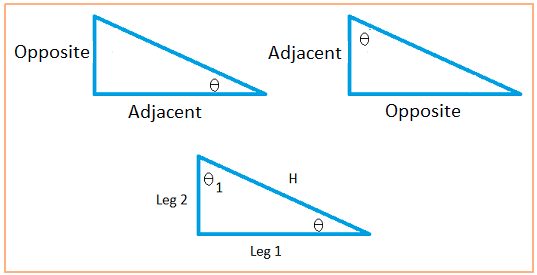
Hypotenuse: the side across from the right angle. It is always the longest side.
Opposite side: the side across from the angle θ.
Adjacent side: the side next to the angle θ that is not the hypotenuse.
The hypotenuse is the side opposite the right angle. In these diagrams, it is the line that is neither vertical nor horizontal.
The two triangles on top do not have any label on the triangles to identify the hypotenuse. However, the hypotenuse is the line that is slanted.
Remember that an angle is made with two sides. The side that is opposite to the angle θ is the side that is not used to create the angle. I hope this helps to identify the opposite side.
The adjacent side is one of the sides that is used to make the angle, but it is not the hypotenuse or the slanted side.
In these diagrams, the adjacent side is going to be either the horizontal side or the vertical side.
Keeping the same names when the angle changes. "Opposite" and "adjacent" depend on which angle you look at: in the third triangle, Leg 2 is opposite θ but adjacent to θ1. Only the hypotenuse never changes.
A right triangle has sides 5, 12 and 13. The angle θ is across from the side of length 5. Which side is adjacent to θ?
Show answer
The side of length 12. 13 is the longest side, so it is the hypotenuse. 5 is opposite θ, so the side left over, 12, is adjacent.
The Six Trigonometric Ratios
Here are the six trigonometric ratios using θ as the angle, and using θ1 as the angle. Leg 1, Leg 2 and H are the sides of the third triangle in the diagram above.
| Ratio | Definition | For angle θ | For angle θ1 |
|---|---|---|---|
| Sine ratio | sin θ = Opposite sideHypotenuse | sin θ = Leg 2H | sin θ1 = Leg 1H |
| Cosine ratio | cos θ = Adjacent sideHypotenuse | cos θ = Leg 1H | cos θ1 = Leg 2H |
| Tangent ratio | tan θ = Opposite sideAdjacent side | tan θ = Leg 2Leg 1 | tan θ1 = Leg 1Leg 2 |
| Cotangent ratio | cot θ = Adjacent sideOpposite side | cot θ = Leg 1Leg 2 | cot θ1 = Leg 2Leg 1 |
| Secant ratio | sec θ = HypotenuseAdjacent side | sec θ = HLeg 1 | sec θ1 = HLeg 2 |
| Cosecant ratio | csc θ = HypotenuseOpposite side | csc θ = HLeg 2 | csc θ1 = HLeg 1 |
cot θ is sometimes written cotan θ.
SOH CAH TOA: Sine = Opposite over Hypotenuse, Cosine = Adjacent over Hypotenuse, Tangent = Opposite over Adjacent. The other three ratios are these three turned upside down. See SOHCAHTOA for more.
- Name the sides: hypotenuse = 5, opposite = 3, adjacent = 4.
- sin θ = 35, cos θ = 45, tan θ = 34.
- Turn them upside down: csc θ = 53, sec θ = 54, cot θ = 43.
sin θ = 3/5, cos θ = 4/5, tan θ = 3/4, cot θ = 4/3, sec θ = 5/4, csc θ = 5/3
A right triangle has sides 8, 15 and 17, and θ is across from the side of length 8. What is cos θ?
Show answer
1517. The hypotenuse is 17 and the side next to θ is 15, so cos θ = adjacent over hypotenuse = 15/17.
Important Observations About the Six Trigonometric Ratios
- The tangent is the ratio of the sine to the cosine.
- The cotangent is the reciprocal of the tangent.
- The cosecant is the reciprocal of the sine.
- The secant is the reciprocal of the cosine.
The reciprocal of a fraction is the fraction turned upside down: the reciprocal of 35 is 53. So if sin θ = 35, then csc θ = 53.
The table also shows that the ratios of θ1 are the ratios of θ in a different order: sin θ1 = cos θ, tan θ1 = cot θ and sec θ1 = csc θ, because the two legs swap roles.
If tan θ = 724, what is cot θ?
Show answer
247. The cotangent is the reciprocal of the tangent, so you turn the fraction upside down.
Summary
- The six trigonometric ratios work only in right triangles.
- The hypotenuse is across from the right angle; the opposite side is across from θ; the adjacent side is next to θ and is not the hypotenuse.
- sin θ = opposite/hypotenuse, cos θ = adjacent/hypotenuse, tan θ = opposite/adjacent (SOH CAH TOA).
- cot θ, sec θ and csc θ are the reciprocals of tan θ, cos θ and sin θ.
- tan θ = sin θ ÷ cos θ, and switching to the other acute angle swaps opposite and adjacent.
Test Yourself: Interactive 10-Question Quiz
Now check what you learned about the six trigonometric ratios. Every answer is explained, and each time you play you get new triangles and questions.
Quiz Complete! 🎉