Standard Deviation Formula
In this lesson, you will learn
- What each symbol in the standard deviation formula means
- When to use the population formula and when to use the sample formula
- How to find the standard deviation in 5 steps
- How to use the short-cut formula
The Standard Deviation Formula and Its Symbols
The standard deviation formula that you will use to find the standard deviation (SD) is shown below.
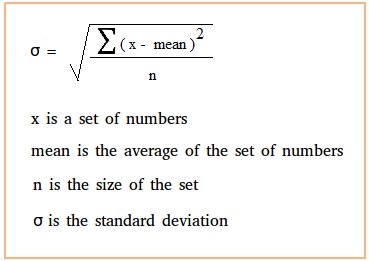
- x represents a set of numbers. For example, x could be {5, 6, 14, 1, 6, 10}.
- The mean is the average of the set of numbers.
- The symbol Σ refers to an addition.
- n is the size of the list or set. For example, for the set above or {5, 6, 14, 1, 6, 10}, n = 6.
- σ is the symbol or the Greek letter sigma used for standard deviation.
In the formula, the expression inside the square root is called variance. Therefore, the standard deviation is the square root of the variance.
The variance of a data set is 25. What is the standard deviation?
Show answer
5. The standard deviation is the square root of the variance, and √25 = 5.
Population Standard Deviation
If you have collected information or a data set from every single member of the population, then you will end up calculating the population standard deviation using the formula below.
- x represents all the numbers in the population.
- µ, the Greek letter mu, is the population mean or the average of all numbers in the population.
- The symbol Σ refers to an addition.
- N is the size of the population.
- σ is the symbol used for standard deviation.
A teacher has the test scores of all 28 students in her class and only wants to describe her class. Which formula should she use, and what is N?
Show answer
The population formula, with N = 28. She has data from every member of the group she cares about, so the class is the population.
Sample Standard Deviation
If you have collected information or a data set from some members of the population, then you will end up calculating the sample standard deviation using the formula below.
- x represents all the numbers in the sample.
- x̄ is the sample mean or the average of all numbers in the sample.
- The symbol Σ refers to an addition.
- n is the size of the sample.
- s is the symbol used for standard deviation.
Notice that the denominator of the variance is n − 1 instead of N in the formula for sample standard deviation. This is an adjustment called Bessel's correction. This division by n − 1 ensures that the sample standard deviation is a good estimate for the population standard deviation. It has been observed by statisticians that when we divide by n, it does not do a good job estimating the population standard deviation. You should use Bessel's correction only if you do not know the population mean and this is usually the case.
Dividing by n when the data is only a sample. For a sample of 10 values, the variance is the sum of the squared differences divided by 10 − 1 = 9, not by 10.
A researcher measures the heights of 20 students in a school of 600 students. Which formula should she use, and what number does she divide by?
Show answer
The sample formula, and she divides by 19. The 20 students are only some members of the population, so she divides by n − 1 = 20 − 1 = 19.
Steps to Follow When Calculating the Standard Deviation
- Step 1: Find the mean of the set of data (mean).
- Step 2: Find the difference between each value and the mean (x − mean).
- Step 3: Square each difference or each answer you got in step 2 (x − mean)2.
- Step 4: Add all the answers you got in step 3 and then divide by the number of answers to get the average. This step will give you the variance.
- Step 5: Take the square root of the average found in step 4.
Dividing by n in step 4 gives the population standard deviation. For a sample, divide by n − 1 in step 4 instead.
The differences from the mean in a data set are −2, 0 and 2. What do you get in step 3?
Show answer
4, 0 and 4. (−2)2 = 4, 02 = 0 and 22 = 4. A squared difference is never negative.
Example: How to Use the Standard Deviation Formula
Using the standard deviation formula, I will now show you how to get the standard deviation step by step.
Let S = {4, 6, 8, 2, 5}
Step 1: Find the mean of S = {4, 6, 8, 2, 5}
mean = 4 + 6 + 8 + 2 + 55
mean = 255 = 5
Step 2: Find the difference between each value in S = {4, 6, 8, 2, 5} and 5
4 − 5 = −1
6 − 5 = 1
8 − 5 = 3
2 − 5 = −3
5 − 5 = 0
Step 3: Square each difference or each answer you got in step 2
(−1)2 = 1
12 = 1
32 = 9
(−3)2 = 9
02 = 0
Step 4: Add 1, 1, 9, 9, and 0. Then divide by 5
1 + 1 + 9 + 9 + 05
205 = 4
Step 5: Take the square root of the average found in step 4. That is the standard deviation
Standard deviation = σ = √4 = 2
- Find the mean: (9 + 15 + 12 + 9 + 15) ÷ 5 = 60 ÷ 5 = 12.
- Find each difference from the mean: −3, 3, 0, −3, 3.
- Square each difference: 9, 9, 0, 9, 9.
- Add the squares: 9 + 9 + 0 + 9 + 9 = 36.
- This is a sample, so divide by n − 1 = 5 − 1 = 4: 36 ÷ 4 = 9. This is the variance.
- Take the square root: √9 = 3.
The sample standard deviation is s = 3.
Find the population standard deviation of {2, 4, 4, 4, 5, 5, 7, 9}.
Show answer
σ = 2. The mean is 40 ÷ 8 = 5. The squared differences are 9, 1, 1, 1, 0, 0, 4 and 16, and their sum is 32. Then 32 ÷ 8 = 4 and √4 = 2.
Short-Cut Formula for the Standard Deviation
Using the short-cut formulas below to find the standard deviation is easier and it will reduce the computation time.
Example Using the Short-Cut Formula
Using the same dataset S = {4, 6, 8, 2, 5} and the short-cut formula, find SD.
Σx2 = 42 + 62 + 82 + 22 + 52
Σx2 = 16 + 36 + 64 + 4 + 25
Σx2 = 145
Σx = 4 + 6 + 8 + 2 + 5
Σx = 25
(Σx)2 = 252
(Σx)2 = 625
Population standard deviation = σ = √Σx2 − (Σx)2NN
Population standard deviation = σ = √145 − 62555
Population standard deviation = σ = √145 − 1255
Population standard deviation = σ = √205
Population standard deviation = σ = √4 = 2
Mixing up Σx2 and (Σx)2. Σx2 means square each number first, then add: 145 in the example. (Σx)2 means add first, then square the total: 252 = 625.
For the data {1, 2, 3}, find Σx2 and (Σx)2.
Show answer
Σx2 = 14 and (Σx)2 = 36. 1 + 4 + 9 = 14, and (1 + 2 + 3)2 = 62 = 36.
Summary
- The standard deviation is the square root of the variance.
- Use the population formula (divide by N) when you have data from every member of the population.
- Use the sample formula (divide by n − 1) when you have data from only some members. This is Bessel's correction.
- To find the standard deviation: find the mean, find each difference from the mean, square the differences, find their average (the variance), then take the square root.
- The short-cut formula uses Σx2 and (Σx)2, and it gives the same answer with less work.
Test Yourself: Interactive 10-Question Quiz
Now check what you learned. Every answer is explained, and each time you play you get new questions.
Quiz complete!