Set-builder notation
Set-Builder Notation
In this lesson, you will learn
- What set-builder notation is, and how to read it
- The difference between set-builder notation and the roster method
- When set-builder notation is the better choice
- How to write sets such as inequalities, multiples, even and odd numbers
What Is Set-Builder Notation?
A set-builder notation describes or defines the elements of a set instead of listing the elements.
For example, the set { 1, 2, 3, 4, 5, 6, 7, 8, 9 } lists the elements.
The same set could be described as { x | x is a counting number less than 10 } in set-builder notation.
We read the set { x | x is a counting number less than 10 } as the set of all x such that x is a counting number less than 10.
When the set is written as { 1, 2, 3, 4, 5, 6, 7, 8, 9 }, we call it the roster method.
The vertical bar | is read "such that". Some books use a colon instead, { x : x > 9 }, or a slash, { x / x > 9 }, as in the figure below. All three mean the same thing.
Write { 2, 4, 6, 8 } in set-builder notation.
Show answer
{ x | x is an even counting number less than 10 }. Other correct answers are possible, such as { x | x = 2n, n is a counting number from 1 to 4 }.
How Set-Builder Notation Works
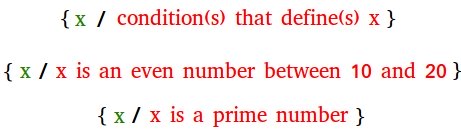
You can list all even numbers between 10 and 20 inside curly braces separated by commas: { 12, 14, 16, 18 }. Again, this is called the roster notation.
However, could you use the roster notation to list all the prime numbers? See now when it is a good idea to use the set-builder notation.
List the elements of { x | x is an odd number between 10 and 20 }.
Show answer
{ 11, 13, 15, 17, 19 }. These are the odd numbers greater than 10 and less than 20.
Why Do We Use Set-Builder Notation?
Some sets are big or have many elements, so it is more convenient to use set-builder notation as opposed to listing all the elements, which is not practical when doing math.
For example, instead of making a list of all counting numbers smaller than 1000, it is more convenient to write { x | x is a counting number less than 1000 }.
It is also very useful to use a set-builder notation to describe the domain of a function.
If f(x) = 2x − 5, the domain of f is { x | x ≠ 5 }.
- You cannot divide by zero, so the bottom, x + 2, must not be 0.
- Find the value that makes it 0: x + 2 = 0 when x = −2.
- Every other real number works, so x can be anything except −2.
Answer: the domain of g is { x | x ≠ −2 }
Which is easier to write: the roster of all counting numbers less than 1000, or the set-builder notation?
Show answer
The set-builder notation. The roster would need 999 numbers, while { x | x is a counting number less than 1000 } fits on one line.
More Examples of Set-Builder Notation
Unless otherwise stated, you should always assume that a given set consists of real numbers.
1) x > 9
{ x | x > 9, x is a real number }
2) The set of all integers that are multiples of five
{ x | x = 5n, n is an integer }
3) { −6, −5, −4, −3, −2, ... }
{ x | x ≥ −6, x is an integer }
4) The set of all even numbers
{ x | x = 2n, n is an integer }
5) The set of all odd numbers
{ x | x = 2n + 1, n is an integer }
Forgetting to say what kind of number x is. { x | x > 9 } contains every real number greater than 9, such as 9.5 and 100.25. If you only want whole numbers, say so: { x | x > 9, x is an integer } = { 10, 11, 12, ... }.
Is 15 in the set { x | x = 2n + 1, n is an integer }?
Show answer
Yes. 15 = 2 × 7 + 1, and 7 is an integer. This set is the set of all odd numbers.
Summary
- Set-builder notation describes the elements of a set with a rule: { x | condition on x }.
- The bar | is read "such that". A colon or a slash is sometimes used instead.
- The roster method lists the elements, such as { 1, 2, 3 }.
- Set-builder notation is the better choice for big or infinite sets, and for the domain of a function.
- Unless stated otherwise, assume x is a real number.
Test Yourself: 10-Question Quiz
Now check what you learned. Every answer is explained, and each time you play you get new questions.
Quiz Complete!
Keep learning