Rule of 72
In this lesson, you will learn
- What the Rule of 72 says, and how to use it
- How to estimate how long it takes money to double
- Why the amount invested does not change the doubling time
- When the Rule of 72 is accurate, and when it is not
The famous "Rule of 72" states that roughly speaking, money will double in (72 ÷ r) years when the money is invested at an annual compounded interest rate of r%.
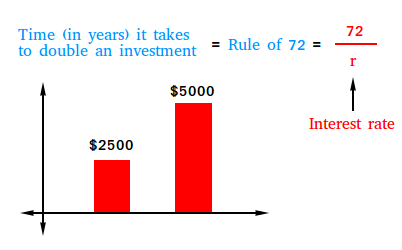
How to Use the Rule of 72
Notice that according to the rule, we are not interested in the amount of money that you will have in your bank account when the money is doubled. We are interested in knowing when the money will be doubled.
Example 1: Suppose you invest money and the compounded annual interest rate is 6%. How long will it take for the money to double?
72 ÷ 6 = 12
The money will double in 72 ÷ 6 years, or 12 years.
Example 2: Suppose instead you invest money and the compounded annual interest rate is 9%. How long will it take for the money to double?
72 ÷ 9 = 8
The money will double in 72 ÷ 9 years = 8 years.
Dividing by the rate as a decimal. For 6%, divide 72 by 6, not by 0.06. Dividing by 0.06 gives 1,200 years, which makes no sense.
About how long does it take money to double at 4% compounded annually?
Show answer
About 18 years. 72 ÷ 4 = 18.
The Amount You Invest Does Not Matter
Finally, notice that it will take the same amount of time for the money to double regardless of the amount you invest as long as the interest rate is the same.
For example, 1 million dollars will take 8 years to double if the compounded annual interest rate is 9%.
By the same token, 100 dollars will take 8 years to double if the compounded annual interest rate is 9%.
Ana invests $50 and Ben invests $5,000, both at 8% compounded annually. Whose money doubles first?
Show answer
Neither: both double in about 9 years. 72 ÷ 8 = 9. Only the rate matters, not the amount.
Higher Rates Double Money Faster
However, the higher the interest rate, the faster the money will double.
On the other hand, the lower the interest rate, the more time it will take for the money to double.
For example, money invested at a rate of 1% interest will take 72 ÷ 1, or 72 years, to double. Imagine that!
Imagine you have 100 dollars in a savings account at a local bank. If they offer 1% compounded annual interest, you will have to wait 72 years to see 200 dollars in the bank.
Yet most banks do not even offer 1%!
- Find the doubling time: 72 ÷ 6 = 12 years.
- Count the doublings: 36 ÷ 12 = 3 doublings.
- Double three times: $1,000 → $2,000 → $4,000 → $8,000.
Answer: about $8,000
You can also use the rule backward to find a rate: to double your money in 10 years, you need about 72 ÷ 10 = 7.2% a year.
What annual rate do you need to double your money in about 6 years?
Show answer
About 12%. 72 ÷ 6 = 12.
How Accurate Is the Rule of 72?
The rule of 72 is not always as accurate as we want it to be.
The rule of 72 gives a very good rough estimate that is close to the real answer when the interest rate is not a big number. However, we get undesired results as we increase the value of the interest rate.
For example, when the interest rate is 25%, according to the rule, it will take 2.88 years for the money to double. However, use the compound interest calculator and enter 10,000 as the principal, 25% in the field that says annual interest rate, 2.88 in the field that says time, and 1 in the field that says interest compounded.
You will notice that the interest is about $9,015 instead of the $10,000 needed to double the money. Therefore, the rule of 72 is off by almost $1,000.
Since even very risky investments do not usually offer a rate higher than 20%, the rule of 72 should give a good estimate as to when your money will double in many cases!
Exact times are for interest compounded once a year, rounded to one decimal place.
For which rate is the Rule of 72 closer to the exact answer: 8% or 30%?
Show answer
8%. The rule works best when the interest rate is not a big number. At 8%, 72 ÷ 8 = 9 years, and the exact time is also about 9 years.
Summary
- The Rule of 72: money doubles in about 72 ÷ r years at an annual compounded rate of r%.
- Divide by the percent number (6 for 6%), not by the decimal.
- The doubling time is the same for any amount; only the rate matters.
- The higher the rate, the faster money doubles. You can also find a rate: 72 ÷ (years to double).
- The rule is a close estimate for small rates and less accurate for big rates such as 25%.
Test Yourself: 10-Question Quiz
Now check what you learned. Every answer is explained, and each time you play you get new questions.
Quiz Complete!