Rationalizing the Denominator of Any Radical Expression
In this lesson, you will learn
- What rationalizing the denominator means
- How to rationalize a denominator with one square root, such as 3√5
- How to use the conjugate when the denominator has two terms, such as 6√5 − √2
What Does Rationalizing the Denominator Mean?
Rationalizing the denominator of a radical expression is the process of removing the radical sign in the denominator of the radical expression.
The reason perhaps mathematicians do this is because they do not like to see a square root sign in the denominator.
Multiplying by a fraction such as √5√5 is multiplying by 1, so it does not change the value of the expression. It only changes how the expression looks. And √5 × √5 = 5, a whole number.
Examples About Rationalizing the Denominator of a Rational Expression
Study the example in the image below carefully before reading the other examples in this lesson.
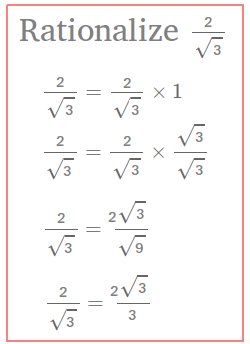
Example #1: Rationalize 3√5
Multiply the numerator and the denominator of the expression above by √5, that is, multiply the expression by:
√5√5
The reason we multiplied the denominator by the square root of 5 is because we want to make the denominator a perfect square.
Notice also that √5√5 = 1.
Therefore, it is like multiplying the expression by 1 which does not change the problem.
3√5 = 3√5 × 1
3√5 = 3√5 × √5√5
3√5 = 3√5√25
3√5 = 3√55
Example #2: Rationalize √2√8n
Multiply the numerator and the denominator of the expression above by √2n, that is, multiply the expression by:
√2n√2n
Notice that if you had multiplied by the square root of 8n, it would still be correct. Multiplying by the square root of 2n will give you smaller numbers to deal with though, and that is better.
√2√8n = √2√8n × √2n√2n
√2√8n = √2 × 2 × √n√8n × 2n
√2√8n = √4 × √n√16n2
√2√8n = 2 × √n4n
√2√8n = √n2n
- The denominator is √2, so multiply by √2√2, which equals 1.
- Numerator: 10 × √2 = 10√2. Denominator: √2 × √2 = √4 = 2.
- Simplify: 10√22 = 5√2, because 10 ÷ 2 = 5.
10√2 = 5√2
Multiplying only the denominator by √5. That changes the value of the expression. Always multiply the numerator and the denominator by the same radical.
Rationalize 4√3.
Show answer
4√33. Multiply by √3√3: the numerator becomes 4√3 and the denominator becomes √9 = 3.
Rationalizing the Denominator of a Rational Expression Using Conjugates
When the denominator has two terms, such as √5 − √2, multiply the numerator and the denominator by its conjugate, √5 + √2. Because (a − b)(a + b) = a2 − b2, the square roots disappear from the denominator.
Example #3: Rationalize 6√5 − √2
Multiply the numerator and the denominator of the expression above by √5 + √2, that is, multiply the expression by:
√5 + √2√5 + √2
6√5 − √2 = 6√5 − √2 × √5 + √2√5 + √2
6√5 − √2 = 6 × (√5 + √2)(√5 − √2)(√5 + √2)
6√5 − √2 = 6 × (√5 + √2)(√5)2 − (√2)2
6√5 − √2 = 6 × (√5 + √2)5 − 2
6√5 − √2 = 6 × (√5 + √2)3
6√5 − √2 = 2 × (√5 + √2)
What should you multiply by to rationalize 4√7 + √3?
Show answer
√7 − √3√7 − √3. The conjugate of √7 + √3 is √7 − √3. Then the denominator is 7 − 3 = 4, and the answer is √7 − √3.
Summary
- Rationalizing the denominator means removing the radical sign from the denominator.
- With one square root in the denominator, multiply the numerator and the denominator by that square root: 3√5 = 3√55.
- Multiplying by a fraction such as √5√5 is multiplying by 1, so the value does not change.
- With two terms such as √5 − √2, multiply by the conjugate √5 + √2: the denominator becomes 5 − 2 = 3.
- Simplify at the end when you can, for example 6 × (√5 + √2)3 = 2(√5 + √2).
Test Yourself: Interactive 10-Question Quiz
Now check what you learned. Every answer is explained, and each time you play you get new questions.
Quiz Complete!