What is a Radical Expression?
In this lesson, you will learn
- What a radical expression is, with numerical and algebraic examples
- How to name the 3 parts: the radical sign, the radicand and the index
- When a root is a real number: even and odd indices
Radical Expression: Definition and Examples
A radical expression is a numerical expression or an algebraic expression that includes a radical.
See below 2 examples of radical expressions.
√x2 + 5 and 105√32
Notice that radical expressions can also have fractions as radicands.
√326 and √3s327s
Is 3x + 7 a radical expression?
Show answer
No. It has no radical sign. 3√x + 7 would be a radical expression.
The 3 Parts of a Radical Expression: Radical Sign, Radicand and Index
There are 3 important pieces of information in any radical expression that are important to identify. These are the radical sign, the radicand, and the index.
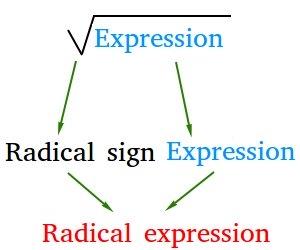
Take a look at the following radical expression.
105√32
- The symbol √ is called a radical sign.
- The numerical expression or algebraic expression within the radical sign is called a radicand. In this case, the radicand is 32.
- The number 5 is called the index.
- The radical sign is √.
- The index is the small number 4, so we are looking for the fourth root.
- The radicand is the number under the radical sign: 81.
- Find the number that gives 81 when it is used as a factor 4 times: 3 × 3 × 3 × 3 = 81.
Index 4, radicand 81, and 4√81 = 3
Calling the 10 in 105√32 the index. The 10 is a number multiplied by the radical. The index is the small number written in the notch of the radical sign: 5.
In 3√−27, what are the index and the radicand?
Show answer
The index is 3 and the radicand is −27. The index sits in the notch of the radical sign; the radicand is under it.
More Information About a Radical Expression and Its Index
An index of 5 means that we are looking for the fifth root. An index of 3 means that we are looking for the cube root. An index of 2 is the square root. Usually, when the index is 2, we do not show the 2.
What if the index is n? Then the expression below means that we are looking for the nth root.
If the index n is even, the radicand a must be nonnegative for the root to be a real number.
For example, the following radical expressions do not have a real number root because the indices are 4 and 2 and these are even numbers.
4√−16 and √−4
If the index n is an odd number, then the radicand does not have to be nonnegative for the root to be a real number.
For example, the following radical expressions still have a real number root since the indices 7 and 5 are odd numbers.
7√−128 and 5√−243
7√−128 = −2 because (−2) multiplied by itself 7 times is −128, and 5√−243 = −3 because (−3)5 = −243. No real number multiplied by itself gives −4, so √−4 is not a real number.
Is 3√−8 a real number? If yes, what is it?
Show answer
Yes, 3√−8 = −2. The index 3 is odd, and (−2) × (−2) × (−2) = −8.
More Examples of Radical Expressions
The following radical expressions have algebraic expressions as radicands.
√16x8
√−16x8 × 4y2 × −2z2
3√−27x12 × −16y15 × −9z9
6√64x24 × 729y36 × 6z12
The following radical expressions have numerical expressions as radicands.
√144
3√−27
√250
√2 + 4 + 3 + 9 + 3 + 5 + 4 + 6
We can add, subtract, multiply, and divide radical expressions.
What is the value of √2 + 4 + 3 + 9 + 3 + 5 + 4 + 6?
Show answer
6. First add under the radical sign: 2 + 4 + 3 + 9 + 3 + 5 + 4 + 6 = 36. Then √36 = 6.
Summary
- A radical expression is a numerical or algebraic expression that includes a radical, such as √x2 + 5 or 105√32.
- The 3 parts are the radical sign √, the radicand (under the sign) and the index (the small number in the notch).
- The index tells which root you want: 2 for the square root (not shown), 3 for the cube root, n for the nth root.
- With an even index, the radicand must be nonnegative for a real root. With an odd index, the radicand can be negative.
Test Yourself: Interactive 10-Question Quiz
Now check what you learned. Every answer is explained, and each time you play you get new questions.
Quiz Complete!