The Quadratic Formula
In this lesson, you will learn
- what the quadratic formula is and when you can use it
- how to find a, b and c and put an equation in standard form first
- how the discriminant tells you how many real solutions there are
- how to solve equations and word problems with the formula
What Is the Quadratic Formula?
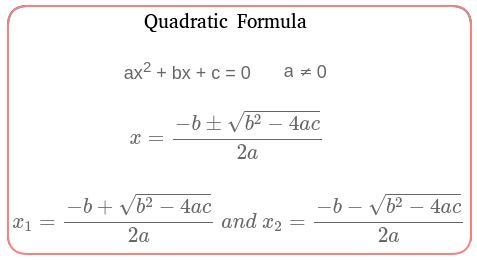
The quadratic formula is a math formula that can be used to solve a quadratic equation that is written in standard form ax2 + bx + c = 0
Notice that the general form of a quadratic equation is ax2 + bx + c = 0 and it is a second order equation in a single variable. Before using the formula shown above, it is important to check two things:
- First, make sure that the coefficient of the leading term is not equal to zero (a ≠ 0). If a is equal to zero, then the equation becomes a linear equation instead.
- Then, make sure that the quadratic equation is indeed written in standard or general form.
The plus or minus sign (±) in the formula is there to show that the quadratic equation may have two solutions (x1 and x2) generally speaking.
Reading a, b and c before the equation is in standard form. In x2 = 5x − 4, the numbers look like b = 5 and c = −4, but in standard form the equation is x2 − 5x + 4 = 0, so b = −5 and c = 4. Always move every term to one side first, and keep the signs with the numbers.
What are a, b and c in 3x2 − 7 = 2x?
Show answer
a = 3, b = −2, c = −7. Subtract 2x from both sides to get the standard form 3x2 − 2x − 7 = 0.
Important Definitions about the Quadratic Formula
- The expression inside the radical symbol or square root sign is called the radicand. Therefore, the radicand in the quadratic formula is b2 − 4ac.
- The discriminant of a quadratic equation in the form ax2 + bx + c = 0 is the value of the expression b2 − 4ac.
- When you are dealing with a function, x1 and x2 are usually called zeros of the function.
- When you are dealing with a quadratic equation, x1 and x2 are usually called solutions or roots of the quadratic equation.
- When you are graphing a quadratic function, (x1, 0) and (x2, 0) are called x-intercepts since these are points where the parabola crosses the x-axis.
In the quadratic formula, what is the radicand?
Show answer
b2 − 4ac. It is the expression under the square root sign, and it is also the discriminant.
The Discriminant
The expression b2 − 4ac, called the discriminant, shows the nature of the solutions.
It is common to use the symbol Δ (delta from the Greek alphabet) when talking about the discriminant.
If Δ or the discriminant is zero, then it makes no difference whether we choose the plus or the minus sign in the formula.
In this case, we say that there is one repeated real solution.
If Δ or the discriminant is positive, then there will be two real solutions.
If Δ or the discriminant is negative, then we will end up taking the square root of a negative number. In this case, there will be two imaginary-number solutions called complex numbers.
Discriminant
For ax2 + bx + c = 0:
Δ = b2 − 4ac = 0 ⟶ One real-number solution
Δ = b2 − 4ac > 0 ⟶ Two different real-number solutions
Δ = b2 − 4ac < 0 ⟶ No real solution, but two different imaginary-number solutions.
Check the lesson about discriminant of the quadratic equation to see what the graph of a quadratic equation looks like when the discriminant is either zero, positive, or negative.
How many real solutions does 2x2 + 3x + 5 = 0 have?
Show answer
None. Δ = 32 − 4(2)(5) = 9 − 40 = −31. The discriminant is negative, so there are no real solutions.
Using the Quadratic Formula to Solve a Quadratic Equation
Solve x2 − 5x + 4 = 0 using the quadratic formula
a = 1, b = −5, and c = 4
and
and
and
The roots of the equation x2 − 5x + 4 = 0 are x1 = 4 and x2 = 1
Please check the lesson about solve using the quadratic formula to see more examples.
- The equation is already in standard form, so a = 2, b = 1 and c = −6.
- Find the discriminant: Δ = 12 − 4(2)(−6) = 1 + 48 = 49. It is positive, so there are two real solutions, and √49 = 7.
- Use the formula:
- Find both solutions: and
- Check x = −2: 2(−2)2 + (−2) − 6 = 8 − 2 − 6 = 0.
x1 = 32 and x2 = −2
Solve x2 + 2x − 8 = 0 using the quadratic formula.
Show answer
x = 2 and x = −4. Δ = 4 + 32 = 36 and √36 = 6, so x = (−2 ± 6) ÷ 2, which gives 2 and −4.
Applications
Example #1
Suppose a soccer player shoots a penalty kick with an initial velocity of 28 ft/s. When will the ball reach a height of 30 feet?
Solution
The function h = −16t2 + vt + s models the height h in feet of the ball at time t in seconds.
The velocity is v and s is the initial height of the ball.
Since the soccer ball must be on the ground before the soccer player shoots the ball, s is equal to 0.
v = 28 ft/s
h is the height of the ball
30 = −16t2 + 28t
Since the standard form of a quadratic equation is ax2 + bx + c = 0, you need to put 30 = −16t2 + 28t in standard form.
Subtract 30 from both sides of the equation
30 − 30 = −16t2 + 28t − 30
0 = −16t2 + 28t − 30
−16t2 + 28t − 30 = 0
Find the values of a, b, and c and then evaluate the discriminant.
a = −16, b = 28 and c = −30
Δ = b2 − 4ac = 282 − 4(−16)(−30)
Δ = b2 − 4ac = 784 + 64(−30)
Δ = b2 − 4ac = 784 − 1920
Δ = b2 − 4ac = −1136
Since the discriminant is negative, the equation 30 = −16t2 + 28t has no real solutions.
Therefore, the ball will not reach a height of 30 feet.
Example #2
Find the dimensions of a square that has the same area as a circle whose radius is 10 inches.
Solution
Let x be the length of one side of the square. Then, the area of the square is x2
The area of the circle is πr2 = 3.14(10)2 = 3.14(100) = 314
x2 = 314
x2 − 314 = 0
x2 − 0x − 314 = 0
a = 1, b = 0, and c = −314
Δ = b2 − 4ac = 02 − 4(1)(−314)
Δ = b2 − 4ac = 1256
√Δ = √(1256) = 35.44
The length of one side of the square is 17.72 inches
In a word problem, check that each solution makes sense. A length cannot be negative, so x2 = −17.72 is rejected and only 17.72 inches is the answer.
A square has an area of 49 square inches. Solve x2 − 49 = 0 to find the length of one side.
Show answer
7 inches. Δ = 0 − 4(1)(−49) = 196 and √196 = 14, so x = ±14 ÷ 2 = ±7. A length cannot be negative, so the side is 7 inches.
Summary
- The quadratic formula solves any quadratic equation in standard form ax2 + bx + c = 0 with a ≠ 0.
- Write the equation in standard form before you read a, b and c, and keep the signs.
- The discriminant Δ = b2 − 4ac tells you the number of real solutions: two if Δ > 0, one if Δ = 0, none if Δ < 0.
- The ± sign gives the two solutions x1 and x2, also called roots or zeros.
- In word problems, reject solutions that do not make sense, such as a negative length.
Test Yourself: 10-Question Quiz
Now check what you learned. Every answer is explained, and each time you play you get new questions.
Quiz Complete!