Permutations
Permutations are ordered arrangement of objects. We have some good illustrations for you here! For example, there are 24 ways to arrange or put 4 books in 4 boxes as shown in the figure below:
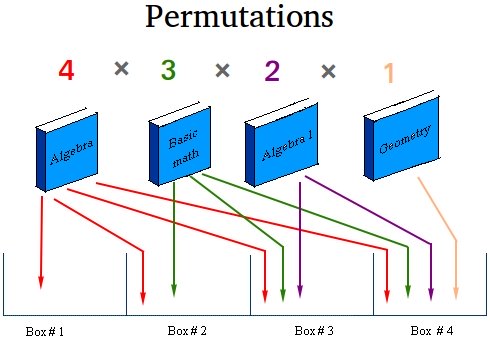
Objects stand for anything you are trying to arrange or put in a certain order.
Other examples of arrangements are:
- You have 5 CDs. How many different ways can you listen to them?
- You are seating 3 people on 3 chairs. How many different ways can people sit?
- You have 6 books to read. How many different ways can you read your books?
You can use the fundamental counting principle to find out how many different permutations or arrangements you can have.
Before solving the situations above, let us make sure you understand how many different ways there are to arrange 4 books in 4 boxes.


Say you put algebra in box #1

This means you have 3 choices to place your next book. Say that you put basic math in box #2

Say that you put the algebra 1 book in box #3


Now to find the total number of arrangement, you need to multiply all your choices as seen in the fundamental counting principle.
Number of permutations = 4 × 3 × 2 × 1 = 24
More examples showing how permutations work
Let us now solve the situations above.
The first person has 3 choices
Once the first person sits, there are only 2 seats left.
Thus, the second person who sits has 2 choices
The last person has 1 choice
The number of ways people can sit = 3 × 2 × 1 = 6 ways
How many different ways can you listen to five CDs?
Assuming you do not listen twice to a CD, you have 5 choices to listen to the first CD.
4 choices to listen to the second CD
3 choices to listen to the third CD
2 choices to listen to the fifth CD
1 choice for the last CD
So you have 5 × 4 × 3 × 2 × 1 = 120 different ways to listen to the 5 CDs