Multiplying Mixed Numbers
In this lesson, you will learn
- What a mixed number is
- How to convert a mixed number into an improper fraction
- How to multiply mixed numbers and write the answer in simplest form
- How to simplify before you multiply to save work
What Is a Mixed Number?
Multiplying mixed numbers is what you will learn here with some easy-to-follow examples.
A mixed number, also called mixed fraction, is any number that has the following format: 9 34. It is called mixed because it is a mixture of a whole number and a proper fraction.
In our example, the whole number is 9.
The proper fraction is 34.
Writing an improper fraction after the whole number. In a mixed number, the fraction part is always a proper fraction: its numerator is smaller than its denominator. So 4 35 is a mixed number, but "4 32" and "7 55" are not.
Converting a Mixed Number into an Improper Fraction
It is extremely important to convert a mixed number into an improper fraction before doing the multiplication.
We show you next how to convert a mixed number into an improper fraction using the mixed number above.
- Multiply the whole number by the denominator of the fraction: 9 × 4 = 36.
- Add the result of step 1 to the numerator of the fraction: 36 + 3 = 39.
- Your numerator is the answer of step 2. Your denominator stays the same. The fraction is 394.
- Finally, simplify the improper fraction you found in step 3 if needed.
Convert 5 23 into an improper fraction.
Show answer
173. 5 × 3 = 15, and 15 + 2 = 17. The denominator stays 3.
Examples About Multiplying Mixed Numbers
Now, you are ready to multiply mixed numbers with a couple of good examples.
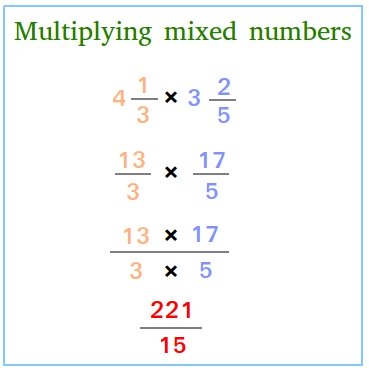
If you did not understand the examples in the figure above, just keep reading.
Example #1: 2 16 × 4 35
Rewrite each mixed number as an improper fraction by following the steps outlined above.
Here is how for 2 16:
Step 1. Multiply the whole number by the denominator of the fraction: 2 × 6 = 12
Step 2. Add the result of step 1 to the numerator of the fraction: 12 + 1 = 13
Step 3. Your numerator is the answer of step 2. Your denominator stays the same.
The fraction is 136, and it is already in simplest form.
Here is how for 4 35:
Step 1. Multiply the whole number by the denominator of the fraction: 4 × 5 = 20
Step 2. Add the result of step 1 to the numerator of the fraction: 20 + 3 = 23
Step 3. Your numerator is the answer of step 2. Your denominator stays the same.
The fraction is 235, and it is already in simplest form.
Now just multiply the fractions. Do this by multiplying the numerators together and the denominators together.
136 × 235 = 13 × 236 × 5 = 29930
Sometimes, teachers or textbooks may ask you to write your answer as a mixed number. So feel free to rewrite 29930 as a mixed number: 299 ÷ 30 = 9 with a remainder of 29, so 29930 = 9 2930.
Example #2: 7 12 × 4 23
Convert the mixed numbers:
7 12 = 7 × 2 + 12 = 152
4 23 = 4 × 3 + 23 = 143
Multiply:
152 × 143 = 15 × 142 × 3 = 2106
And 2106 = 35.
- Convert 1 34: 1 × 4 = 4, 4 + 3 = 7, so 1 34 = 74.
- Convert 2 25: 2 × 5 = 10, 10 + 2 = 12, so 2 25 = 125.
- Multiply the numerators and the denominators: 7 × 124 × 5 = 8420.
- Simplify: 84 and 20 are both divisible by 4, so 8420 = 215.
- Write it as a mixed number: 21 ÷ 5 = 4 with a remainder of 1, so 215 = 4 15.
1 34 × 2 25 = 4 15
Multiplying the whole numbers and the fractions separately. For 1 34 × 2 25, 1 × 2 = 2 and 34 × 25 = 620 do not give the answer. Convert to improper fractions first: the right answer is 4 15.
Multiply 1 12 × 2 13.
Show answer
72 = 3 12. 32 × 73 = 216 = 72.
A Shortcut: Simplify Before You Multiply
Sometimes, multiplying mixed numbers is a piece of cake with some good observations. Look at example #2 again: 152 × 143.
If you notice that 15 divided by 3 is 5 and 14 divided by 2 is 7, you can just multiply 5 and 7 to get 35. Swapping the two denominators is allowed, because both ways you get 15 × 142 × 3.
152 × 143 = 153 × 142 = 5 × 7 = 35
Between the whole number and the fraction of a mixed number, there is always a + sign: 7 12 means 7 + 12. That is why you cannot multiply the whole numbers and the fractions separately.
Multiply 94 × 83 by simplifying first.
Show answer
6. 9 ÷ 3 = 3 and 8 ÷ 4 = 2, so the product is 3 × 2 = 6.
Summary
- A mixed number is a whole number plus a proper fraction, such as 9 34 = 9 + 34.
- To convert it into an improper fraction: whole number × denominator + numerator, over the same denominator.
- Convert every mixed number before you multiply.
- Multiply the numerators together and the denominators together, then simplify.
- If you are asked for a mixed number, divide the numerator by the denominator: the quotient is the whole number and the remainder is the new numerator.
Test Yourself: Interactive 10-Question Quiz
Now check what you learned. Every answer is explained, and each time you play you get new questions.
Quiz Complete!
Keep learning