Inclination of a Line
In this lesson, you will learn
- what the inclination (angle of inclination) of a line is
- how the sign of the slope tells you if the inclination is acute or obtuse
- why the slope and the inclination are linked by m = tan θ
- how to find the slope from the inclination, and the inclination from the slope
What Is the Inclination of a Line?
The inclination of a line or angle of inclination is the acute, right, or obtuse angle that is formed when a nonhorizontal line intersects the x-axis.
Formal definition: The inclination of a nonhorizontal line is the positive angle θ with θ less than 180 degrees and measured counterclockwise from the positive x-axis to the line.
Can the inclination of a line be 200 degrees?
Show answer
No. The inclination is always less than 180 degrees.
Positive Slope or Negative Slope: Acute or Obtuse Angle?
In the figure below, there are two angles. However, the angle in blue is the angle of inclination since it is measured counterclockwise according to the definition. We see that the slope is positive.
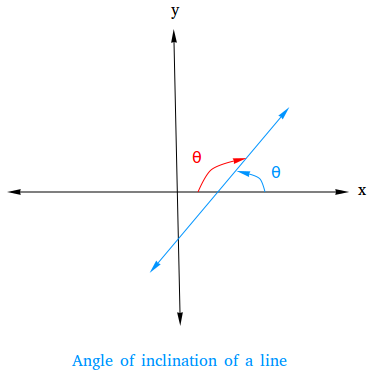
When the slope is positive, the angle of inclination is an acute angle.
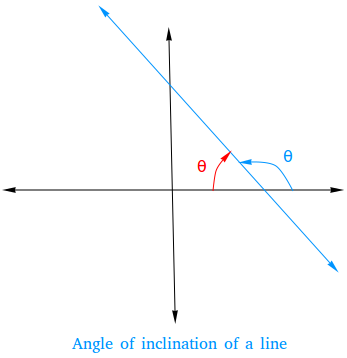
In the figure above, you can again see that there are two angles. The angle in blue is once again the angle of inclination since it is measured counterclockwise according to the definition.
Notice though that this time the angle is bigger than 90 degrees and the slope is negative.
When the slope is negative, the angle of inclination is an obtuse angle.
The four angles formed at the x-axis
Notice also that when a line intersects with the x-axis, 4 angles are formed as shown below.
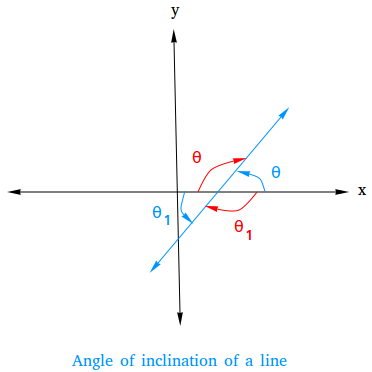
However the angles in blue are vertical angles and therefore have the same measure. By the same token, the angles in red are vertical angles and also have the same measure. Therefore, we only need to concern ourselves with θ and θ.
θ is not the angle of inclination, so we are left with θ.
Picking the red angle, which opens to the left of the line. The angle of inclination always starts at the positive x-axis (the part to the right of the crossing point) and turns counterclockwise until it reaches the line.
A line has slope −3. Is its angle of inclination acute or obtuse?
Show answer
Obtuse. The slope is negative, so the angle of inclination is between 90 and 180 degrees.
The Slope and the Inclination: m = tan θ
The relationship between the slope of a line and its inclination is given by the following equation.
m is the slope of the line and θ is its angle of inclination. The equation works for every line that is not vertical.
A line has inclination 0 degrees. What is its slope?
Show answer
m = 0. tan 0° = 0, so the line is horizontal.
How to Derive the Equation Relating the Inclination of a Line to the Slope (m = tan θ)
Slope is positive
Consider the following figure. Point (x1, 0) intersects the x-axis and (x2, y2) is another point on the line.
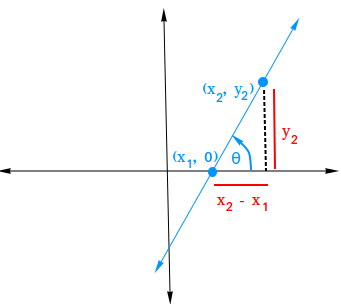
If m = 0, θ = 0 since the line is horizontal. Therefore, the result is true for horizontal lines since m = 0 = tan 0.
If the line has a positive slope, then
Combining equation I and equation II, we get m = tan θ.
Slope is negative
Consider the following figure. Point (x1, 0) intersects the x-axis and (x2, y2) is another point on the line.
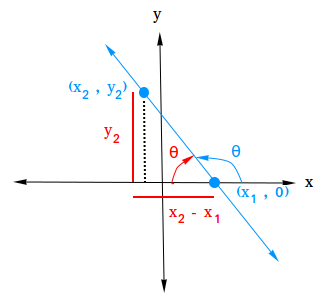
Key concept: θ is the reference angle for θ, so θ = 180° − θ.
Therefore, sin(θ) = sin(θ). For example, sin(120°) = sin(60°) ≈ 0.8660254038.
However, the cosines have opposite signs, so tan(θ) = −tan(θ). For example, tan(120°) = −tan(60°) ≈ −1.732.
In the right triangle, the side opposite θ is y2. The side next to θ lies on the x-axis, and its length is x1 − x2, because x1 is bigger than x2 here.
Combining equation I and equation II, we get m = tan θ.
Is tan(150°) equal to tan(30°) or to −tan(30°)?
Show answer
−tan(30°). 30° is the reference angle for 150°. The sines are equal, but the tangents have opposite signs.
Exercises on How to Find or Calculate the Angle of Inclination
1) A vertical line
When the line is vertical, the inclination of a line is 90 degrees. In this case, there is no answer for the slope.
2) A horizontal line
When the line is horizontal, the inclination of a line is 0 degrees.
3) Find the slope when the inclination of a line is 45 degrees
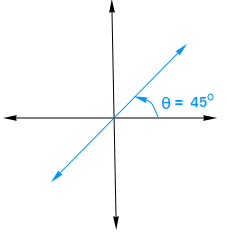
m = tan θ = tan 45°
Type 45 degrees and use the tan key on a scientific calculator. You will see that tan(45°) = 1.
m = 1
Now suppose, you are given a slope of 1 and want to find the angle of inclination.
θ = tan−1(1)
Type 1 and use the tan−1 key on a scientific calculator. You will see that θ = tan−1(1) = 45 degrees.
4) Find the slope when the inclination of a line is 135 degrees
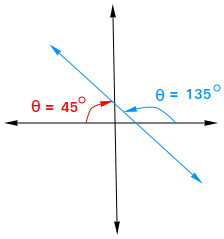
m = tan θ = tan 135°
Type 135 degrees and use the tan key on a scientific calculator. You will see that tan(135°) = −1.
m = −1
Now suppose, you are given a slope of −1 and want to find the angle of inclination. Find tan−1(−1).
Type −1 and use the tan−1 key on a scientific calculator. You will see that tan−1(−1) = −45 degrees.
As you can see, −45 degrees is not the 135 degrees angle we started with. To get 135 degrees, you need to add 180 degrees to −45 degrees.
When the slope is negative, θ = 180° + tan−1(−1) = 180° + (−45°) = 135°
Positive slope: θ = tan−1(m). Negative slope: θ = 180° + tan−1(m).
Giving the calculator answer −45° as the inclination. An angle of inclination is never negative. When the slope is negative, add 180° to the calculator answer.
- The slope is negative, so the angle of inclination is obtuse.
- Use the tan−1 key: tan−1(−√3) = −60°.
- Add 180°: θ = 180° + (−60°) = 120°.
- Check: tan(120°) = −tan(60°) = −√3. This is the slope we were given.
θ = 120°
Find the angle of inclination of a line with slope √3.
Show answer
60°. The slope is positive, so θ = tan−1(√3) = 60°.
For more exercises, check this website.
Summary
- The inclination of a line is the angle θ measured counterclockwise from the positive x-axis to the line, with 0° ≤ θ < 180°.
- Positive slope: the inclination is acute. Negative slope: the inclination is obtuse.
- A horizontal line has inclination 0°. A vertical line has inclination 90° and no slope.
- The slope and the inclination are linked by m = tan θ.
- To find θ from m, use tan−1(m), and add 180° when the slope is negative.
Test Yourself: Interactive 10-Question Quiz
Now check what you learned. Every answer is explained, and each time you play you get new questions.
Quiz Complete! 🎉