Identity Property of Multiplication
In this lesson, you will learn
- What the identity property of multiplication says: a × 1 = a
- What multiplicative inverses (reciprocals) are
- The identity property of division: a ÷ 1 = a
What Is the Identity Property of Multiplication?
The identity property of multiplication, also called the multiplication property of one, says that a number does not change when that number is multiplied by 1.
You can see this property readily with a printable multiplication chart. Display the chart in front of your student and have them look at the products in the first row or column.
Again, as you can see in the figure below, the concept says that any number multiplied by 1 gives the same number.
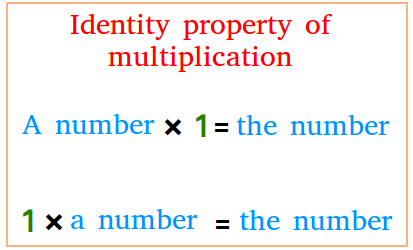
To help students get the point, I usually pick a very big number such as 25 billion and tell them to multiply this number by 1.
If they get the point, they will say 25 billion, and it proves that the size of the number does not matter.
Believe it or not, some students were confused and gave me a different answer. I hope you got the point!
The number 1 is called the multiplicative identity: multiplying by 1 keeps the identity of a number. Do not mix it up with the zero property: a × 0 = 0.
Other Examples Showing the Identity Property of Multiplication
- 3 × 1 = 3
- −20 × 1 = −20
- 1 × y = y
- 10 × 1 = 10
- 6 × 1 = 6
- −z × 1 = −z
- 68 × 1 = 68
- 1 × 4 = 4
- 1 × (−9) = −9
- x × 1 = x
- (a + b) × 1 = a + b
Adding 1 instead of multiplying by 1: 45 × 1 is 45, not 46. Only 45 + 1 = 46.
What is 1 × 3,750?
Show answer
3,750. Multiplying by 1 does not change the number, and the order does not matter.
Multiplicative Inverse Property
If you multiply two numbers and the product is 1, we call the two numbers multiplicative inverses or reciprocals of each other.
For example, 4 is the multiplicative inverse of 14 because 4 × 14 = 1.
14 is also the multiplicative inverse of 4 because 14 × 4 = 1.
Notice that the multiplicative inverse of 1 is 1 since 1 × 1 is 1. By the same token, the multiplicative inverse of −1 is −1 since (−1) × (−1) is 1. In fact, 1 and −1 are the only two numbers that can be their own multiplicative inverse.
To find the reciprocal of a fraction, flip it: the reciprocal of 23 is 32, because 23 × 32 = 66 = 1. The number 0 has no reciprocal, because 0 times any number is 0, never 1.
- Flip the fraction: the reciprocal of 58 is 85.
- Check: 58 × 85 = 4040 = 1.
The multiplicative inverse of 58 is 85.
What is the multiplicative inverse of 7?
Show answer
17. 7 × 17 = 1.
Identity Property of Division
Notice also that any number divided by 1 returns the same number. We call this the identity property of division.
A few examples showing the identity property of division:
- 2 ÷ 1 = 2
- x ÷ 1 = x
- −5 ÷ 1 = −5
- 50 ÷ 1 = 50
- −x ÷ 1 = −x
The order matters in division: 8 ÷ 1 = 8, but 1 ÷ 8 = 18. Only dividing by 1 keeps the number the same.
Summary
- Identity property of multiplication: a × 1 = a and 1 × a = a.
- 1 is the multiplicative identity; the size or sign of the number does not matter.
- Two numbers are multiplicative inverses (reciprocals) when their product is 1, such as 4 and 14.
- 1 and −1 are their own inverses, and 0 has no inverse.
- Identity property of division: a ÷ 1 = a.
Test Yourself: Interactive 10-Question Quiz
Now check what you learned. Every answer is explained, and each time you play you get new questions.
Quiz Complete!