Finding the Perimeter
In this lesson, you will learn
- what the perimeter of a shape is
- how to find the perimeter of polygons by adding the lengths of the sides
- how to find the perimeter of a shape on a grid, using the Pythagorean theorem for slanted sides
- how to find missing side lengths before finding the perimeter
Finding the Perimeter of a Polygon by Adding the Sides
Finding the perimeter of a shape means that you are looking for the distance around the outside of that shape.
Example #1: Find the distance around the following irregular polygon

Distance around = 5 inches + 4 inches + 2 inches + 3 inches + 6 inches = 20 inches
Example #2: Find the distance around the following trapezoid

Distance around = 5 inches + 8 inches + 4 inches + 3 inches = 20 inches
Example #3: Find the distance around the following triangle

Distance around = 5 inches + 4 inches + 2 inches = 11 inches
Example #4: Find the distance around the following rectangle

Distance around = 3 inches + 3 inches + 6 inches + 6 inches = 18 inches
Example #5: Find the distance around the following square

Distance around = 5 inches + 5 inches + 5 inches + 5 inches = 20 inches
You can get the same answer by doing 4 × 5 = 20
Skipping a side or adding the same side twice. Start at one corner, go all the way around the shape, and add each side exactly once.
A triangle has sides of 6 m, 8 m and 10 m. What is its perimeter?
Show answer
24 m. 6 m + 8 m + 10 m = 24 m.
Finding the Perimeter of a More Interesting Shape Such as a House by Counting Unit Squares
How would you find the perimeter of the shape below looking like a house?
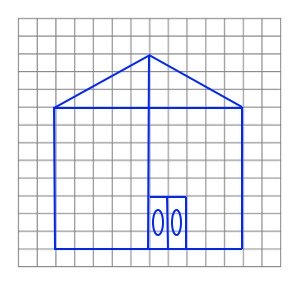
Remember that the perimeter is the distance around the shape. Therefore, you will need to ignore some of the lines and some of the shapes.
Some of these lines or shapes are there to distract or confuse you. For example, you need to ignore the door and the two lines inside the house. Below, we show the length of 3 sides.
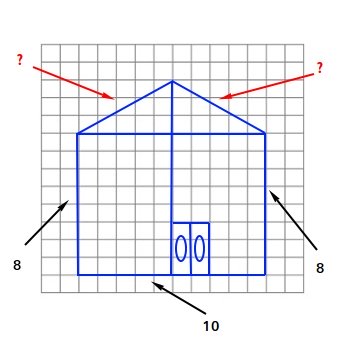
The only thing that is missing is the length of the line shown with a question mark (?)
To find it, you need to notice that this line is the hypotenuse of the right triangle. Therefore, you can use the Pythagorean theorem to find it.
c2 = a2 + b2
c2 = 32 + 52
c2 = 9 + 25
c2 = 34
c = √34 ≈ 5.83
Perimeter ≈ 10 + 8 + 8 + 5.83 + 5.83 = 37.66
A roof line is the hypotenuse of a right triangle with legs of 6 and 8 units. How long is the roof line?
Show answer
10 units. c2 = 62 + 82 = 36 + 64 = 100, so c = √100 = 10.
Finding the Perimeter When One or More Side Lengths Are Missing
Find the perimeter of the shape below that has two missing sides.
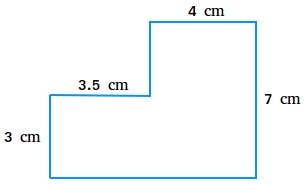
We need to find these two missing sides before we can find the perimeter. Were you able to see which sides are missing? If not, we show them below with a red line and a green line.
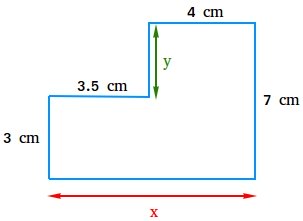
In a shape with only straight corners, the sides going one way add up to the opposite side. Here, the bottom side x is as long as the two top sides together, and the two left heights together (3 cm and y) are as tall as the right side.
- x = 4 cm + 3.5 cm = 7.5 cm
- 3 cm + y = 7 cm
3 cm − 3 cm + y = 7 cm − 3 cm
y = 4 cm - Perimeter = 3 cm + 3.5 cm + 4 cm + 4 cm + 7 cm + 7.5 cm = 29 cm
The perimeter is 29 cm.
A rectangle has a length of 9 cm and a width of 4 cm. Only these two sides are labeled. What is its perimeter?
Show answer
26 cm. Opposite sides of a rectangle are equal, so the missing sides are 9 cm and 4 cm: 9 + 4 + 9 + 4 = 26 cm.
Summary
- The perimeter is the distance around the outside of a shape.
- To find it, add the lengths of all the sides, each side exactly once, and keep the unit.
- Ignore lines and shapes inside the figure, like the door of the house.
- A slanted side on a grid is the hypotenuse of a right triangle: use c2 = a2 + b2.
- When sides are missing, find them first from the sides you know, then add all the sides.
Test Yourself: Interactive 10-Question Quiz
Now check what you learned about finding the perimeter. Every answer is explained, and each time you play you get new shapes and numbers.
Quiz Complete! 🎉