Finding a Percentage
This lesson aims to provide a clear and thorough understanding of how to find a percentage by expressing the rate as a decimal or a fraction and then multiplying it by the base. By the end of this lesson, you will be proficient in calculating percentages confidently and accurately.
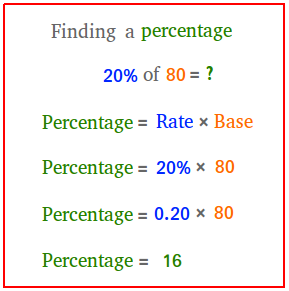
Core Concepts and Definitions
Before diving into the calculations, it's crucial to understand the three fundamental terms involved in finding a percentage:
Rate: The rate is the percent. It indicates how much of something you have in relation to the base. For example, in "40 % of 60 is 24," the rate is 40%.
Base: The base is the quantity you are taking the percent of. In the previous example, 60 is the base.
Percentage: This is the result obtained when the rate is applied to the base. Continuing with the same example, 24 is the percentage (i.e., 40% of 60 is 24).
Percentage = Rate × Base
Step-by-Step Process to Find a Percentage
To find a percentage, follow these systematic steps:
1. Identify the Rate and the Base:
- Rate: The given percent
- Base: The number you are finding the percentage of.
2. Convert the Rate to a Decimal or Fraction:
- Decimal Conversion: Divide the number next to the % symbol by 100.
- Example: 25% becomes 0.25 (25 ÷ 100).
- Fraction Conversion: Express the percent as a fraction over 100 and simplify if possible.
- Example: 25% becomes 1/4 (since 25/100 simplifies to 1/4).
3. Multiply the Converted Rate by the Base:
Using the decimal or fraction, perform the multiplication to find the percentage.
Finding a percentage with a Few Examples
Example #1: Find 25% of 100
Percentage = Rate × Base
Percentage = 25% × 100
Percentage = 0.25 × 100
Percentage = 25
Example #2: What number is 75% of 200?
Percentage = Rate × Base
Percentage = 75% × 200
Percentage = 0.75 × 200
Percentage = 150
Example #3: x is 20% of 20. What is x?
Percentage = Rate × Base
Percentage = 20% × 20
Percentage = 0.20 × 20
Percentage = 4
Notice that you can also find the percentage by converting the rate into a fraction before multiplying it by the base. We show how to do this for example #1.
Example #4: Find 25% of 100
Percentage = Rate × Base
Percentage = 25% × 100
Percentage = 1/4 × 100
Percentage = 1/4 × 100/1
Percentage = (1× 100)/(4 × 1)
Percentage = 100/4
Percentage = 25
Real-Life Applications of Percentages
Understanding percentages is not just an academic exercise; it's highly practical in everyday life. Here are a few scenarios where percentage calculations are essential:
1. Shopping Discounts: Determining the final price after a percentage discount.
Example: A jacket is priced at $80 with a 25% discount.
The discount amount is 25% × $80 = 0.25 × $80 = $20
So, the final price is $80 − $20 = $60
2. Interest Rates: Calculating interest on savings or loans.
Example: A bank offers 3% annual interest on a savings account with a $1,000 deposit.
The interest earned in a year is 3% × 1,000 = 0.03 × 1,000 = $30
3. Tax Calculations: Computing the amount of tax to be paid on a purchase.
Example: The sales tax is 8% on a $50 item.
The tax is 8% × 50 = 0.08 × 50 = $4
The total cost = 50 + 4 = $54