Factoring Strategy
Learn how to choose the best factoring strategy when factoring polynomials. The following is just a guideline so you know how to approach the problem without wasting too much time using the wrong approach.
In this lesson, you will learn
- Why you always look for a greatest common factor (GCF) first
- How the number of terms tells you which factoring method to try
- How to finish: factor further, then check by multiplying
The Factoring Strategy in 4 Steps
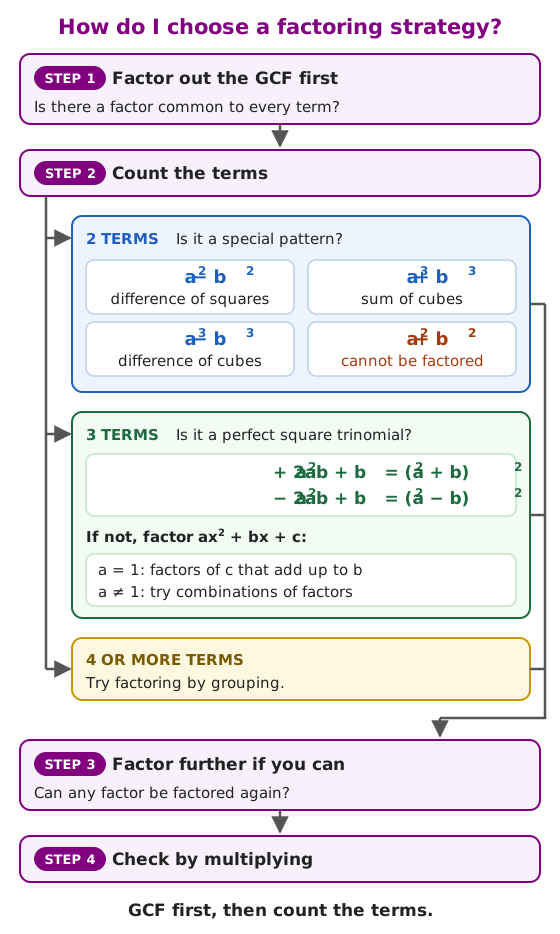
This flowchart shows the whole strategy. Start at the top and follow the arrows.
Step 1: Factor Out the Greatest Common Factor (GCF)
Are there any common factors? If so, factor out the greatest common factor (GCF).
Skipping the GCF. In 2x2 − 18, neither 2x2 nor 18 is a perfect square, so it does not look like a difference of two squares. Factor out 2 first: 2(x2 − 9). Now x2 − 9 is a difference of two squares.
Factor out the GCF of 5x2 + 10x.
Show answer
5x(x + 2). Both terms can be divided by 5 and by x, so the GCF is 5x.
Step 2: Count the Terms of the Polynomial
How many terms does the polynomial have?
Two terms
If there are two terms, decide if one of the following can be used to factor the polynomial.
- Difference of two squares: a2 − b2 = (a − b)(a + b)
- Sum of two cubes: a3 + b3 = (a + b)(a2 − ab + b2)
- Sum of two squares: a2 + b2 cannot be factored!
- Difference of two cubes: a3 − b3 = (a − b)(a2 + ab + b2)
Which formula fits x3 − 27?
Show answer
Difference of two cubes. x3 − 27 = x3 − 33 = (x − 3)(x2 + 3x + 9).
Three terms
If there are three terms, try one of the following.
- Perfect square trinomials: a2 + 2ab + b2 = (a + b)2 or a2 − 2ab + b2 = (a − b)2
- If the polynomial is not a perfect square trinomial, then factor using the method used to factor trinomials of the form ax2 + bx + c.
If a = 1, look for factors of c that will add up to b.
If a is not equal to 1, factor the first term, factor the last term, and try all the different combinations until you get the correct one.
Factor x2 + 7x + 12.
Show answer
(x + 3)(x + 4). Here a = 1. The factors 3 and 4 of 12 add up to 7.
Four or more terms
If there are 4 or more terms, try factoring by grouping.
Factor x3 + 2x2 + 3x + 6 by grouping.
Show answer
(x + 2)(x2 + 3). Group the terms in pairs: x2(x + 2) + 3(x + 2) = (x + 2)(x2 + 3).
Steps 3 and 4: Factor Further, Then Check
Step 3. Check to see if the factored polynomial can be factored further.
Step 4. Check by multiplying.
- Step 1: The GCF is 2, so 2x4 − 32 = 2(x4 − 16).
- Step 2: x4 − 16 has 2 terms. It is a difference of two squares, because x4 = (x2)2 and 16 = 42. So 2(x4 − 16) = 2(x2 − 4)(x2 + 4).
- Step 3: x2 − 4 is again a difference of two squares: x2 − 4 = (x − 2)(x + 2). x2 + 4 is a sum of two squares, so it cannot be factored.
- Step 4: Check by multiplying: (x − 2)(x + 2) = x2 − 4, then (x2 − 4)(x2 + 4) = x4 − 16, and 2(x4 − 16) = 2x4 − 32.
2x4 − 32 = 2(x − 2)(x + 2)(x2 + 4)
Stopping too early. 2(x2 − 4)(x2 + 4) is not finished, because x2 − 4 can still be factored.
Factor 3x2 − 12 completely.
Show answer
3(x − 2)(x + 2). The GCF is 3: 3(x2 − 4). Then x2 − 4 is a difference of two squares.
Summary
- Step 1: Always look for a GCF first and factor it out.
- Step 2: Count the terms. 2 terms: difference of squares, sum of cubes or difference of cubes (a sum of two squares cannot be factored).
- 3 terms: perfect square trinomial, or factor ax2 + bx + c. 4 or more terms: try factoring by grouping.
- Step 3: Check whether any factor can be factored further.
- Step 4: Check your answer by multiplying the factors.
Test Yourself: Interactive 10-Question Quiz
Now check what you learned. Every answer is explained, and each time you play you get new questions.
Quiz Complete!