Factoring by Grouping
In this lesson, you will learn
- What factoring by grouping means and its three key steps
- How to split the middle term of ax2 + bx + c using the product a × c
- How to factor each group and pull out the common binomial
- How to factor a four-term polynomial by grouping
What is factoring by grouping?
Just like the name implies, factoring by grouping means that you will group terms with common factors before factoring. Among various factoring techniques, factoring by grouping is particularly useful for trinomials and higher-degree polynomials where other methods might be cumbersome. This lesson delves deep into factoring by grouping, providing clear explanations and multiple examples to ensure a thorough understanding.
Factoring by grouping involves organizing the terms of a polynomial into groups that share a common factor. Once grouped, each set of terms is factored individually, and if done correctly, a common binomial factor emerges, allowing the entire polynomial to be factored completely.
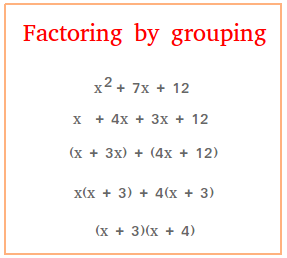
Key steps
- Group terms: Organize the polynomial into pairs (or groups) of terms that have common factors.
- Factor each group: Factor out the greatest common factor (GCF) from each group.
- Factor out the common binomial: If the grouping is successful, a common binomial factor will appear, which can then be factored out.
A trinomial ax2 + bx + c has only three terms. To group it, first split the middle term bx into two terms whose coefficients multiply to a × c and add up to b. That gives four terms you can group.
Interactive explorer: factor by grouping step by step
Pick a trinomial (or type your own), choose the pair that splits the middle term, and watch each step of the grouping happen.
Step 1: find the pair that splits the middle term
Step 2: rewrite with four terms
Step 3: group the first two and the last two terms
Step 4: factor out the GCF of each group
Step 5: factor out the common binomial
Example 1: factoring a simple quadratic
Let's explore several examples to illustrate the factoring by grouping process.
- Analyze the polynomial: The polynomial has three terms, making it a trinomial. To use factoring by grouping, we need to express it as a four-term polynomial.
- Expand the middle term: Find two numbers that multiply to 1 × 6 = 6 and add up to 5. 5x = 3x + 2x
- Rewrite the polynomial: x2 + 5x + 6 = x2 + 3x + 2x + 6
- Group terms: Group the first two terms and the last two terms: (x2 + 3x) + (2x + 6)
- Factor each group: Factor out the GCF from each group: x(x + 3) + 2(x + 3)
- Factor out the common binomial: Both groups contain (x + 3): (x + 3)(x + 2)
Conclusion: x2 + 5x + 6 = (x + 3)(x + 2)
Grouping differently, such as pairing x2 with 2x and 3x with 6, yields the same result. Notice also that there is more than one way we can expand 5x. Therefore, different groupings are possible.
5x is also equal to 4x + x, 6x − x, 7x − 2x, 8x − 3x, and so forth. However, not all groupings will work!
How should you split the middle term of x2 + 7x + 12?
Show answer
7x = 4x + 3x. 4 × 3 = 12 and 4 + 3 = 7, so x2 + 7x + 12 = x2 + 4x + 3x + 12 = x(x + 4) + 3(x + 4) = (x + 4)(x + 3).
Example 2: a slightly more complex quadratic
- Analyze the polynomial: The polynomial is a trinomial with coefficients and/or minus sign(s) that complicate simple factoring.
- Expand the middle term: Find two numbers that multiply to 1 × (−12) = −12 and add up to −4.
Initial attempts:
−2x + (−2x) → Sum: −4, Product: 4 (Incorrect)
−3x + (−x) → Sum: −4, Product: 3 (Incorrect)
Correct combination: −6x + 2x → Sum: −4, Product: −12 - Rewrite the polynomial: x2 − 4x − 12 = x2 − 6x + 2x − 12
- Group terms: (x2 − 6x) + (2x − 12)
- Factor each group: x(x − 6) + 2(x − 6)
- Factor out the common binomial: (x − 6)(x + 2)
Conclusion: x2 − 4x − 12 = (x − 6)(x + 2)
Insight: Not all obvious groupings work, highlighting the importance of finding the correct combination.
Which two terms split the middle term of x2 + 2x − 15?
Show answer
5x and −3x. 5 × (−3) = −15 and 5 + (−3) = 2. Then x2 + 5x − 3x − 15 = x(x + 5) − 3(x + 5) = (x + 5)(x − 3).
Example 3: factoring with coefficients
- Analyze the polynomial: The trinomial has a leading coefficient other than 1, which requires careful grouping.
- Expand the middle term: Multiply the leading coefficient by the constant: 3 × 8 = 24. Find two numbers that multiply to 24 and add to 14: 12 and 2. 14y = 12y + 2y
- Rewrite the polynomial: 3y2 + 14y + 8 = 3y2 + 12y + 2y + 8
- Group terms: (3y2 + 12y) + (2y + 8)
- Factor each group: 3y(y + 4) + 2(y + 4)
- Factor out the common binomial: (y + 4)(3y + 2)
Conclusion: 3y2 + 14y + 8 = (y + 4)(3y + 2)
When the leading coefficient is not 1, multiply it by the constant term to find suitable factors.
Factor 2x2 + 7x + 3 by grouping.
Show answer
(2x + 1)(x + 3). 2 × 3 = 6, and 6 + 1 = 7, so 2x2 + 6x + x + 3 = 2x(x + 3) + 1(x + 3) = (x + 3)(2x + 1).
Example 4: a more complex quadratic
- Analyze the polynomial: The trinomial has large coefficients, making simple factoring challenging.
- Multiply the leading coefficient and constant: 11 × (−12) = −132
- Find two numbers that multiply to −132 and add to −41. Potential pairs that add up to −41:
−46 and 5
−45 and 4
−44 and 3
−40 and −1
−39 and −2
−38 and −3
−37 and −4
Correct pair: −44 and 3, since this is the one that is equal to −132 when multiplied. - Rewrite the polynomial: 11x2 − 41x − 12 = 11x2 − 44x + 3x − 12
- Group terms: (11x2 − 44x) + (3x − 12)
- Factor each group: 11x(x − 4) + 3(x − 4)
- Factor out the common binomial: (x − 4)(11x + 3)
Conclusion: 11x2 − 41x − 12 = (x − 4)(11x + 3)
Insight: When multiple groupings are possible, utilizing the product of the leading coefficient and the constant term can expedite finding the correct factors.
Common pitfalls and tips when factoring by grouping
- Incorrect grouping: Not all groupings will lead to a common binomial factor. Ensure that the numbers chosen for expanding the middle term are correct.
- Multiple groupings: Sometimes, multiple groupings are possible. Test each to find the one that results in a common binomial factor.
- Leading coefficient greater than 1: When the leading coefficient isn't 1, multiply it by the constant term to find suitable factors for the middle term.
- Verification: Always multiply the factored binomials to verify the correctness of the factoring.
Factoring a positive number out of a group that starts with a minus sign. In x2 − 2x − 3x + 6, the second group is (−3x + 6). Factoring out 3 gives 3(−x + 2), which does not match x(x − 2). Factor out −3 instead: −3(x − 2). Then x(x − 2) − 3(x − 2) = (x − 2)(x − 3).
Advanced example: factoring a four-term polynomial
- Analyze the polynomial: This is a four-term polynomial, making it suitable for factoring by grouping.
- Group terms: (12x3 + 8x2) + (−18x − 12)
- Factor each group: First group: 12x3 + 8x2 = 4x2(3x + 2). Second group: −18x − 12 = −6(3x + 2)
- Factor out the common binomial: 4x2(3x + 2) − 6(3x + 2) = (3x + 2)(4x2 − 6)
- Factor further if possible: 4x2 − 6 = 2(2x2 − 3)
Final factored form: 12x3 + 8x2 − 18x − 12 = 2(3x + 2)(2x2 − 3)
Factor x3 + 2x2 + 5x + 10 by grouping.
Show answer
(x + 2)(x2 + 5). (x3 + 2x2) + (5x + 10) = x2(x + 2) + 5(x + 2) = (x + 2)(x2 + 5).
Summary
- Factoring by grouping: group terms, factor the GCF out of each group, then factor out the common binomial.
- For ax2 + bx + c, split the middle term into two terms whose coefficients multiply to a × c and add up to b.
- Either order of the two middle terms works.
- When a group starts with a minus sign, factor out a negative GCF so the binomials match.
- Always check your answer by multiplying the factors.
Practice: Factor 3 Trinomials by Grouping
Each problem gives you a working board with the four lines of factoring by grouping, and you fill it in yourself. Problem 1 guides you one small step at a time. Problem 2 uses fewer, bigger steps, with a hint for each one. In problems 1 and 2 you can also look at the pairs of factors. Problem 3 has the same steps as problem 2 but no help at all. You can skip a problem at any time, and each time you play you get new problems.
Practice Complete!