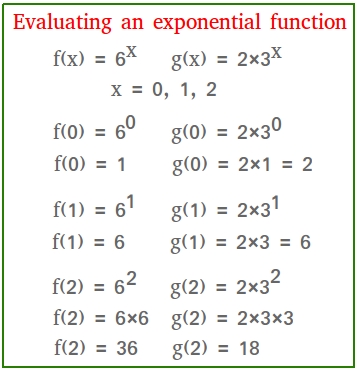
Evaluate an exponential function
This lesson will show how to evaluate an exponential function and how to solve a real-world problem by evaluating an exponential function.
An example showing how to evaluate an exponential function
Example #1
Evaluate the following function for x = 0, 1, 2, -1, -2.
Notice that this time, we used a table to organize our calculations. It is always good practice to use a table when evaluating exponential functions.
| x | f(x) | |
| 0 | 4 | |
| 1 | 20 | |
| 2 | 100 | |
| -1 | 0.8 | |
| -2 | 0.16 |
Notice that you can also write the answers as shown below:
f(0) = 4
f(1) = 20
f(2) = 100
f(-1) = 0.8
f(-2) = 0.16
Evaluate an exponential function to solve a real-world problem.
Example #2
Suppose 30 toads are taken to an island. The toad population quintuple every 3 months. Model this situation with an exponential function and then evaluate the function to find how many toads would be there after 4 years.
Solution
There are two Important keys words to understand in this problem and these are 'quintuple' and 'every 3 months'.
Quintuple:
The word quintuple means that the population was increased 5 times.
Every 3 months:
Every 3 months is the same as every one-fourth of a year or 1 quarter.
For this problem, there are 4 quarters in a year since the growth is happening every 3 months. For two years then, we get 8 quarters.
f(8) = 30 × 58
f(8) = 30 × 390625
f(8) = 11718750
After two years, there will 11,718,750 toads in that island.
Notice that when x = 0, f(0) = 30×50
f(0) = 30×1
f(0) = 30.
x = 0 refers to the starting point or the day the toads were taken to the island.
A little summary on how to evaluate an exponential function