Electric potential
Before you study this lesson about electric potential, make sure you review the lesson about electric potential energy which defined the concept using a single positive charge as shown below. Then, you can study this lesson.
There is nothing special about using one charge. We could in fact use two, three, or as many charges as we want.
If we use four positive charges instead of one, the magnitude of four
charges is higher than that of one. This makes sense since you will have
to do more work to move these four charges closer to the charged rod.
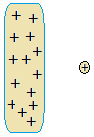 Lower magnitude
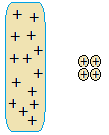 Higher magnitude
As a result, the electric potential energy of using four charges will be 4 times the electric potential energy of using just one charge.
Say for instance the electric potential energy of one charge was 5 joules. Then, the electric potential energy of using two of such a charge will be 10 joules.
Be careful! 1 charge does not mean 1 joule of energy. A charge could in fact generate an electric potential energy as small as 0.0002 joule.
Definition of electric potential
By definition, the electric potential is the electric potential energy per charge
Electric potential energy is measured in joules and charge is measured in coulombs.
The unit of electric potential is J/C or volts. It is also called voltage.
1 volt = 1 joule of energy per 1 coulomb of charge
The electric potential has the same value at any point in an electric field.
Here an example to illustrate this. Say for instance we place a positive charge in an electric field. Suppose the charge of the particle is 1.20 × 10⁻¹⁷ C and the electric potential energy is 2.40 × 10⁻¹⁶ J.Electric potential = 2 ×10-16 × 10+17
Electric potential = 2 × 10+1
Electric potential = 2 × 10 = 20 J/C = 20 volts
Suppose we replace the particle that has a charge of 1.20 × 10⁻¹⁷ with one that has twice as much positive charge.
The charge of the new particle is 2.40 × 10⁻¹⁷ C and the electric potential energy will then double as already explained or it will be 4.80 × 10⁻¹⁶ J.
Electric potential = 2 ×10-16 × 10+17
Electric potential = 2 × 10+1
Electric potential = 2 × 10 = 20 J/C = 20 volts
Why did we have to establish a difference between electric potential and electric potential energy? In electricity, we prefer to work with the electric potential energy per charge rather than dealing with the total electric potential energy.