What Is a Deficient Number?
In this lesson, you will learn
- what a deficient number is
- how to find the proper factors of a number and add them
- how to decide whether a number is deficient
- why every prime number is a deficient number
Definition of a Deficient Number
In number theory, a deficient number is a number in which the sum of its proper factors is less than the number.
The proper factors of a number are all of its factors except the number itself. For example, the factors of 10 are 1, 2, 5 and 10, so the proper factors of 10 are 1, 2 and 5.
- List all the factors of 21: 1, 3, 7 and 21.
- Leave out 21 itself. The proper factors are 1, 3 and 7.
- Add the proper factors: 1 + 3 + 7 = 11.
- Compare the sum with the number: 11 is smaller than 21.
21 is a deficient number.
Examples Explaining What a Deficient Number Is
The number 4
For example, the number 4 is deficient. The proper factors of 4 are 1 and 2. Since 1 + 2 = 3 and 3 is smaller than 4, 4 is deficient.
Notice that 4 is not included among the proper factors of 4.
The number 15
15 is also deficient.
The proper factors of 15 are 1, 3, and 5. Since 1 + 3 + 5 = 9 and 9 is smaller than 15, 15 is deficient.
The number 42
42 is not a deficient number.
The proper factors of 42 are 1, 2, 3, 6, 7, 14, 21.
Notice that 1 + 2 + 3 + 6 + 7 + 14 + 21 = 54. Since 54 is bigger than 42, 42 is not a deficient number.
In order for a number to be a deficient number, the sum of the proper factors of the number must be smaller than the number, not greater than or equal to the number.
Adding the number itself to the sum. For 4, the sum 1 + 2 + 4 = 7 is bigger than 4, which would make 4 look not deficient. Only add the proper factors: 1 + 2 = 3, so 4 is deficient.
Is 10 a deficient number?
Show answer
Yes. The proper factors of 10 are 1, 2 and 5, and 1 + 2 + 5 = 8 is smaller than 10.
The First 20 Deficient Numbers
The first 20 deficient numbers are 1, 2, 3, 4, 5, 7, 8, 9, 10, 11, 13, 14, 15, 16, 17, 19, 21, 22, 23, and 25.
From the list above, you can clearly see that all the prime numbers from 1 to 25 are included in the list. Based on that, we can say with confidence that all prime numbers are also deficient numbers.
Did you not quite understand the examples above? Do you need more explanations? Take a look at the figure below that summarizes everything.
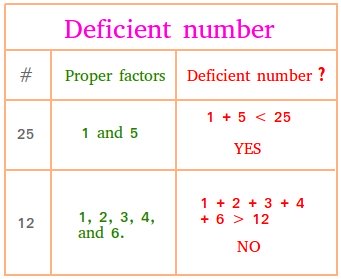
Every whole number from 1 up falls into one of three groups. If the proper factors add up to less than the number, it is deficient. If they add up to exactly the number, it is perfect. If they add up to more than the number, it is abundant.
Why is 6 not in the list of deficient numbers?
Show answer
Because 1 + 2 + 3 = 6. The sum of the proper factors is equal to 6, not smaller, so 6 is a perfect number.
Why Are All Prime Numbers Also Deficient Numbers?
The reason that all prime numbers are deficient numbers as well is that the sum of all proper factors of a prime number is always going to be 1.
The prime number 401
For example, 401 is a prime number since 401 can only be divided by 1 and 401.
The only proper factor for this prime number is 1 since 401 cannot be included when we perform the test of adding the proper factors.
The prime number 73
By the same token, 73 is a prime number since 73 can only be divided by 1 and 73.
The only proper factor for this prime number is 1 since 73 cannot be included when we perform the test of adding the proper factors.
The proper factors of a prime number add up to 1, and 1 is smaller than any prime number. So every prime number is deficient.
97 is a prime number. Is 97 deficient?
Show answer
Yes. The only proper factor of 97 is 1, and 1 is smaller than 97.
Summary
- The proper factors of a number are all of its factors except the number itself.
- A number is deficient when the sum of its proper factors is less than the number.
- To check, list the proper factors, add them, and compare the sum with the number.
- If the sum is equal to the number, the number is perfect. If the sum is greater, it is abundant.
- Every prime number is deficient, because its only proper factor is 1.
Test Yourself: Interactive 10-Question Quiz
Now check what you learned. Every answer is explained, and each time you play you get new questions.
Quiz complete!
Keep learning