Converse of a Conditional Statement
The converse of a conditional statement exchanges or switches the hypothesis and the conclusion.
Study the table in this lesson carefully so that you can understand this concept clearly!
In this lesson, you will learn
- how to write the converse of a conditional statement
- how to write the converse in symbols: the converse of p → q is q → p
- how to decide whether a converse is true or false
An Example Showing the Converse of a Conditional Statement
What is the converse of the conditional statement below?
If you have a driver's license, then you can drive a car by yourself.
Again, to find the converse of this conditional statement, just switch the hypothesis and the conclusion. The hypothesis is shown in blue and the conclusion is shown in red.
The converse of this conditional statement is:
If you can drive a car by yourself, then you have a driver's license.
In the lesson about conditional statement, we said that the symbol that we use to represent a conditional is p → q.
The converse of p → q is q → p, as illustrated in the table further down in this lesson.
Write the converse of: "If it is a holiday, then the school is closed."
Show answer
If the school is closed, then it is a holiday. The hypothesis "it is a holiday" and the conclusion "the school is closed" switch places.
More Examples Showing How to Find the Converse of Conditional Statements
Conditional: If the measure of an angle is 30 degrees, then the angle is acute.
Converse: If an angle is acute, then the measure of the angle is 30 degrees.
Conditional: If a figure is a rectangle, then it has four sides.
Converse: If a figure has four sides, then the figure is a rectangle.
Conditional: If a triangle is a right triangle, then the measure of one angle is 90 degrees.
Converse: If one angle of a triangle measures 90 degrees, then the triangle is a right triangle.
Did you not clearly understand the examples above? Did you not understand them at all? Here is a table summarizing the concept.
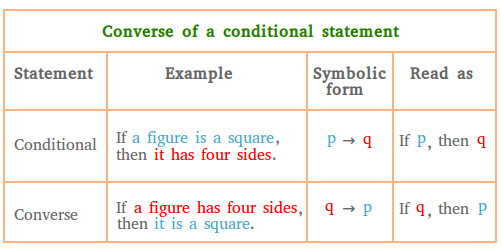
Only changing the words instead of switching the two parts. "If a figure is a square, then it has four sides" has the converse "If a figure has four sides, then it is a square": the part after "if" and the part after "then" trade places.
What is the converse of: "If a number is divisible by 10, then it is even"?
Show answer
If a number is even, then it is divisible by 10. "It is even" is now the hypothesis, and "it is divisible by 10" is the conclusion.
Is the Converse True? The Truth Value of the Converse
Sometimes, it may be necessary to evaluate the truth value of a conditional statement and of its converse. For example, the truth value of the conditional statement in the figure above is true.
It is true because of the simple fact that a square always has four sides.
However, the truth value of the converse is false. A figure that has four sides may not be a square. The figure could be a rectangle, a parallelogram, or even a kite.
A true conditional can have a false converse. To show that a converse is false, find one example that makes the converse's hypothesis true but its conclusion false. This is called a counterexample.
- The conditional is true: an angle of 30 degrees is less than 90 degrees, so it is acute.
- The converse is "If an angle is acute, then the measure of the angle is 30 degrees."
- Look for a counterexample: a 45-degree angle is acute, but it does not measure 30 degrees.
The converse is false, even though the conditional is true.
Sometimes the converse is true as well. "If a triangle is a right triangle, then one angle measures 90 degrees" and its converse are both true.
Is the converse of "If an animal is a dog, then it is a mammal" true or false?
Show answer
False. The converse is "If an animal is a mammal, then it is a dog." A cat is a mammal that is not a dog.
Check the math-dictionary.com site if you need more information on this topic. The math-dictionary.com site also has a great figure illustrating the conditional and the converse of a conditional statement.
Summary
- The converse of a conditional statement switches the hypothesis and the conclusion.
- The converse of "If p, then q" is "If q, then p". In symbols, the converse of p → q is q → p.
- A true conditional does not always have a true converse.
- One counterexample is enough to show that a converse is false.
Test Yourself: 10-Question Quiz
Now check what you learned. Every answer is explained, and each time you play you get new questions.