Commutative Property in Real Life
Find below some examples of commutative property in real life and some other examples where you can use the commutative property.
In this lesson, you will learn
- what it means for a real-life situation to be commutative
- how to test a situation by swapping the order of the events
- how real-life situations connect to 3 + 5 = 5 + 3
- how many different orders three events can have
What Makes a Situation Commutative?
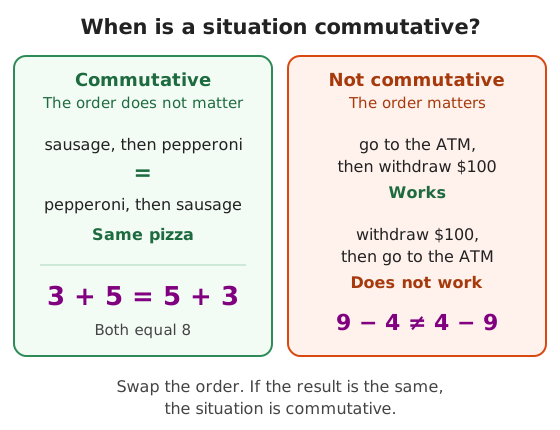
A situation is commutative when you can change the order of the events and still get the same result. In math, addition and multiplication are commutative: 3 + 5 = 5 + 3 and 4 × 6 = 6 × 4.
- Swap the order: Kim feeds the dog and then waters the plants.
- Compare the results: the plants are watered and the dog is fed either way.
- The result is the same, so the order does not matter.
This situation is commutative.
Can the Commutative Property Be Used in the Situation Described?
Example #1: Robert and Maria order sausage and pepperoni on their pizza.
Here, we are trying to see if sausage and pepperoni are commutative. This situation is commutative since the order we put the ingredients on the pizza is not important.
Example #2: Jeff reads the lesson on solving equations and then takes the quiz.
This situation is not commutative. The order of events matters in this case. Jeff must read the lesson before he takes the quiz.
Example #3: Harry went to the ATM and then withdrew 100 dollars.
This situation is not commutative. The order of events matters in this case. Harry cannot withdraw money without going to the ATM first.
Deciding from the words alone. A sentence with “and then” can still be commutative. Always ask: if the events happen in the other order, is the result the same?
Emma puts on her socks and then her shoes. Is this situation commutative?
Show answer
No. The order matters: she must put on her socks before her shoes.
More Examples of the Commutative Property in Real Life
Example #4: To get ready, Tom washes his face and puts his pants on.
This situation is commutative. The order of events does not matter. Tom can either wash his face first or put his pants on first.
Example #5: During a physical exam, Sarah's doctor checks her blood pressure, blood sugar level, and heart rate.
This situation is commutative. The doctor could check Sarah in any of the following orders.
- Blood pressure, blood sugar level, heart rate
- Blood pressure, heart rate, blood sugar level
- Blood sugar level, blood pressure, heart rate
- Blood sugar level, heart rate, blood pressure
- Heart rate, blood sugar level, blood pressure
- Heart rate, blood pressure, blood sugar level
Three events can happen in 6 different orders. When a situation is commutative, all 6 orders give the same result.
Omar buys milk and bread at the store. Is this situation commutative?
Show answer
Yes. He ends up with milk and bread whether he picks up the milk or the bread first.
Summary
- A situation is commutative when changing the order of the events does not change the result.
- To check, swap the order and ask whether the result is the same.
- Toppings on a pizza, or washing your face and putting your pants on, are commutative.
- Reading a lesson before taking the quiz, or going to the ATM before withdrawing money, are not commutative.
- In math, addition and multiplication are commutative, but subtraction and division are not.
Test Yourself: Interactive 10-Question Quiz
Now check what you learned. Every answer is explained, and each time you play you get new questions.
Quiz complete!